
Featured Municipal & Highway Solar Light Poles
Engineered for mission-critical urban arterials, highway interchanges, extreme climatic zones, and zero-grid smart city developments.

Engineered for extreme conditions, heavy solar arrays, and high wind-shear coastal zones.
View Specifications
High-grade octagonal and conical shafts compliant with AASHTO and EN 40 municipal standards.
View Specifications
Integrated luminaire, monocrystalline PV module, and LiFePO4 energy storage system.
View Specifications
15m to 45m polygonal lighting towers with motorized lowering systems for extensive aprons and terminals.
View Specifications
High-flux smart-dimming off-grid luminaire designed for multi-lane boulevards and commercial roads.
View Specifications
Heavy-duty sports illumination structures with custom floodlight crossbars and DIALux aiming matrix.
View Specifications
Heavy-load galvanized structural poles for logistics corridors, transit hubs, and toll interchanges.
View Specifications
Low-voltage steel transmission and hybrid lighting poles manufactured from premium Q355B steel.
View SpecificationsThe Modern Industrial Paradigm of Solar Street Pole Manufacturing
Global municipal infrastructure is experiencing an unprecedented structural transition. The historical convention of deploying isolated steel shafts equipped with passive luminaires is obsolete. Today, EPC contractors, national transport ministries, and urban planners demand unified, mechanically resilient assets capable of supporting off-grid energy generation, multi-sensor telecommunications, and extreme dynamic wind loads.
As a vertically integrated OEM street light pole solar manufacturer and exporter, Yangzhou Xintong Traffic Equipment Group addresses the systemic vulnerabilities inherent in fragmented procurement. By unifying high-grade structural metallurgy (Q235B and Q355B steel), precision longitudinal submerged-arc welding, deep-basin hot-dip galvanizing, and advanced photovoltaic engineering under one operational umbrella, we eliminate the structural and electrical mismatches that cause premature field failures.
Engineering Rule-of-Thumb: Dynamic Moment of Resistance
A solar lighting pole does not merely support vertical static weight; it operates as a continuous vertical cantilever subjected to dynamic bending moments generated by wind pressures impacting the photovoltaic sail area (EPA). Our designs are pre-calculated to sustain bending forces up to 210 km/h gusts with zero permanent plastic deformation.
Total Lifecycle Cost (TCO) vs. Initial CAPEX
Procuring low-cost municipal lighting poles without traceable metallurgical mill sheets or third-party galvanizing validation results in an exponential increase in OPEX. Infrastructure asset degradation studies indicate that structural corrosion, battery electrolyte dry-out, and localized weld cracking account for over 72% of early-stage decommissioning in developing markets.
- 25-Year Structural Longevity: Verified hot-dip zinc coatings ≥86 μm according to ASTM A123 / ISO 1461.
- Zero Substation Dependency: 100% autonomous off-grid operation eliminates costly underground cabling and transformer installations.
- Tender Compliance Certainty: Fully integrated structural calculations (AASHTO LTS, EN 40-3) submitted alongside photometrics.
Emerging Engineering Standards in International Solar Procurement
Analysis of over 1,200 tender documents across Central Asia, the Middle East, Africa, and Latin America reveals explicit technical shifts governing OEM fabrication.
Effective Projected Area (EPA) Aerodynamics
Standard street light poles fail when solar panels are retrofitted without wind-load adjustments. International tenders now stipulate strict drag-coefficient modeling. Our engineering department calculates the aggregate EPA of luminaires, photovoltaic arrays, bracket tilt angles, and camera mounts to prevent dynamic resonant vortex shedding.
LiFePO4 Integration & Thermal Management
Tenders across GCC desert corridors and equatorial regions specify high-temperature Grade-A Lithium Iron Phosphate (LiFePO4) storage. We integrate embedded or top-mounted IP68-sealed battery chambers with active thermal protection, delivering over 4,000 deep discharge cycles at 80% DoD even under continuous 55°C ambient operating conditions.
Submerged Arc Single-Seam Fabrication
Structural engineers reject longitudinal lap joints in high-stress corridors. Our 100,000 m² manufacturing floor employs automated CNC tandem press brakes capable of producing tapered octagonal, conical, and polygonal shafts up to 16 meters in a single continuous seam, guaranteeing uninterrupted grain boundaries.
| Technical Metric | Commercial Grade (Generic) | Xintong Industrial OEM Specification | Tender Compliance Reference |
|---|---|---|---|
| Raw Structural Steel | Recycled / Mixed Grade Steel | Prime Q235B / Q355B Low-Silicon Structural Plate | EN 10025 / ASTM A572 Gr 50 |
| Galvanizing Thickness | 45 μm – 60 μm (Electro-plated or thin dip) | ≥86 μm Average (Batch Hot-Dip Immersion) | ISO 1461 / ASTM A123 |
| PV Module Technology | Standard Poly / Early Mono (17% Eff.) | N-Type TOPCon Monocrystalline (22.8%+ Eff.) | IEC 61215 / IEC 61730 |
| Battery Chemistry | Gel / AGM VRLA Lead-Acid | Cell-Level Monitored LiFePO4 with Smart BMS | UN38.3 / IEC 62619 / CE |
| Calculated Wind Tolerance | 100 – 120 km/h (Unverified) | Up to 210 km/h (Finite Element Analysis Verified) | AASHTO LTS-6 / EN 40-3-1 |
Metallurgical Integrity & Environmental Barrier Systems
Engineered to endure 25+ years of exposure to salt-spray coastal atmospheres, extreme freeze-thaw cycles, and high-UV desert climates.
Submerged Arc Longitudinal Welding
Structural failure in lighting poles originates almost exclusively at defective longitudinal weld joints. We use automatic double-wire submerged-arc welding machines with continuous optical seam-tracking. This achieves complete penetration along the entire taper, eliminating gas inclusions, pinholes, and residual internal stresses.
Internal & External Zinc Metallurgy
Following multi-stage acid pickling and fluxing, our steel structures are fully submerged into a 450°C molten zinc bath. The metallurgical reaction creates intermetallic iron-zinc alloy layers (Γ, δ, and ζ phases) metallurgically bonded to the parent steel, topped by a pure outer zinc (η) layer that protects both the interior shaft cavity and exterior face.
Duplex Powder Coating System
For high-salinity or harsh municipal aesthetic environments, we apply an electrostatic thermoset polyester powder coating over the sweep-blasted galvanized surface. Cured at 200°C, this 80 μm to 120 μm architectural barrier provides 1,000+ hours of salt-spray resistance (ASTM B117) and preserves color fastness against intense UV radiation.
Tailored Engineering Across Challenging Geographies
Infrastructure projects cannot rely on a universal template. We adapt mechanical, metallurgical, and solar variables to meet local environmental realities.
Middle East & GCC Corridor (Arid / High Particulate)
Primary Challenges: Airborne abrasive sand particles, ambient temperatures regularly exceeding 50°C, and extreme UV degradation of optical lenses.
- Thermal Isolation: Battery compartments isolated within insulated subterranean vaults or ventilated upper pole housings.
- Abrasion-Resistant Coating: High-hardness TGIC polyester coatings preventing micro-scratch erosion of the zinc underlayer.
- Self-Cleaning Optical Angles: Steeply pitched PV mounting systems (≥25°) minimizing particulate accumulation and reducing soiled energy output losses.
Central Asia & Sub-Arctic Zones (Low Temperature / Low Sun)
Primary Challenges: Prolonged winter nights, extreme sub-zero temperatures down to -40°C, and significant snow-load moments.
- Low-Temperature LiFePO4: Smart heating jackets and BMS algorithms permitting charging cycles down to -30°C without lithium plating.
- Impact-Tough Metallurgy: Q355D or Q355E structural steel retaining high Charpy V-notch impact toughness at cryogenic temperatures.
- Oversized Autonomy Ratios: Bifacial solar arrays engineered with 5 to 7 days of full autonomy to accommodate extended overcast conditions.
Southeast Asia & Coastal Corridors (Typhoons & Salt Mist)
Primary Challenges: Category 4 and 5 typhoons, high relative humidity, and aggressive chloride-induced pitting.
- Aerodynamic Conical Shafts: Low drag-coefficient continuous conical cross-sections with reinforced flange baseplates up to 32mm thick.
- C5-M Marine Protection: Certified duplex coatings tested to resist over 3,000 hours of continuous neutral salt spray.
- Gusseted Anchor Engineering: Dual-nut hot-dip galvanized J-bolts (Grade 8.8) with structural triangular base stiffeners.
Sub-Saharan Africa & Latin America (Off-Grid Electrification)
Primary Challenges: Unstable utility grids, vandalism/theft vulnerability, and remote access logistics.
- Integrated All-in-One Architecture: Elimination of exposed external wiring and ground-level battery boxes to prevent copper and cell theft.
- Modular Sectional Packaging: Polygonal slip-joint pole construction allowing nested transport, minimizing container freight volume.
- Intelligent IoT Mesh Monitoring: LoRaWAN/NB-IoT telemetry reporting battery voltage and lamp status back to central ministries.
Precision Fabrication Workflow at the Gaoyou Plant
Our 100,000 m² base in Jiangsu operates under certified ISO 9001, ISO 14001, and ISO 45001 management frameworks, tracking material integrity from raw plate to container loading.
Steel Sourcing & Spectral Analysis
High-yield Q235B/Q355B coils undergo optical emission spectrometry to verify low silicon (≤0.04%) and phosphorus content, ensuring consistent galvanizing adhesion without brittleness.
CNC Laser Cutting & Dual Tandem Bending
Tapered plates are cut on automated 16-meter plasma/laser beds, then formed into conical, octagonal, or multi-faceted geometric sections using our 1,200-ton hydraulic tandem press brake.
Submerged Arc Welding & Flange Integration
Automated longitudinal seam welding ensures deep structural fusion. Structural baseplates are double-fillet welded internally and externally with automated robotic arms.
Deep Basin Hot-Dip Galvanization
Structures are chemically degreased, acid-pickled to white metal, fluxed, and immersed in high-purity zinc kettles at 450°C, reaching full metallurgical bond throughout interior and exterior walls.
Precision Straightening & Duplex Finish
Post-galvanization thermal deflection is corrected via multi-point hydraulic straighteners. Poles then enter the electrostatic powder line for high-adhesion outdoor polymer application.
Comprehensive QA & Packaging Logistics
Magnetic thickness gauges inspect zinc layers, ultrasonic flaw testing checks key weld roots, and poles are spiral-wrapped with shock-absorbing non-woven fabric for maritime container safety.
Worldwide Engineering Deployments
Our civil lighting poles and solar systems operate across mission-critical transport arteries, international sea terminals, and municipal developments.
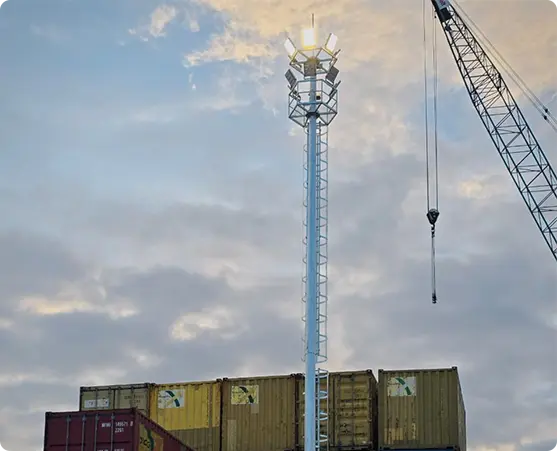
Polygonal 30-meter high-mast lighting towers providing continuous 24/7 illumination across container loading zones, fully engineered against regional tropical typhoons.
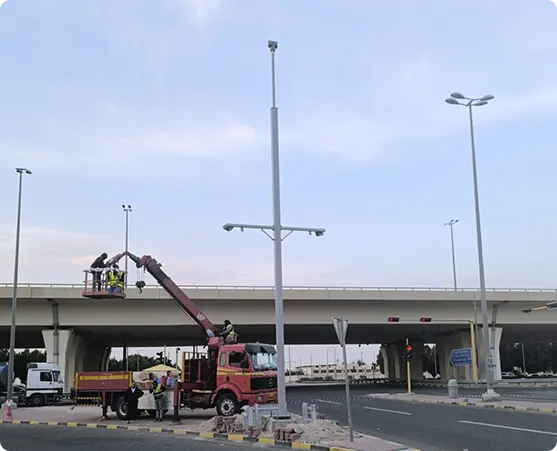
Galvanized steel camera and lighting shafts deployed along highway networks, engineered to withstand high ambient desert heat and aggressive sandstorm abrasion.
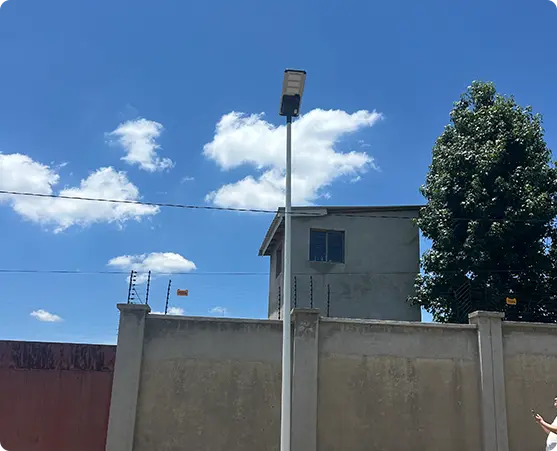
Autonomous solar street lighting installations providing reliable public lighting independent of national electrical grid load-shedding cycles.
Off-grid solar street illumination for heavy container logistics arteries, featuring specialized optics and marine-grade anti-corrosion barrier coatings.
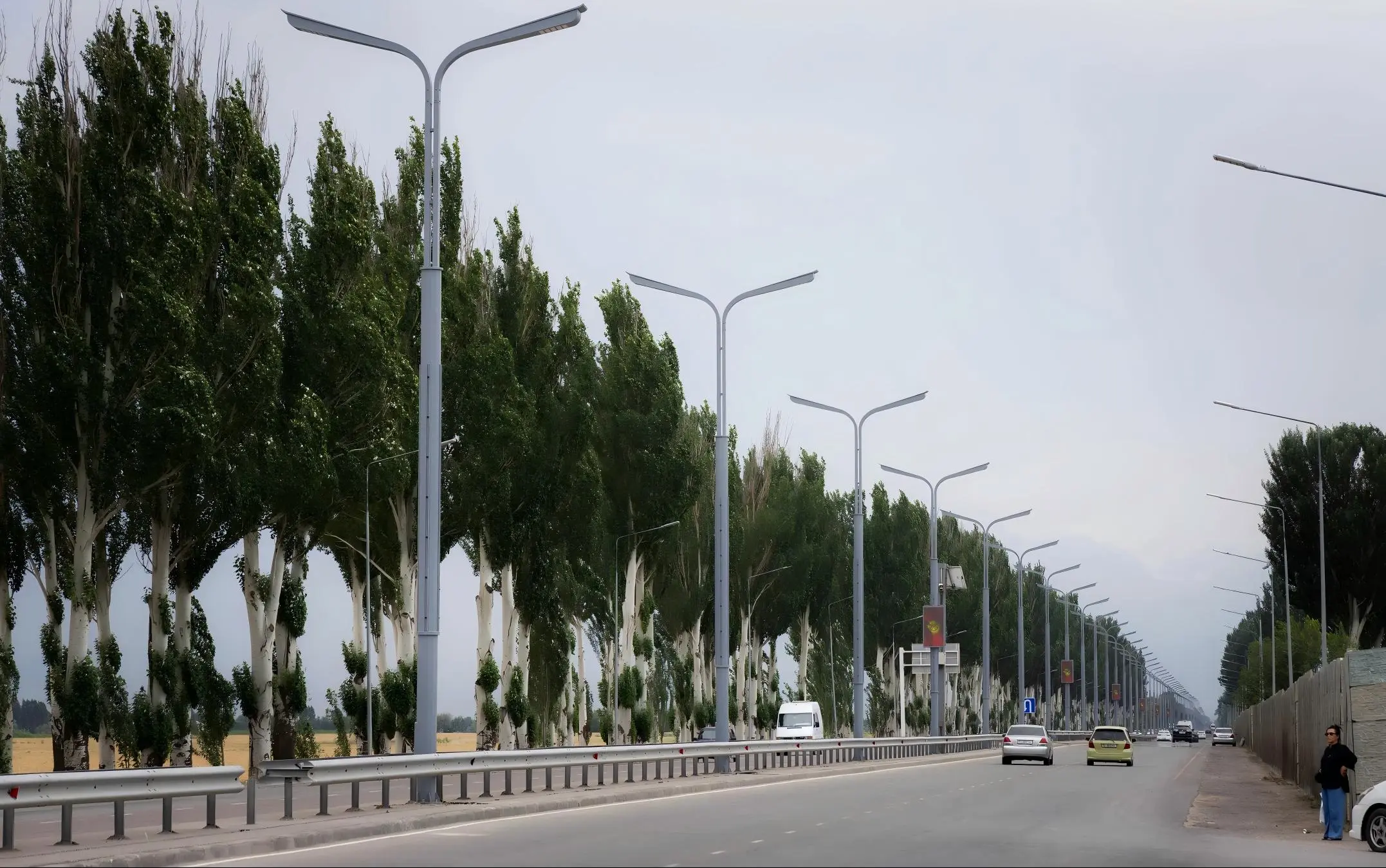
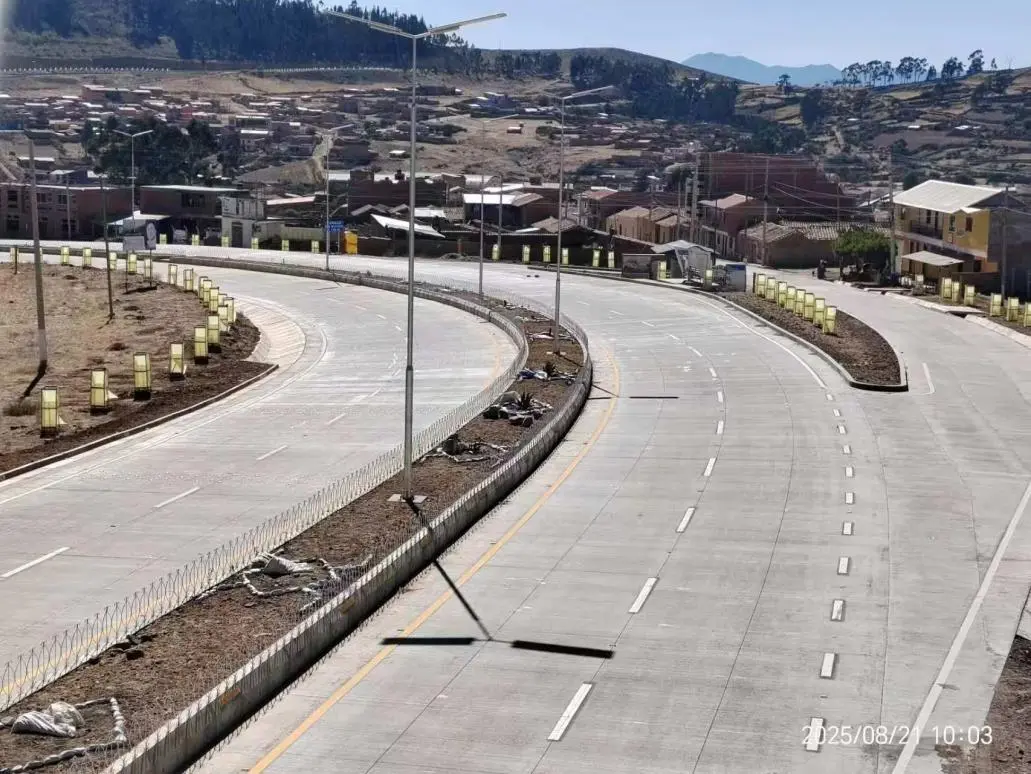
Double-arm conical galvanized poles designed for Central Asian winter freeze-thaw cycles, high wind gusts, and rigorous expressway illumination uniformity.
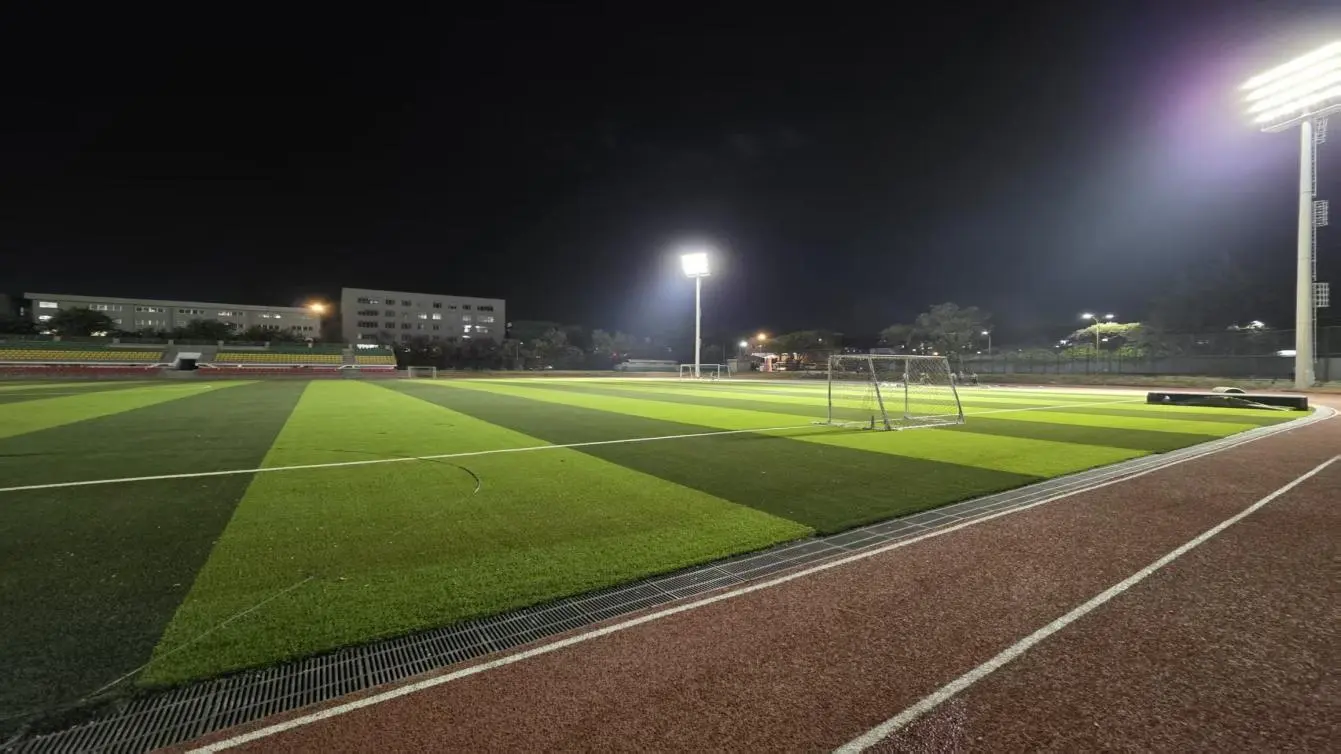
Polygonal high mast floodlight structures engineered based on precise DIALux lighting studies to ensure international broadcast-standard lux distribution.
The Technical Roadmap: Solar Poles as Smart City Edge Nodes
The convergence of municipal telecommunications, edge compute nodes, and decentralized renewable generation is transforming the traditional street pole into an active IoT communication gateway. Yangzhou Xintong Traffic Equipment Group is pioneering integrated multi-functional smart pole systems designed for modern municipal engineering requirements.
Our R&D pipeline integrates 5G small-cell micro-base stations directly into the pole superstructure. By concealing radio antennas behind RF-transparent glass-fiber composites while integrating bifacial vertical solar wraps around the pole shaft, we deliver continuous clean power without compromising urban aesthetics or aerodynamic stability.
360° solar collection harvesting direct, diffused, and ground-reflected albedo light, eliminating horizontal dust settling.
Onboard microprocessors dynamically balance lighting lux based on real-time pedestrian density while tracking battery health status.
Smart City Central IoT Cloud Platform
Our proprietary cloud architecture interfaces with urban operations centers via standard MQTT and RESTful APIs, providing granular, luminaire-by-luminaire operational oversight:
- Automated Fault Diagnostic Alerts: Instant notifications for broken driver circuits, depleted cells, or surface soiling anomalies.
- Dynamic Photometric Scheduling: Automated step-down dimming during early morning hours to extend battery reserves during monsoon or winter seasons.
- Predictive Component Replacement: Machine learning algorithms analyzing internal resistance curves to identify battery cells approaching end-of-life before service interruptions occur.
Frequently Asked Technical & Procurement Questions
Clear, definitive answers directly addressing engineering calculations, procurement requirements, and manufacturing workflows.
Specialized Steel Light Poles & Advanced Solar Systems
Explore our precision-manufactured product portfolio covering split-type solar assemblies, smart city poles, and low-voltage power distribution structures.
High-lumen integrated solar luminaire engineered for educational campuses, industrial parks, and arterials.
View Specifications
Heavy-duty sports lighting masts featuring precision DIALux photometric design and multi-fixture platforms.
View Specifications
Engineered polygonal steel towers for expressway interchanges, public plazas, and regional bus terminals.
View Specifications
Heavy structural low-voltage power distribution and hybrid lighting poles built from prime Q355B structural steel.
View Specifications
Conical, octagonal, and customizable lighting shafts engineered specifically for municipal civil tenders.
View Specifications
Architectural aesthetic landscape poles matching historical urban centers, parkways, and pedestrian plazas.
View Specifications
Integrated octagonal and square shafts housing CCTV brackets, environmental sensors, and EV chargers.
View Specifications
High-capacity split solar street lighting engineered for major multi-lane highways and low-sun high latitudes.
View SpecificationsEngage Directly with Our Infrastructure Project Team
Bypass intermediary agents. Submit your Bill of Quantities (BOQ), tender drawings, or project requirements directly to our senior structural and photometric engineers for review and pricing within 24 hours.
Tender Specification Checklist
To fast-track your technical review and DIALux lighting calculations, please supply the following parameters with your inquiry:
- Roadway Classification: Road width, lane count, central median dimensions, and target lux/uniformity ($U_0$).
- Pole Specifications: Desired height (3m to 40m), single/double outreach arm projection, and shaft profile (conical/octagonal).
- Local Environmental Loads: Maximum design wind speed (m/s or km/h) and installation distance from marine coastlines.
- Power Architecture: Grid-connected, autonomous off-grid solar, or hybrid power system.
- Required Autonomy Days: Required backup duration under consecutive zero-solar overcast conditions (typically 3–5 days).