
Primary Export Utility & Lighting Systems
Precision-formed tubular steel distribution poles and heavy-duty structural infrastructure engineered for utility providers, municipalities, and multinational EPC contractors worldwide.







The Global Paradigm Shift: Steel Tubular Poles in Modern Power Grids
Accelerating grid hardening initiatives, high-density renewable power integration, and urban aesthetic mandates are driving the worldwide transition from traditional timber and spun concrete poles toward high-yield cold-formed steel poles.
Grid Hardening & Resilience
National transmission operators and power distribution utilities across North America, Europe, and Southeast Asia are decommissioning rot-prone wooden poles and micro-cracking concrete structures. High-tensile steel poles engineered to ASCE Manual 48 and ANSI C136 absorb severe gust momentums and cyclonic vibrations without brittle structural collapse.
Renewable Feeder Interconnection
Distributed generation—specifically utility-scale solar photovoltaic parks and onshore wind corridors—demands medium-voltage (11kV to 69kV) distribution poles capable of supporting heavy bundle conductors, line surge arresters, and pole-mounted three-phase step-up transformers with minimum line sag and deflection tolerances.
Narrow Right-of-Way (ROW) Footprint
Rapid urban densification has escalated land acquisition expenses. Polygonal tapered steel monopoles provide exceptional cantilever moment capacity with footprint requirements up to 70% smaller than conventional four-legged steel lattice towers, dramatically slashing municipal permitting cycles.
| Structural Material Class | Strength-to-Weight Ratio | Corrosion & Biological Resistance | Installation Footprint & Heavy Rigging | Expected Service Life (HDG) | Total Cost of Ownership (TCO) |
|---|---|---|---|---|---|
| Cold-Formed Tubular Steel (Q355B / ASTM A572) | Superior (High Elasticity) | Immune to Rot / Termites / UV | Minimal ROW; Rapid Crane Placement | 50+ Years (ISO 1461 Galvanized) | Lowest (Zero In-Service Spalling) |
| Prestressed Spun Concrete | Poor (Extremely Heavy) | Spalling & Rebar Corrosion Risk | Requires Heavy-Duty Track Cranes | 25–35 Years (Susceptible to freeze/thaw) | High Logistics & Rigging Outlay |
| Creosote / CCA Treated Timber | Moderate | Severe (Woodpecker, Termites, Rot) | Simple Augering | 15–25 Years (Environmentally Toxic) | High (Frequent Replacement Cycles) |
Engineering Scale & Supply Chain Resilience in Jiangsu
Founded in 1999, Yangzhou Xintong Traffic Equipment Group operates an integrated 100,000 m² smart manufacturing center in Gaoyou, Jiangsu—China's world-renowned specialized engineering cluster for utility poles, lighting structures, and intelligent power distribution networks.
Tier-1 Raw Material Integration
Direct mill sourcing of certified hot-rolled structural steel coils (Q235B, Q355B, Q460C, and ASTM A572 Grade 50) directly from Baosteel and Shagang Group. Every batch includes full chemical heat analysis and mechanical tensile/elongation traceability conforming to EN 10204 Type 3.1 certification.
16-Meter Tandem CNC Press Brakes
Equipped with ultra-long 1,600-to-2,000 ton CNC hydraulic tandem bending machines. Our automated tooling cold-forms conical, octagonal, 12-sided, and 16-sided polygonal pole sections up to 16 meters in a single continuous stroke, eliminating unnecessary transverse circumferential welds and joint weak spots.
Automated Submerged-Arc Welding
Longitudinal seams are automatically welded using twin-wire submerged-arc welding (SAW) tracking systems. All welders are qualified under AWS D1.1 and EN ISO 9606-1 standards, ensuring full-penetration root passes verified via non-destructive ultrasonic testing (UT) and magnetic particle inspection (MPI).
Total Immersion Hot-Dip Galvanizing
Our dedicated in-house zinc bath kettles operate under strict computerized thermal regulation. Fully pickling and degreasing steel poles before immersion guarantees an internal and external zinc barrier layer of 86–120 microns (over 610 g/m² to 850 g/m²), fully exceeding ASTM A123, ISO 1461, and BS 729 criteria.
Telescopic Nested Slip-Joint Logistics
Engineered modular slip joints designed according to ASCE criteria permit precision nesting of multi-section power poles inside one another. This proprietary packaging geometry increases standard 40-foot High-Cube container volume utilization by up to 45%, radically lowering intercontinental freight overhead per structural ton.
Full-Stack OEM & ODM Customization
From custom transformer cross-arm brackets, climbing step pegs, and disconnector switch mounting plates to insulated conductor arms and internal grounding earthing studs, our technical bureau translates project specifications into verified CAD/CAM production lines within 24 hours.
Specialized Engineering for Demanding Climatic Zones
Grid infrastructure must operate reliably across divergent geographic extremes. Xintong structural engineers configure base plates, taper rates, steel grades, and protective coatings to withstand severe operational variables.
Coastal & Marine Saline Atmospheres (C4 / C5-M)
Salt spray and relentless airborne chlorides cause devastating galvanic destruction to sub-standard assets. For maritime facilities, ports, and shoreline utilities, Xintong applies a high-durability Duplex Coating System: high-density hot-dip galvanizing followed by mechanical sweep-blasting and electrostatically applied aliphatic polyurethane or fluorocarbon powder coating (120+ microns). Verified by 3,000-hour ASTM B117 salt spray endurance testing.
High-Wind & Cyclonic Corridors (Category 5 Resistance)
Deployed along typhoon routes in the Western Pacific and hurricane basins in the Caribbean. By selecting polygonal cross-sections (12 or 16 facets) engineered via non-linear finite element structural simulations, our poles optimize drag coefficients ($C_d$) while resisting harmonic vortex-induced vibrations up to gust velocities of 60 m/s (216 km/h) under full ice/conductor cable load.
Arid Desert & High-Thermal Swings (-20°C to +55°C)
Operating across Middle Eastern and Central Asian desert terrains requires immunity to abrasive silica dust storms and intense ultraviolet solar radiation. Our specialized thermocured polyester exterior powders resist chalking, blistering, and micro-cracking while retaining dielectric clearances on heavy distribution transformers.
Seismic Zones & Soft Soil Foundation Engineering
In seismically active circum-Pacific belts, concrete poles shear catastrophically at ground line due to high brittle inertia. Cold-formed steel poles feature high plastic deformation ductility, absorbing lateral seismic ground accelerations without collapse. Xintong provides matched anchor cage foundation design templates (ASTM A36/A449 heavy-hex foundation bolts) or direct-embedment root sections with bituminous anti-corrosion ground sleeves for rapid bog or unstable substrate anchoring.
Emerging Trends: Smart Multifunctional Grid Infrastructure
Modern aerial distribution networks are evolving from passive wire-carrying columns into active, intelligent digital utility backbones. Xintong leads this transition through multi-discipline structural innovation.
5G Small Cell & Telecom Convergence
Telecommunication carriers and electric utilities are increasingly sharing right-of-way assets. Our hybrid multifunctional distribution structures accommodate 10kV–35kV power lines on the upper level, while housing integrated 5G millimeter-wave microcells, fiber-optic distribution boxes, and emergency RF repeaters internally through concealed wireways.
IoT Grid Dynamic Line Rating (DLR)
Utility engineers are retrofitting distribution poles with real-time temperature, wind, and conductor sag sensors to enable dynamic capacity dispatch. Our smart poles are prefabricated with dedicated NEMA/IP66 enclosure mounts, inductive harvesting power taps, and secure grounding channels for sensor arrays.
Decarbonized Metallurgy & EPDs
Global ESG mandates require EPC firms to quantify Scope 3 embodied carbon. Xintong leverages high-efficiency electric arc furnace (EAF) steel and closed-loop, zero-waste pickling recovery systems, paving the way for third-party Environmental Product Declaration (EPD) lifecycle audits across all structural pole exports.
Comprehensive Global Procurement & Compliance Guide
Winning international competitive tenders issued by state utilities and international development banks demands meticulous adherence to international standards, rigorous factory audit clearances, and fully documented quality assurance packages.
Tender Specification Compliance Checklist
When preparing tender submittals, our engineering office verifies every design variable:
• Design Wind Speed: 3-second gust wind velocities per ASCE 7-16 or local meteorological profiles.
• Conductor Tension & Span: Transverse wind, longitudinal dead-end tension, and vertical ice-weight loads.
• Pole Top Deflection Limits: Strict verification that horizontal deflection under normal service load does not exceed 1%–2.5% of above-ground height.
Third-Party Inspection & Factory Audits
We welcome pre-shipment inspections (PSI) and direct facility audits by independent world-class testing agencies:
• Bureau Veritas (BV), SGS, TÜV Rheinland, and Intertek.
• Verification Gates: Spectrographic steel heat analysis, ultrasonic weld inspection, Preece copper sulfate dipping tests for galvanizing uniformity, and destructive full-scale cantilever load tests.
Commercial & Logistical Terms (Incoterms 2020)
Offering flexible global procurement models tailored for major engineering contractors:
• FOB Shanghai / Ningbo: Optimized factory-to-port inland transport in Jiangsu.
• CIF / CFR Worldwide: Direct breakbulk chartering for oversized masts or containerized slip-joint nested consignments.
• Complete Documentation: Form E, CO, Certificate of Conformity (COC), and bilingual mill test reports.
Proven Infrastructure Deliveries Across 80+ Nations
From heavy industrial seaport operations to critical inter-city transmission arteries, review our landmark structural installations manufactured to demanding international certifications.
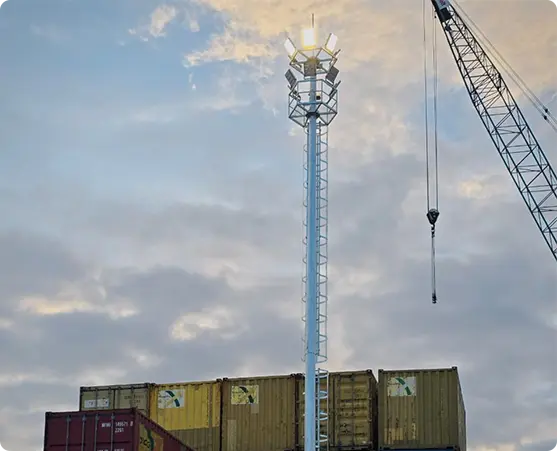
Cebu Baseport Terminals 2 & 4 High Mast Lighting
Fabrication and supply of heavy polygonal galvanized high-mast towers equipped with motorized raising/lowering crowns, enduring harsh maritime Pacific typhoons and saline corrosion while illuminating container terminal operations.
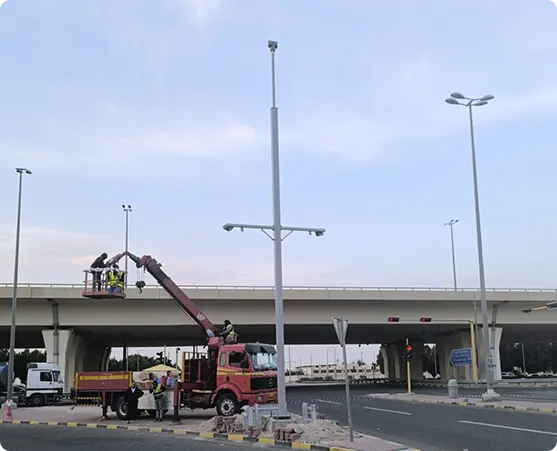
Surveillance & Distribution Poles
Heavy-duty hot-dip galvanized camera and low-voltage distribution monopoles engineered with specialized internal thermal vents, operating reliably in sustained 50°C+ ambient Arabian Gulf summer conditions.
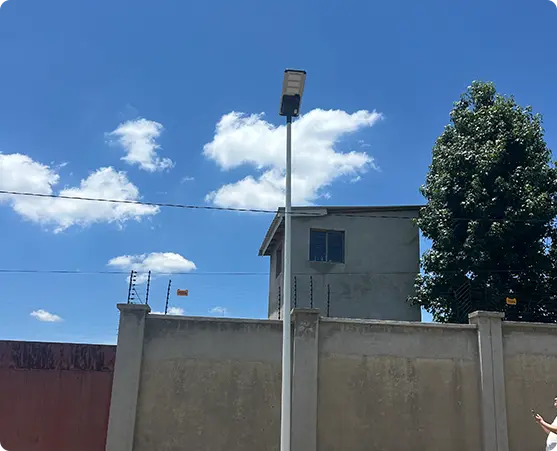
7m / 60W Integrated Off-Grid Network
Complete decentralized solar street lighting deployment providing continuous, zero-emission municipal illumination across urban corridors completely uninhibited by regional utility grid outages.
Frequently Answered Engineering Inquiries
Direct clarity regarding raw material properties, design software validation, galvanizing standards, connection mechanics, and overseas tender submission requirements.
Q1 What primary steel grades and mill standards are used in your pole production?
We primarily utilize high-strength low-alloy structural steels: Chinese GB/T standard Q235B (yield strength $\ge 235$ MPa) and Q355B (yield strength $\ge 355$ MPa), which directly correspond to European EN 10025 S235JR and S355JR, as well as American ASTM A36 and ASTM A572 Grade 50. For ultra-heavy transmission towers, Q460C or ASTM A572 Grade 65 steel is selected to minimize pole wall thickness while maximizing ultimate bending capacity.
Q2 Which international design standards do your structural calculations follow?
Our engineering team designs to international benchmarks including ASCE Manual 48 (Design of Steel Transmission Pole Structures), AASHTO LTS-6 (Standard Specifications for Structural Supports for Highway Signs, Luminaires, and Traffic Signals), ANSI C136.20, and European EN 40-3. Finite element analysis (FEA) and PLS-POLE modeling are conducted to verify non-linear second-order P-Delta moment deflections under full transverse load.
Q3 How is hot-dip galvanizing quality verified for high-salinity marine environments?
All poles undergo full-immersion hot-dip galvanizing conforming to ASTM A123 or ISO 1461. Before galvanizing, poles are chemically cleaned in acid pickling tanks to eliminate mill scale and oxides. Zinc coating thickness is verified using digital magnetic thickness gauges (standard min. 86 microns; custom heavy zinc coatings up to 120–140 microns available). For C5-M extreme marine applications, we apply a complementary epoxy/polyurethane duplex powder coat.
Q4 Slip-joint connections versus flanged connections: how should engineers choose?
For high-voltage and medium-voltage distribution poles exceeding 12–15 meters, slip joints (telescopic friction fit) are the most cost-effective and structurally ductile option. They eliminate heavy internal flanges, reduce shipping cube volume, and assemble rapidly on-site using hydraulic jacking devices (standard 1.5 times the female inside diameter overlap). Flanged connections are favored where overhead crane access is restricted or when precise foundation-to-tip vertical plumb tolerance is critical.
Q5 What technical data must an EPC contractor submit to receive a tender quotation?
To provide an accurate engineering bill of quantities (BOQ) and price quotation within 24 hours, please furnish: (1) Overall mounting height above ground and nominal pole class; (2) Design 3-second gust wind velocity (m/s or km/h); (3) Conductor configuration, cross-arm quantity, and transformer dead weights; (4) Soil condition for direct-embedment vs. anchor-bolt base plate selection; (5) Required anti-corrosion coating specification (HDG only vs Duplex).
Q6 Can your factory support customized hardware, cross-arms, and earthing lugs?
Yes. As an authentic OEM manufacturer with dedicated metal fabrication workshops, we custom-produce cross-arms, insulated conductor brackets, transformer platforms, fused cut-out switch mounts, climbing rungs/safety cables, and internal copper-bonded grounding studs. All accessory fittings are galvanized in the same batch to eliminate galvanic potential mismatches.
Q7 What quality control and testing documentation is supplied with every export shipment?
Every export shipment includes a comprehensive Project Quality Dossier consisting of: (1) Traceable Mill Test Certificates (MTC) conforming to EN 10204 Type 3.1; (2) Certified Ultrasonic Weld Testing (UT) & Magnetic Particle Inspection (MPI) reports; (3) Digital coating thickness measurement logs; (4) Dimension inspection protocols; and (5) Factory warranty certificates extending up to 10 years.
Q8 How do you optimize container packing to prevent transit damage and abrasion?
Poles are bundled using protective non-abrasive geotextile strapping, heavy rubber separators, and wood cribbing to prevent zinc-to-zinc contact abrasion during maritime transit. Multi-section poles are telescopically nested where design diameters permit, maximizing shipping container weight capacity without incurring dead freight charges.
Comprehensive Certified Pole Line Portfolio
Browse our complete range of high-efficiency utility distribution poles, heavy-duty mast assemblies, and municipal engineering solutions available for direct containerized export dispatch.


Initiate Your Utility Pole Tender Calculation
Bypass intermediaries. Submit your structural drawings, cantilever line loadings, or tender Bill of Quantities (BOQ) directly to Xintong chief structural engineers for prompt compliance review and competitive factory-direct pricing.