
High Mast & Infrastructure Engineering Systems
Explore our core OEM production series deployed across international seaports, mega-airports, highway interchanges, and smart municipal networks.

Best XT-DT-1 Series (Split Type) Manufacturer, Factories
Explore Specifications
OEM PUBLIC TRANSIT Series Municipal High Mast Poles Manufacturers, Supplier
Explore Specifications
High-Quality STADIUM SERIES High Mast Light Factory, Exporter
Explore Specifications
OEM XINTONG Multifunctional Light Poles Integrated Design, Octagonal, Conical & Square
Explore Specifications
OEM AIRPORT-PORT SERIES High Mast Light Manufacturer, Supplier
Explore Specifications
High-Quality URBAN-GRID Series Low Voltage Steel Power Distribution Poles
Explore Specifications
Custom XINTONG Full Series Municipal Street Light Poles Conical & Octagonal
Explore Specifications
Best Series Decorative Street Light Pole Manufacturers, Manufacturer
Explore SpecificationsThe Global High Mast Lighting Landscape: Engineering Scale & Commercial Realities
Large-scale area illumination is undergoing an unprecedented structural and technological evolution driven by mega-infrastructure expansions, deep-water port automation, and stringent international energy covenants.
Aviation & Intermodal Freight Velocity
International airports and automated intermodal logistics hubs operate 24/7/365 under intense photometric compliance mandates. Under ICAO Aerodromes Annex 14 and FAA AC 150/5360-13, high mast lighting must eliminate disability glare for pilots while providing high uniformity ratios (Uo > 0.40) across apron tarmac corridors.
Modern high mast installations range between 25m and 45m, holding multi-directional LED luminaire clusters yielding up to 600,000 lumens, ensuring ground handling operations maintain absolute visual clarity without shadows.
Maritime Port Electrification & Automation
Global container terminals handling 24,000+ TEU vessels require lighting towers capable of enduring aggressive coastal C5-M marine atmospheric corrosiveness. Port operators are phasing out antiquated 1000W-2000W high-pressure sodium fixtures in favor of engineered high mast LED matrices.
These systems drastically cut container stacking shadows, reduce carbon footprints by up to 65%, and support automated guided vehicle (AGV) navigational sensors via flicker-free, optical-grade luminaire integration.
High-Speed Highway Interchanges & Toll Plazas
Municipal departments of transportation worldwide are transitioning from traditional continuous median poles to centralized high mast lighting configurations at complex grade separations. A single 30m high mast replaces up to 18 individual street lighting poles.
This layout removes hazardous roadside collision obstacles for motorists, minimizes electrical cabling infrastructure, and reduces municipal maintenance disruptions by centering all service activities onto safe service easements.
Engineered Wind-Resilience & Polygonal Tapering
High mast structures operating between 15 meters and 50 meters face relentless cyclical dynamic loading. At Xintong Group, every mast section is custom-engineered using high-yield structural steel (Q355B / ASTM A572 Grade 50) and formed into 12-sided, 16-sided, or 20-sided regular polygonal tapers.
This polygonal geometry suppresses Von Kármán vortex shedding, minimizing catastrophic resonant oscillation during sustained laminar winds and high-velocity storm gusts up to 60 m/s (134 mph).
- AASHTO Structural Compliance: Designed per AASHTO Standard Specifications for Structural Supports for Highway Signs, Luminaires, and Traffic Signals.
- EN 40 & BS 5649 Verification: Rigorous structural verification under Eurocode 3 (EN 1993-1-1) for wind pressure, dead weight, and deflection limits.
- Finite Element Analysis (FEA): Advanced modal and fatigue stress analysis conducted on base flange weldments, anchor bolts, and mast section slip joints.
| Pole Height (m) | Shaft Sections | Material Grade | Bottom Outer Dia. | Top Outer Dia. | Max Design Wind Velocity | Recommended Applications |
|---|---|---|---|---|---|---|
| 15 – 20 m | 1 or 2 Sections (Slip-fit) | Q235B / Q355B | 350 – 440 mm | 180 – 220 mm | Up to 50 m/s (180 km/h) | Expressway Toll Plazas, Public Squares, Freight Yards |
| 25 – 30 m | 2 or 3 Sections (Slip-fit) | Q355B / ASTM A572 | 480 – 620 mm | 220 – 260 mm | Up to 55 m/s (198 km/h) | Highway Interchanges, Container Terminals, Rail Depots |
| 35 – 40 m | 3 or 4 Sections (Slip-fit) | Q355B / Q460D | 650 – 820 mm | 260 – 300 mm | Up to 60 m/s (216 km/h) | Deep-Water Ports, International Aprons, Mining Corridors |
| 45 – 50 m+ | 4 or 5 Sections (Slip-fit) | Q355B / Q460D Custom | 850 – 1100 mm | 300 – 360 mm | Custom Coastal Typhoons | Mega Industrial Shipyards, Border Checkpoints, Olympic Stadiums |
Motorized Raising & Lowering Winch Mechanisms (R&L System)
Eliminating dangerous high-altitude boom-truck operations and industrial scaffolding, our automatic lowering crown systems guarantee rapid, ground-level maintenance in under 15 minutes.
Dual-Drum Self-Locking Winch
Heavy-duty worm-gear power drive with irreversible mechanical auto-locking. Eliminates drum slippage and holds the entire luminaire ring securely without motor brake reliance.
Triple Mechanical Latching (Pawl)
Once raised to the top headframe, stainless steel mechanical latching dogs lock the ring securely onto structural pins, unloading all tension from the wire ropes for 100% operational safety.
Aviation-Grade SS316 Ropes
Redundant multi-strand AISI 316 stainless steel wire ropes engineered with an 8:1 safety factor. Non-rotating construction prevents cable twisting during vertical transit.
Quick-Disconnect Power Hub
Integrated multi-pin industrial electrical coupling disconnects high-voltage power instantly during lowering, protecting maintenance personnel and isolating phase lines automatically.
25+ Years Corrosion Resistance: Hot-Dip Galvanizing & Duplex Coating
In aggressive maritime salt-spray, industrial sulfur emissions, and extreme UV exposures, ordinary surface coatings deteriorate within years. Xintong deploys complete in-house hot-dip galvanization.
Full-Immersion Zinc Bath (ISO 1461)
Following high-precision CNC longitudinal submerged arc welding, entire mast sections are pickled, fluxed, and immersed in 450°C molten zinc. Internal and external surfaces achieve a minimum metallurgical zinc thickness of 86μm – 100μm, metallurgically bonding Fe-Zn alloy layers.
Duplex Electrostatic Powder Armor
For coastal infrastructure requiring architectural aesthetics or enhanced chemical protection, our automated spray lines apply an additional 100μm of architectural thermosetting polyester resin powder, cured at 200°C for superior gloss retention and UV impedance.
Certified Non-Destructive Testing (NDT)
Every export shipment is verified with magnetic particle inspection, ultrasonic weld thickness profiling, and zinc adhesion bend testing. Full mill certificates and ISO 9001/14001 compliance dossiers are provided directly for tender acceptance.
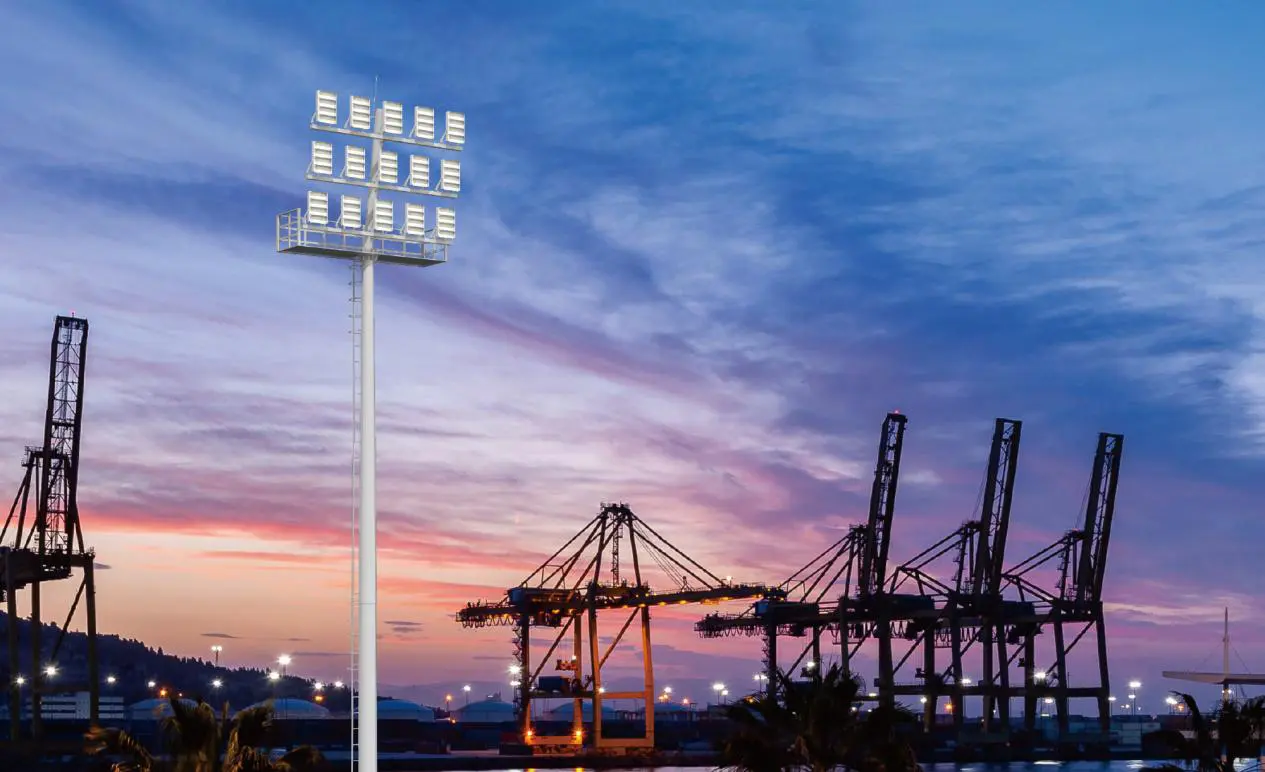
DIALux Precision Photometry & Glare Mitigation
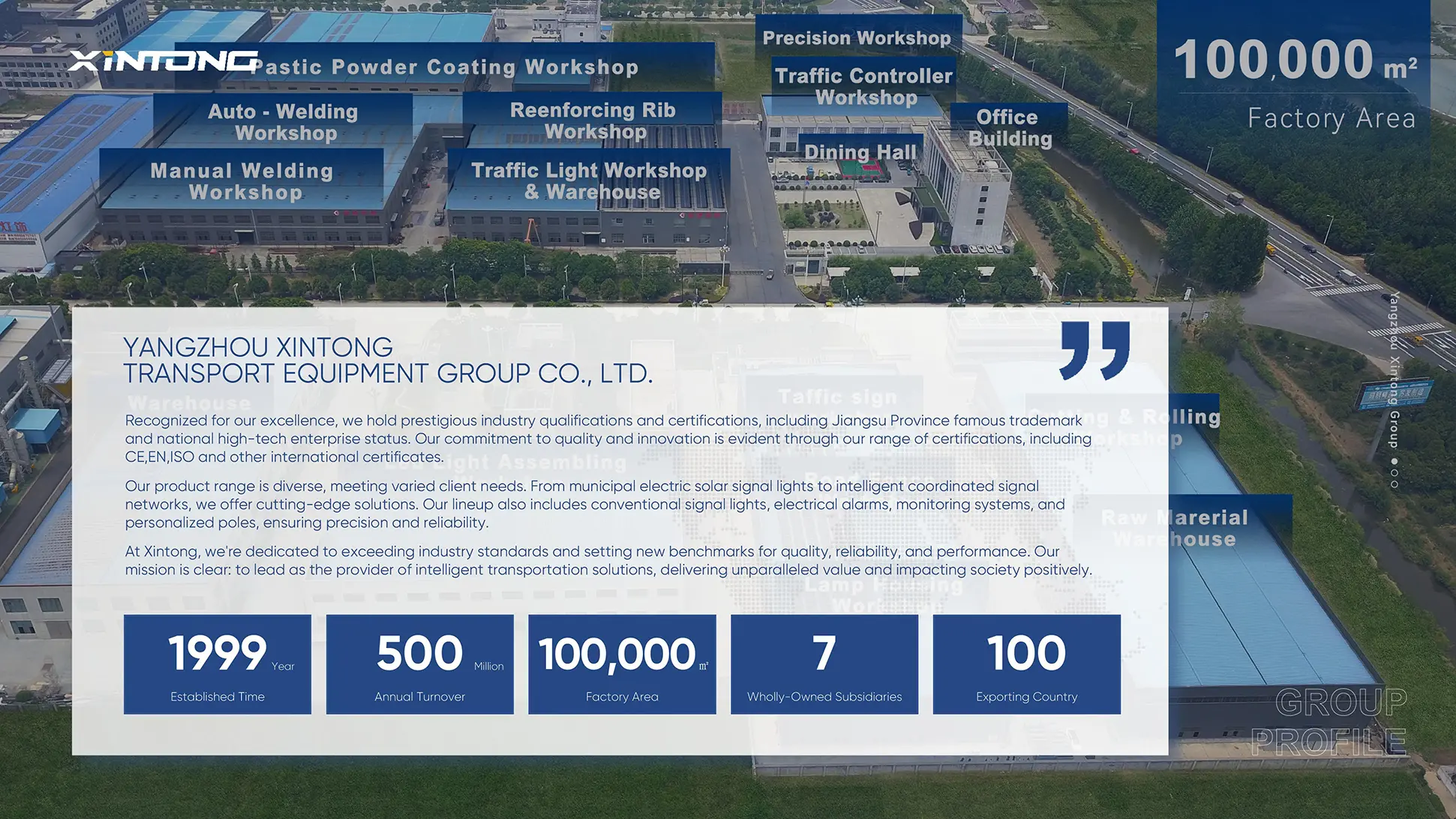
Illuminating a 200,000 m² shipping yard or an Olympic stadium requires far more than brute luminous flux. In-house optical engineers simulate site-specific target illuminance using advanced DIALux evo modeling to achieve precision lux uniformity ratios while completely eliminating stray upward skyglow.
- Ultra-High Efficacy LED Engines: 150 lm/W to 180 lm/W fixture efficacy utilizing Lumileds / Cree chips paired with Mean Well or Inventronics IP67 drivers.
- Asymmetrical TIR Optics: Custom batwing, narrow spot (15°), and wide forward-throw (60°x120°) PMMA optical lenses directing zero light waste beyond boundaries.
- Dark-Sky & Wildlife Compliance: Certified 0% upward light output ratio (ULOR = 0%) to prevent nocturnal ecological disruption and urban light pollution.
Tailored High Mast Solutions Across Extreme Geo-Climates
From sub-zero Arctic freeze to searing Arabian desert heat, our installations undergo structural adaptation to survive the world’s harshest operational realities.
Middle East Desert Environments
Engineered for continuous ambient temperatures exceeding +55°C, high sand-dust abrasion, and intense ultraviolet solar irradiation. Fixtures utilize IP66/IP67 sealed optic chambers, high thermal dissipation extruded aluminum heat sinks, and specialized anti-static powder coatings that resist fine sand accumulation.
Coastal Marine & Typhoon Belts
Designed for South Pacific and Caribbean hurricane regions with sustained winds up to 60 m/s. Base plates feature heavy gusset reinforcements, high-tensile 8.8-grade hot-dip galvanized anchor cages, and dual-layer marine epoxy/zinc protection to thrive under saline ocean mist.
High-Latitude & Central Asian Winters
Poles engineered for -40°C sub-zero environments using low-temperature impact tested structural steels (Q355D / Q355E) with Charpy V-notch impact energy certification. Internal winch lubrication oils and silicone gaskets prevent freezing or embrittlement during prolonged blizzards.
Verified Track Record: International Infrastructure Projects
Demonstrating technical compliance and logistical excellence across demanding EPC contractor specifications worldwide.
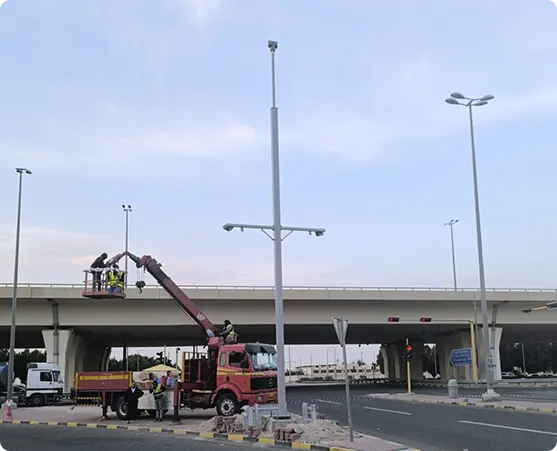
Cebu Baseport Terminal 2 & 4 Expansion
Manufactured and supplied 30m hot-dip galvanized polygonal high masts with motorized raising systems, supporting 24/7 container turnaround under heavy tropical marine conditions.
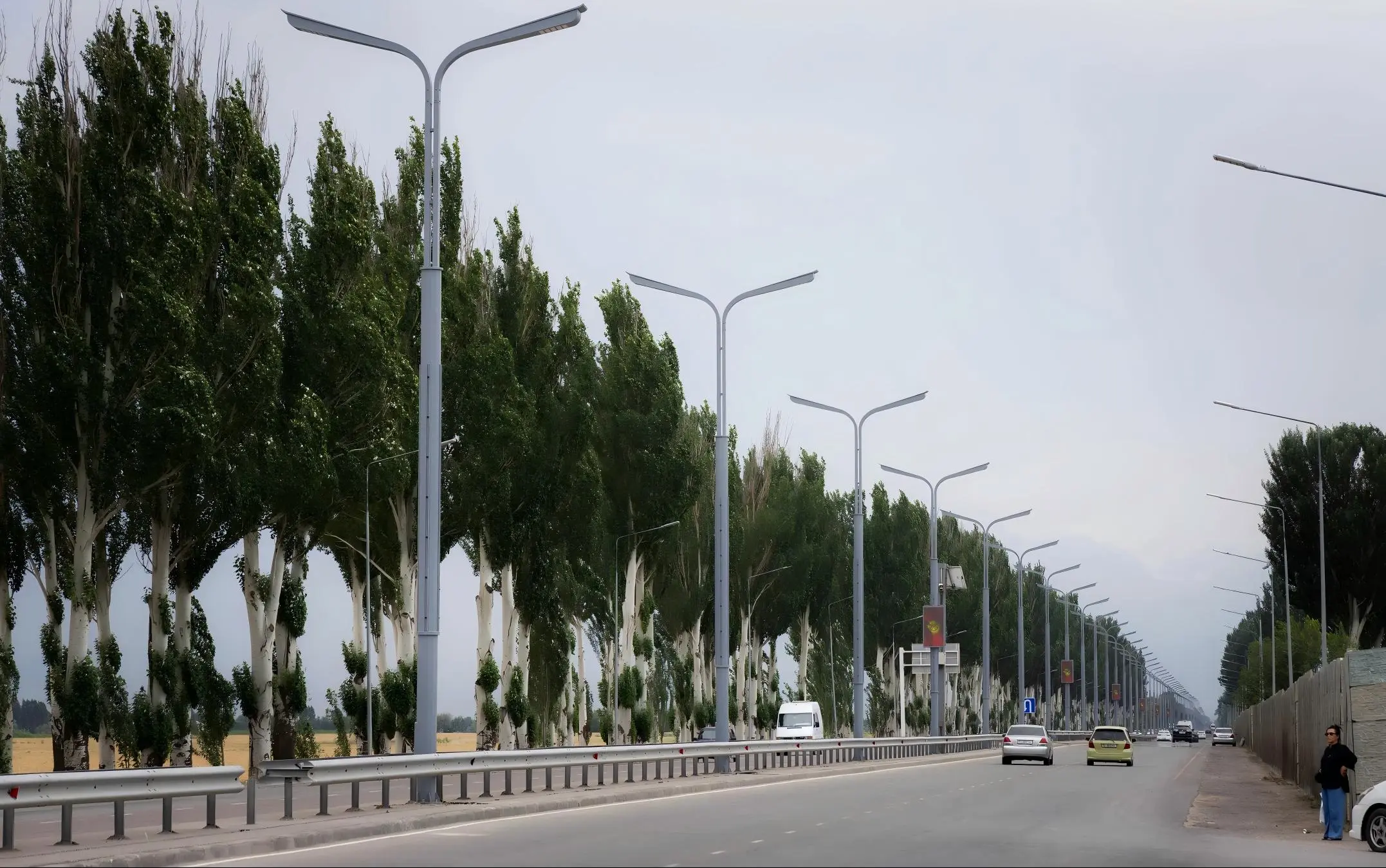
Manas International Airport Expressway
Engineered double-arm conical galvanized steel masts enduring extreme Central Asian seasonal freezing cycles while maintaining optimal luminance uniformity along key arterial corridors.
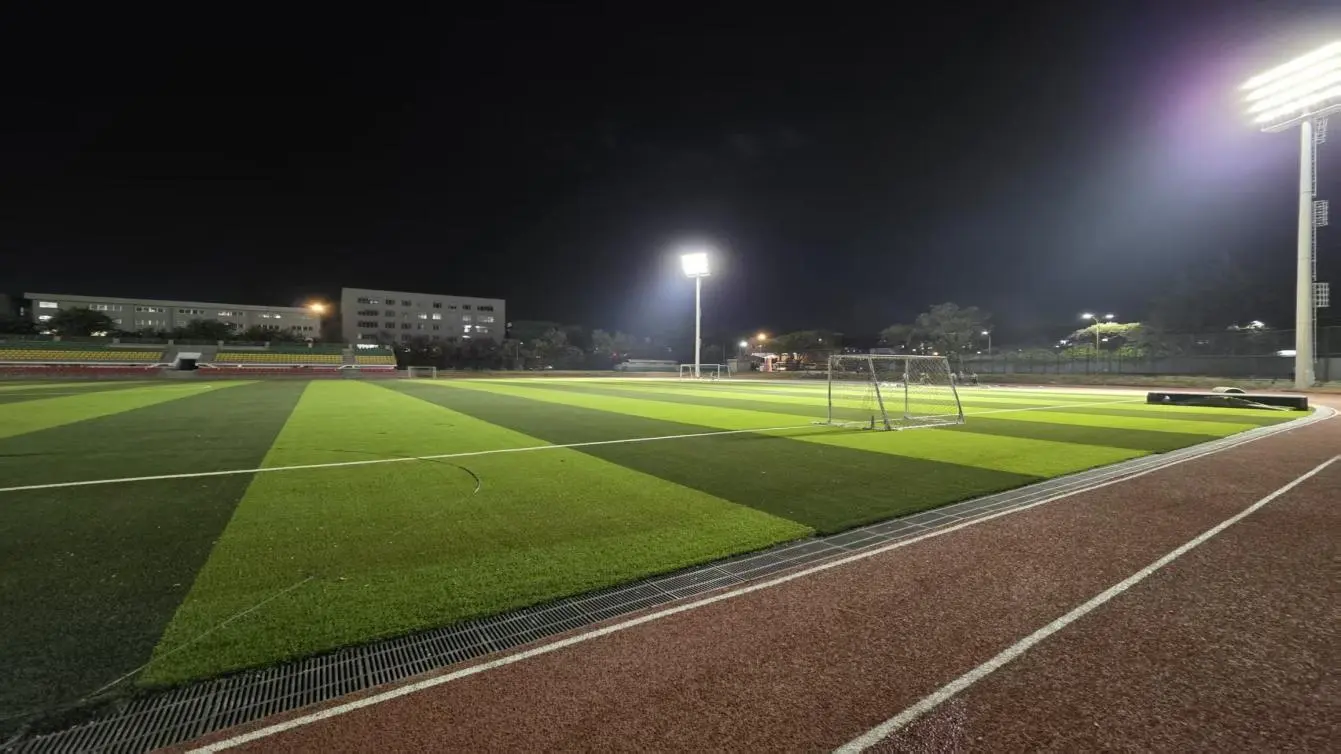
National Athletics Track & Stadium Lighting
Engineered customized 35m fixed-head floodlight towers accommodating high-output sports optics, tailored precisely to meet FIFA and IAAF Class II competition broadcast criteria.
Technology Roadmap: Smart IoT, Hybrid Power & Dark-Sky Autonomy
The high mast tower is transforming from a passive lighting pole into an active smart infrastructure node capable of multi-sensor telemetry and hybrid green energy generation.
IoT Centralized Gateway Architecture
Integration of NEMA/Zhaga smart sockets, LoRaWAN, and cellular NB-IoT nodes. Enables facility managers to schedule dynamic step-dimming, monitor real-time power factor, track lamp life, and receive automatic maintenance alarms via centralized cloud platforms.
Off-Grid & Hybrid Microgrid High Masts
For remote mineral extraction mines, military logistics bases, and highway toll intersections far from municipal power grids, our custom hybrid high masts integrate high-efficiency monocrystalline PV panels and high-density LiFePO4 energy storage arrays.
Dynamic Adaptive Photometrics
Next-generation high mast arrays incorporate automated radar and lidar sensors that automatically increase illumination intensity during peak intermodal cargo handling or high-traffic periods, then dim to 20% baseline during off-peak hours to slash operational energy consumption.
High Mast Lighting Technical Specifications FAQ
Comprehensive engineering and procurement inquiries answered directly by our factory project engineers.
How are high mast slip-fit joints assembled and verified on site?
Our telescopic slip joints are manufactured according to strict AASHTO dimensional tolerances. The overlap length is engineered to be at least 1.5 times the internal diameter of the mating bottom section. Assembly requires hydraulic chain pullers or come-alongs to pull sections until factory-inscribed matchmarks align perfectly, guaranteeing structural rigidity without field welding.
What structural safeguards protect the raising and lowering winch from mechanical failure?
Our system uses a dual-drum self-locking worm gear winch paired with secondary irreversible internal brake gears. Furthermore, when the luminaire ring reaches the top, mechanical latching hooks automatically engage into heavy forged pins on the masthead. This fully relieves tension from all stainless steel wire ropes during normal operation, ensuring zero risk of cable drop.
How does hot-dip galvanizing prevent corrosion inside the hollow mast shaft?
Full-immersion hot-dip galvanizing per ASTM A123 / ISO 1461 guarantees complete molten zinc flow across both exterior and interior walls. Degreasing, pickling acids, and liquid zinc enter through pre-engineered vent and drainage holes in internal diaphragms, creating an impermeable 86μm+ zinc metallurgical barrier throughout the entire internal circumference.
What design data is required to provide an EPC tender-compliant proposal?
To produce full CAD structural drawings and photometric simulations, we require: (1) Mounting height or target footprint dimensions; (2) Required average lux level and uniformity ratio (Eavg/Uo); (3) Design wind velocity (m/s or km/h); (4) Local seismic zone coefficients; (5) Soil bearing capacity for foundation bolt calculations; and (6) Control preferences (Manual, Photocell, DALI, or IoT).
High Mast & Specialized Infrastructure Solutions
Direct factory manufacturing backed by verified material test reports, mill certifications, and global export packaging for long-distance marine transport.

OEM XT-YTH-9 Series (All-In-One) Factory, Factories
Explore Specifications
Buy XINTONG Municipal Street Light Pole Series Factories, Exporter
Explore Specifications
Buy XT-YTH-3 Series (All-In-One) Exporter, Exporters
Explore Specifications
Custom XINTONG High Strength Light Pole Series: Heavy Loads Manufacturers
Explore Specifications
OEM AIRPORT-PORT SERIES High Mast Light Manufacturer, Supplier
Explore Specifications
High-Quality STADIUM SERIES High Mast Light Factory, Exporter
Explore Specifications
OEM PUBLIC TRANSIT Series Municipal High Mast Poles Manufacturers, Supplier
Explore Specifications