
Primary Highway & High Mast Structural Assemblies
Fabricated from mill-certified Q235B and Q355B structural steel, processed under automated single-pass submerged arc welding, and safeguarded with full-immersion hot-dip galvanization.

OEM XT-YTH-9 Series (All-In-One) Factory
View Specifications
OEM AIRPORT-PORT SERIES High Mast Light
View Specifications
High-Quality STADIUM SERIES High Mast Light
View Specifications
High-Quality URBAN-GRID Power Distribution Poles
View Specifications
Best XT-DT-1 Series (Split Type) Manufacturer
View Specifications
OEM PUBLIC TRANSIT Series High Mast Poles
View Specifications
OEM XINTONG Multifunctional Smart Poles
View Specifications
Buy XT-YTH-3 Series (All-In-One) Exporter
View SpecificationsAdvanced Metallurgy & Aerodynamic Engineering for Expressways
Highway lighting poles operate in relentless dynamic stress environments characterized by vortex-induced vibration, high-velocity wind buffeting, and acoustic shock waves from heavy vehicular transit. Engineering resilience begins at the atomic level.
Certified Steel Chemistries
We utilize traceable low-silicon, low-phosphorus prime structural steels—predominantly Q235B ($f_y \ge 235\,\text{MPa}$) and micro-alloyed Q355B / Q355D ($f_y \ge 355\,\text{MPa}$), conforming respectively to EN 10025 S275JR and S355JR, or ASTM A572 Grade 50. Controlling silicon content below 0.04% or within the Sandelin range (0.15%–0.25%) prevents brittle zinc-iron alloy overgrowth during galvanization.
Single-Seam Forming & SAW
Our hydraulic tandem bending presses (up to 2,000-ton capacity) form conical and polygonal shafts up to 14 meters in length without cross-transverse splicing. Longitudinal seams undergo continuous automated Submerged Arc Welding (SAW) per AWS D1.1 and EN ISO 15614, guaranteeing full penetration welds exceeding 90% throat thickness with automated NDT ultrasonic verification.
Duplex Anti-Corrosion Armor
Galvanized strictly in accordance with ISO 1461 and ASTM A123, molten zinc immersion at 450°C develops a metallurgically bonded multi-tier intermetallic barrier (Gamma, Delta, Zeta layers) topped by pure Eta zinc. Average coating thickness ranges from 86µm to 120µm, further fortified by electrostatic polyester powder top-coats delivering C5-M marine life expectancies exceeding 30 years.
Aerodynamic Profiling: Drag Coefficient ($C_d$) Optimization
On unrestricted multi-lane motorways, wind resistance dictates foundation size and anchor bolt strain. Tapered octagonal profiles exhibit a nominal drag coefficient of $C_d \approx 1.05$, whereas precision conical tubular sections achieve $C_d \approx 0.65$ to $0.80$ depending on Reynolds numbers ($Re$). Our finite element structural models (ANSYS & SolidWorks Simulation) calculate dynamic resonance, ensuring natural pole frequencies remain well isolated from vortex shedding frequencies ($f_s = S_t \cdot V / D$).
Integrated Chinese Manufacturing & Global Supply Chain Muscle
Located in Gaoyou, Jiangsu—the premier worldwide epicenter for municipal lighting and traffic engineering—Yangzhou Xintong Traffic Equipment Group represents over 25 years of end-to-end industrial manufacturing integration.
100,000 m² Dedicated Footprint
Operating seven fully modern automated fabrication lines. From raw hot-rolled coil leveling and laser plasma slitting to automatic roll forming, base-plate robot welding, and our dedicated enclosed environmental zinc hot-dip plant, zero processing is subcontracted. Total control equals total quality.
Shorter EPC Lead Times
Direct partnerships with major domestic steel mills (Baosteel, Shagang) give Xintong privileged rolling mill scheduling and raw plate warehousing. While Western fabricators quote 16–24 week lead times, our Gaoyou plant delivers multi-thousand pole project lots within 20 to 30 business days, fully containerized.
Unbeatable Economies of Scale
Aggregated material consumption, proprietary CNC hydraulic tooling, and zero middleman margins allow us to deliver tier-one quality at 25%–40% lower capital cost per metric ton. This provides international EPC bidding consortiums with decisive margin advantages in sovereign competitive tenders.
How Global Procurement Teams De-Risk Infrastructure Tenders
Winning government highway bids requires complete traceability, verifiable structural compliance, and exhaustive documentation. Xintong provides turnkey engineering submittal binders designed for instantaneous consultant approval.
AASHTO & EN 40 Design Dossiers
Every project submittal includes structural calculation reports conforming to AASHTO Standard Specifications for Structural Supports for Highway Signs, Luminaires, and Traffic Signals or European EN 40-3. Deflection limits under 3-second gust wind loads are certified to not exceed $\delta \le 0.04 \times H$.
DIALux evo Photometrics
Our photometric engineers simulate complete roadway layouts across EN 13201 (M1 to M6 lighting classes) and IESNA RP-8. We optimize pole height, spacing, overhang, boom angle, and lumen packages to guarantee mandatory roadway luminance ($L_{avg}$), overall uniformity ($U_o \ge 0.40$), and longitudinal uniformity ($U_l \ge 0.70$).
Mill Test Traceability (MTC 3.1)
Materials are tagged by batch heat number and supplied with EN 10204 Type 3.1 inspection certificates verifying yield, ultimate tensile strength, elongation, and chemical ladle analysis. Pre-shipment Factory Acceptance Tests (FAT) by independent third parties (SGS, Bureau Veritas, TÜV, Intertek) are routinely coordinated.
Containerized Nested Packaging
To minimize high ocean freight expenses, our industrial packaging engineers design customized nested cradling using non-marking woven geotextile wraps and protective wood dunnage. Tapered poles fit efficiently inside standard 40ft HQ shipping containers, maximizing metric tonnage capacity without coating abrasion.
Highway Light Pole Structural Design Parameters
Standard technical baseline for municipal dual-carriageways, expressways, cloverleaf interchanges, and logistics access corridors.
| Pole Height (m) | Shaft Geometry | Top / Bottom Dia. (mm) | Wall Thickness (mm) | Base Flange (mm) | Anchor Bolts (PCD) | Max Wind Speed | Target Application |
|---|---|---|---|---|---|---|---|
| 6m – 8m | Conical / Octagonal | Ø60–76 / Ø140–165 | 3.0 – 3.5 mm | 300 × 300 × 16 | 4 × M20 (PCD 240) | 160 km/h (44 m/s) | Ramps & Service Roads |
| 9m – 10m | Octagonal / Conical | Ø76–89 / Ø180–200 | 3.75 – 4.0 mm | 350 × 350 × 18 | 4 × M24 (PCD 280) | 180 km/h (50 m/s) | 4-Lane Dual Arterials |
| 11m – 12m | Tapered Octagonal | Ø89–100 / Ø210–240 | 4.0 – 4.5 mm | 400 × 400 × 20 | 4 × M27 (PCD 320) | 200 km/h (55 m/s) | 6-8 Lane Interstates |
| 14m – 15m | Dodecagonal Tapered | Ø100–120 / Ø260–300 | 5.0 – 6.0 mm | 450 × 450 × 25 | 6 × M30 (PCD 380) | 220 km/h (61 m/s) | Toll Plazas & Interchanges |
| 18m – 30m | Polygonal High Mast | Ø200–280 / Ø400–650 | 6.0 – 8.0 mm (Slip) | Circular Base Ø800–1100 | 8–12 × M36 (PCD 650+) | 240+ km/h (67 m/s) | Ports, Airports & Junctions |
*Note: All shaft geometries can be customized per project wind zone maps, seismic acceleration coefficients ($S_s, S_1$), and specific soil bearing capacities ($q_a$).
Engineered Resilience for Global Extreme Microclimates
Highway infrastructure cannot fail when nature turns violent. We engineer region-specific structural modifications to meet localized environmental conditions worldwide.
Middle East & GCC Desert Corridors
Extreme diurnal thermal shifts (ambient +55°C), high UV exposure, and abrasive airborne particulate matter cause premature coating failures. We utilize dual-pass hot-dip galvanization coupled with high-adhesion thermosetting fluoropolymer powders (PVDF) that resist sand-blasting erosion and withstand extreme temperatures without thermal cracking.
Coastal Typhoons & Salt Spray (C5-M)
For maritime coastal expressways throughout Southeast Asia, the Caribbean, and Central America, salt-laden marine air accelerates galvanic corrosion. We mandate ISO 12944 Corrosivity Category C5-M systems: minimum 100µm hot-dip galvanizing, followed by epoxy micaceous iron oxide (MIO) primer and aliphatic polyurethane top-coating tested past 1,500 hours ASTM B117 salt spray exposure.
Central Asian & Nordic Sub-Zero Climates
Under extreme winter conditions (-30°C to -45°C), conventional carbon steel risks catastrophic brittle fracture. We utilize specialized fine-grained Q355D / Q355E steels with guaranteed Charpy V-notch impact energy absorption ($\ge 34\,\text{J}$ at $-20^\circ\text{C}$ or $-40^\circ\text{C}$), safeguarding highway structures against cold embrittlement failure.
Passive Safety & Breakaway Bases
In adherence to AASHTO MASH (Manual for Assessing Safety Hardware) and EN 12767 passive safety classifications (100NE3, 100LE3), Xintong manufactures impact-absorbing slip bases and frangible couplings designed to release cleanly upon vehicular collision, significantly mitigating occupant deceleration and injury.
Smart Highway Hubs & Industrial Decarbonization
The humble lighting pole is transforming into the nerve center of intelligent transportation systems (ITS) and connected autonomous vehicle (CAV) corridors.
5G & V2X Connected Roadway Masts
Modern expressway concessions demand infrastructure that supports Vehicle-to-Infrastructure (V2I) communication. Our engineered smart poles incorporate internal isolated raceways for high-frequency cabling, active internal ventilation cooling, vibration-isolated bracketry for radar/LiDAR sensors, and blind RF-transparent radome housings for 5G microcells.
Adaptive IoT Telemetry & Dynamic Dimming
Integrating Zhaga Book 18 or NEMA 7-pin smart sockets, our highway poles interface with centralized IoT cloud networks via LoRaWAN, NB-IoT, or cellular. Luminaires respond dynamically to real-time traffic flux, ambient optical contrast, and hazardous fog conditions, trimming municipal operating expenditures by over 40%.
Sustainable Steel & Green Galvanizing
To assist international developers in satisfying strict ESG criteria, our production facility adopts recycled Electric Arc Furnace (EAF) structural steel with low embedded carbon footprints, lead-free zinc kettles exceeding 99.995% purity, and closed-loop acid pickling wash recycling systems eliminating industrial liquid effluent.
Field-Tested Across Global Transport Corridors
From sovereign expressway corridors in Central Asia to marine deepwater container ports in South America, Xintong structures deliver decades of dependable, maintenance-free performance.
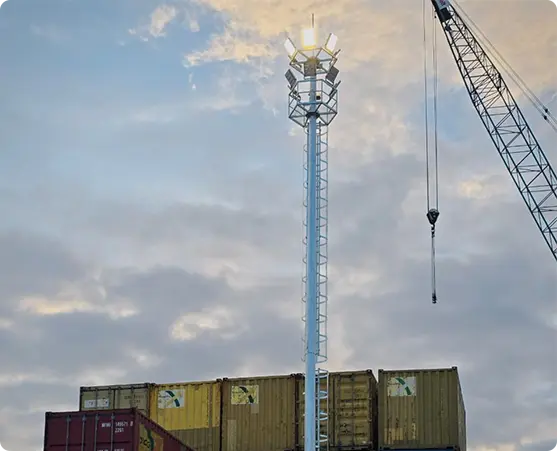
Cebu Baseport Terminals 2 & 4
Engineered and delivered polygonal motorized raising and lowering high masts for round-the-clock heavy maritime cargo operations. Built to survive Category 5 typhoon gusts exceeding 240 km/h with heavy C5-M marine galvanizing.
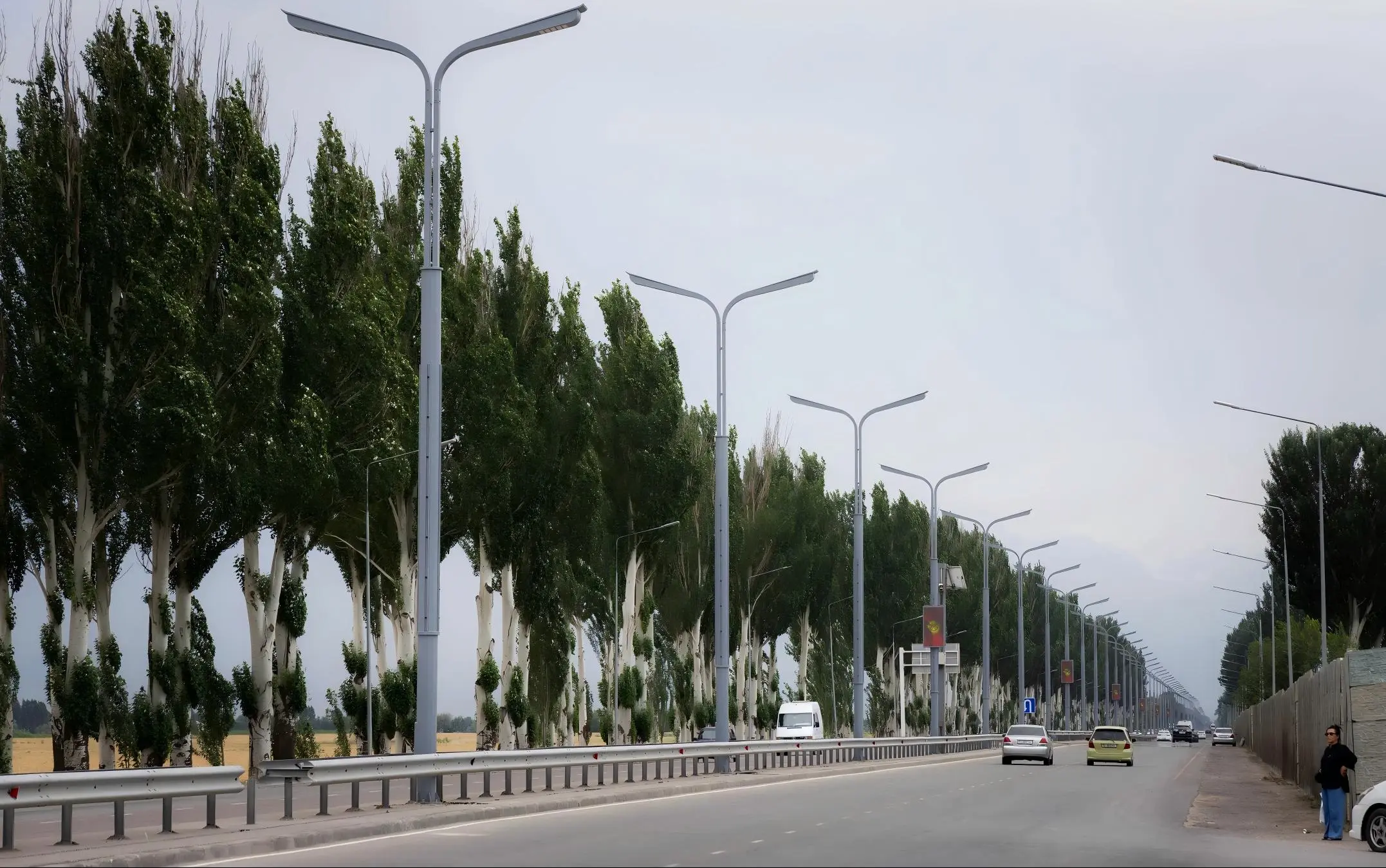
Manas International Airport – Bishkek Highway
Manufactured double-arm hot-dip galvanized conical steel highway poles. Engineered with low-temperature impact resistant steel to withstand sub-zero Central Asian winters while ensuring continuous Class M2 roadway illumination.
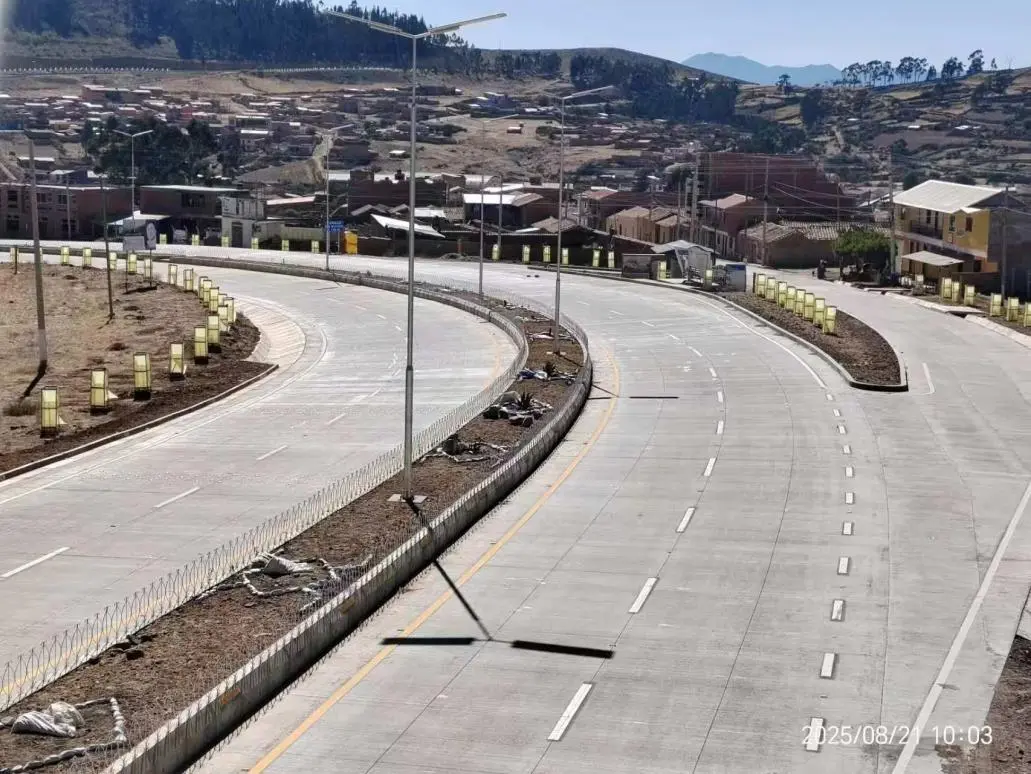
Chancay Port Municipal Logistics Arterial
Customized split-type solar-powered high-efficiency LED street lighting systems for logistics transport routes serving South America's major Pacific deep-water transshipment hub.
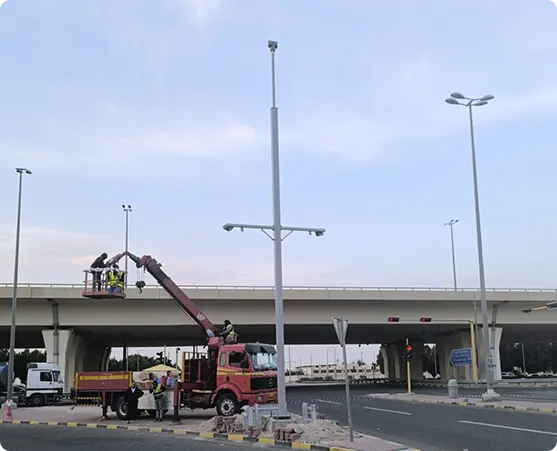
Kuwait Expressway ITS Surveillance Towers
Supplied rigid octagonal CCTV and speed monitoring steel poles engineered for low tip-deflection to maintain crystal-clear vehicle license plate camera tracking in high-temperature desert storm conditions.
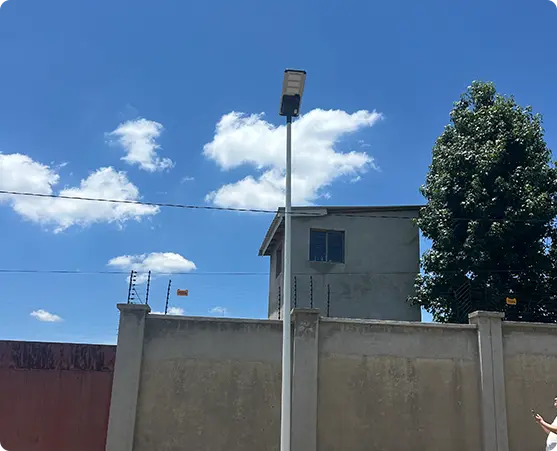
National Route Off-Grid Solar Electrification
Supplied self-contained solar roadway poles ensuring uninterrupted critical transit illumination across regional bypasses vulnerable to utility grid load-shedding.
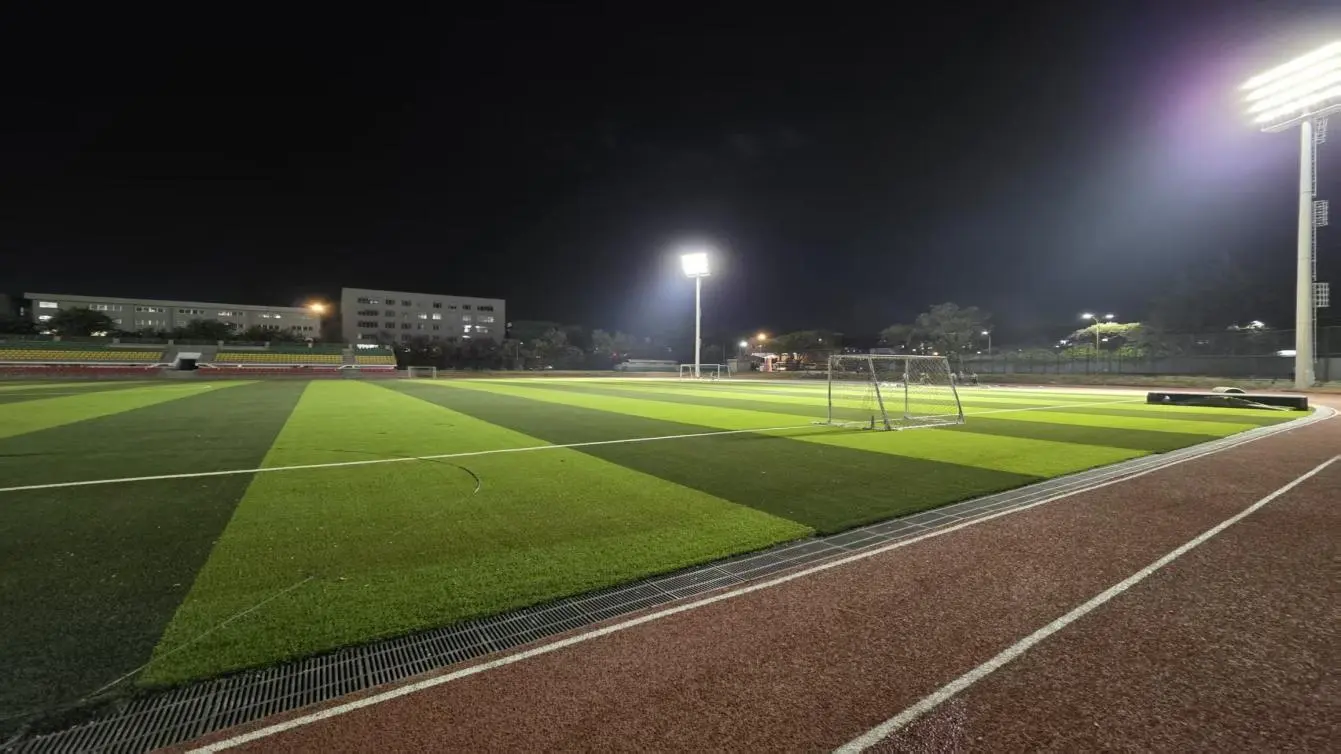
National Athletics Arena High Mast System
Delivered custom multi-head floodlight masts configured per DIALux sports lighting criteria, achieving high color rendering indices ($R_a \ge 80$) and low visual glare ratings for international broadcasts.
Municipal, Decorative & Heavy-Load Engineering Lines
Explore our full line of highway lighting standards, decorative boulevard poles, and severe-condition structural assemblies manufactured to project specifications.

Best Series Decorative Street Light Pole
View Specifications
Custom High-Strength Light Pole Series
View Specifications
Buy XINTONG Municipal Street Light Pole Series
View Specifications
Custom Full Series Municipal Street Light Poles
View Specifications
Best XT-DT-1 Series (Split Type) Manufacturer
View Specifications
OEM PUBLIC TRANSIT Series High Mast Poles
View Specifications
OEM XINTONG Multifunctional Light Poles
View Specifications
Buy XT-YTH-3 Series (All-In-One) Exporter
View SpecificationsFrequently Asked Engineering & Procurement Questions
In-depth technical answers addressing structural calculation models, galvanizing durability, international certifications, and factory acceptance procedures.
Consult Directly with Our Senior Export Project Engineers
Skip the sales agents. Send your Bill of Quantities (BOQ), tender drawings, or lighting specifications to our factory engineering division. We deliver complete structural reviews, DIALux photometric simulations, and competitive factory-direct quotations within 24 hours.
Tender Checklist Service
- Wind speed & gust calculations
- Roadway luminance class (EN/IESNA)
- Base plate & anchor bolt drawings
- Raw steel heat trace & MTC 3.1
- Container packing & freight layout