
Core Infrastructure & Export Pole Systems (Part I)
Explore eight of our certified hot-dip galvanized structural pole assemblies and all-in-one solar systems engineered in Gaoyou, Jiangsu for global municipal tenders and utility-scale deployments.







The Next Generation of Galvanized Light Poles: Global Procurement & Technological Shift
Modern lighting poles are no longer passive steel shafts. Municipalities, civil engineering ministries, and international EPC (Engineering, Procurement, and Construction) consortia now demand intelligent structural platforms capable of supporting renewable harvesting, IoT instrumentation, and 30-to-50-year maintenance-free service lives under stringent environmental conditions.
Corrosion Science: Dual-Immersion HDG
Standard cold zinc plating fails within 3 to 5 years in maritime and industrial belts. Leading export manufacturers adhere strictly to ISO 1461, ASTM A123, and BS EN ISO 1461 standards, utilizing automated hot-dip galvanizing baths maintained at 450°C (842°F). This chemical reaction bonds iron-zinc alloys (Gamma, Delta, and Zeta phases) topped by a pure Eta zinc shield, providing cathodic self-healing protection that withstands high-salinity coastal spray and severe salt tests over 1,500 hours.
Aerodynamic Wind-Load Engineering
AASHTO LTS (Standard Specifications for Structural Supports for Highway Signs, Luminaires, and Traffic Signals) and Eurocode 1 (EN 1991-1-4) dictate that pole wall taper and cross-sectional geometry (conical versus octagonal vs 12-sided polygonal) drastically change aerodynamic drag coefficients. Automated CNC press braking guarantees accurate cross-sectional radius, eliminating stress concentration notches and mitigating vortex-shedding resonance fatigue.
Multi-Tenancy Smart City Integration
Urban infrastructure is undergoing unprecedented convergence. Lighting poles must now reserve internal cabling channels, isolated power circuits, and CNC-cut flange ports for 5G microcell transceivers, PTZ public safety cameras, digital LED municipal displays, vehicle charging terminals, and IoT air-quality monitoring pods. Integrated manufacturing ensures structural load-bearing capacity without compromising baseline illumination performance.
Targeted Solutions for Infrastructure, Ports & Utility Networks
Engineered from prime Q235B, Q355B, and SS400 structural steel with mill-test traceable chemical compositions, our galvanized poles are tailored to project-specific environmental classifications (C1 through C5-M / CX per ISO 12944).
| Application Sector | Structural Profile | Typical Height (m) | Zinc Coating Spec | Structural & Safety Standard | Design Wind Velocity |
|---|---|---|---|---|---|
| Expressways & Interchanges | Tapered Conical / Octagonal | 8m – 14m | ≥ 86 μm (ASTM A123) | EN 40-3, AASHTO M 180 | Up to 160 km/h (45 m/s) |
| Deepwater Seaports & Docks | 16-Side Polygonal High Mast | 20m – 35m | ≥ 100 μm + Marine Epoxy | ISO 1461, ISO 12944 C5-M | Up to 200 km/h (Typhoon Spec) |
| Smart City Boulevards | Modular Cylindrical / Square | 6m – 10m | ≥ 85 μm + Polyester Powder | CE, RoHS, IEC 60598 | Up to 140 km/h (38 m/s) |
| International Airports & Aprons | Motorized Raising/Lowering Mast | 25m – 45m | ≥ 100 μm Double-Dip | ICAO Annex 14, FAA AC 150 | Up to 180 km/h (50 m/s) |
| Low-Voltage Rural Grids | Heavy-Gauge Stepped/Octagonal | 9m – 15m | ≥ 86 μm (GB/T 13912) | IEEE C2, ANSI C136.20 | High Transverse Tension Load |
1. CNC Laser & Precision Bending
Operating 14-meter and 16-meter tandem CNC hydraulic press brakes with up to 1,600 tons of bending capacity. Steel plates are laser cut to sub-millimeter tolerances, ensuring continuous longitudinal taper without localized bowing or warping.
2. Submerged Arc Automated Welding
Single-seam longitudinal welding utilizes automated submerged-arc welding (SAW) and gas metal arc welding (GMAW). Every batch undergoes non-destructive ultrasonic testing (UT) and magnetic particle inspection (MPI) to verify 100% weld penetration.
3. Complete Hot-Dip & Duplex Coating
Chemical pickling, fluxing, and total immersion hot-dip galvanizing safeguard both internal and external walls. For architectural or coastal environments, electrostatic thermosetting polyester powder coating is applied, offering 100% UV and salt spray resistance.
Engineering Case Studies & International Deliveries
From container freight terminals in the Pacific to alpine highway corridors in Central Asia, our poles deliver proven survivability, verified photometric performance, and turnkey tender compliance.
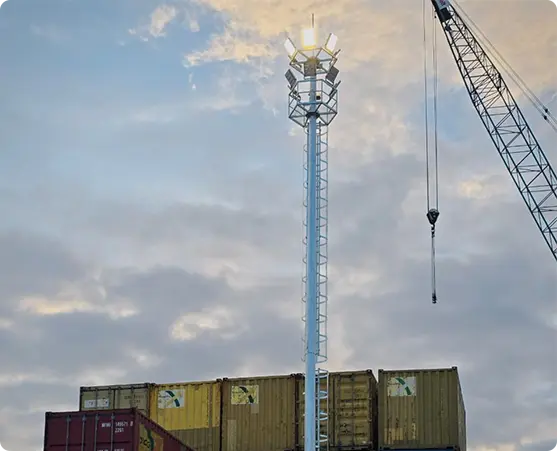
Cebu Baseport Maritime Terminals (Philippines)
Scope: 30m Heavy-Duty Polygonal High Mast Towers
Engineered for continuous exposure to high tropical humidity and saline sea breezes. Fitted with dual-drum lowering winches and marine-grade LED floodlights that maintain 50 Lux operational ground-level illuminance across container aprons.
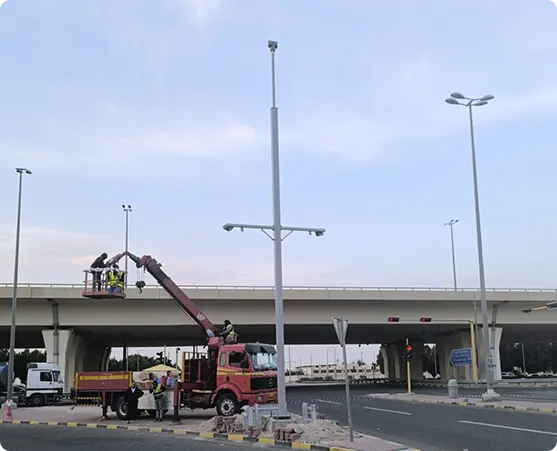
Smart Highway Surveillance Network (Kuwait)
Scope: Conical Smart Camera Poles with Internal Cooling
Custom fabricated with heavy foundation flange plates and internal cable raceways to endure Middle Eastern ambient temperatures exceeding 52°C and severe desert sandstorms without mechanical vibration or camera jitter.
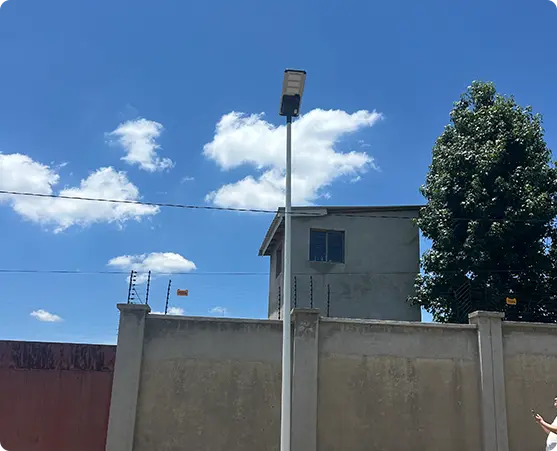
Off-Grid Municipal Arterials (South Africa)
Scope: 7m Octagonal Hot-Dip Galvanized Solar Poles
Designed to neutralize rolling power blackouts and load-shedding disruptions. Integrated with tamper-proof battery housings, high-efficiency solar modules, and galvanized anchor-cage assemblies for rapid, trench-free installation.
Tender-Ready Technical Documentation & Global EPC Compliance
We eliminate procurement friction by providing complete engineering packages alongside factory-direct supply. International contractors and engineering consultants receive turnkey documentation verifying compliance with local statutory codes.
DIALux Photometric Studies
Complete .ies photometric simulations modeling road luminance (cd/m²), overall uniformity (Uo), longitudinal uniformity (Ul), and threshold increment (TI) conforming to EN 13201 and IESNA RP-8-18 standards.
CAD Structural Calculations
Detailed engineering reports detailing bending moments, shear stresses, anchor bolt tensioning, and natural frequency oscillation damping to prevent fatigue failure per AASHTO LTS-6 and ASCE 7-22 codes.
Material Test Certificates (MTC)
Full traceability conforming to EN 10204 Type 3.1. Complete spectrometer chemical breakdown (C, Si, Mn, P, S) and mechanical tensile/yield strength validation for every coil of raw steel processed.
Coating Thickness Validation
Electromagnetic and eddy-current thickness testing ensuring the minimum zinc coating weight exceeds 610 g/m² (86 μm) per ASTM A123, accompanied by cross-hatch adhesion testing for powder finishes.
Technology Roadmap: The Future of Urban Lighting Structures (2025–2035)
As the world transitions toward carbon-neutral infrastructure and autonomous vehicle ecosystems, the demands placed upon street lighting poles are expanding rapidly. Our engineering laboratories are pioneering four forward-looking manufacturing paradigms:
Green Steel & Low-Carbon Galvanizing
Adopting EAF (Electric Arc Furnace) recycled steel plate and energy-efficient induction zinc kettles to reduce embedded product carbon footprint by up to 35% in compliance with EU CBAM import rules.
Structural Digital Twin Integration
Embedding fiber-Bragg grating (FBG) strain sensors and micro-accelerometers inside high-mast bases to stream continuous structural health telemetry, alerting operators to foundation shifts before catastrophic failures.
Vehicle-to-Infrastructure (V2I) Hubs
Developing standardized modular bracket interfaces for cellular-V2X roadside units, radar transceivers, and LiDAR traffic sensors to facilitate level 4 and level 5 autonomous vehicle guidance.
Graphene-Zinc Hybrid Nanocoatings
Formulating ultra-thin graphene-doped zinc coatings that provide superior scratch resistance, hydrophobic self-cleaning surface tension, and 60+ year corrosion barriers in extreme marine environments.
Frequently Asked Questions: Technical & Export Specifications
Comprehensive answers to the structural, metallurgic, and logistics questions most commonly submitted by municipal engineers, EPC procurement directors, and import agencies.
Yangzhou Xintong Traffic Equipment Group is a verified direct manufacturer operating continuously since 1999. Our integrated production base covers 100,000 m² in Gaoyou, Jiangsu Province, China. We operate 7 specialized production workshops equipped with automated CNC decoiling, heavy tandem press brakes, automated submerged arc welding, enclosed pickling and fluxing lines, hot-dip galvanizing baths, and automated electrostatic powder coating lines. Clients and international inspection firms (such as SGS, Bureau Veritas, and TÜV) are welcome to perform on-site audits or live video verification anytime.
We manufacture exclusively from certified high-tensile structural steel plates conforming to Chinese Standard GB/T 700 (Q235B) and GB/T 1591 (Q355B/Q355D), which correspond directly to European Standard EN 10025 (S235JR and S355JR), ASTM A36, and ASTM A572 Grade 50. For extreme sub-zero applications down to -40°C, low-temperature impact tested steels (Q355D/E) are utilized. Every consignment is dispatched with traceable EN 10204 Type 3.1 chemical analysis and mechanical property mill test certificates.
Corrosion protection is achieved through full-immersion hot-dip galvanizing per ISO 1461, ASTM A123, or AASHTO M 111. Steel shafts are completely immersed into molten zinc at 450°C, producing a metallurgical bond with an average thickness of 86 μm to 100 μm (610–710 g/m²). For coastal and high-salinity industrial projects (ISO 12944 C4/C5 classes), we offer a Duplex Coating System: hot-dip galvanizing followed by surface sweeping, conversion phosphating, and an 80–120 μm electrostatic architectural polyester powder finish, providing dual-barrier resistance against salt fog, acid rain, and solar ultraviolet degradation.
Yes. Our senior engineering division generates comprehensive CAD shop drawings, finite element structural calculations (FEA), and DIALux photometric simulations. We engineer pole shaft wall thickness, base plate dimensions, and anchor bolt cage configurations to withstand local design gust velocities ranging from 120 km/h to over 200 km/h (typhoon rating) per AASHTO LTS-6, ASCE 7-22, or Eurocode 1 (EN 1991-1-4) wind load criteria.
Standard production cycles range from 15 to 25 days depending on batch volume and custom tooling requirements. Export packaging is designed specifically for containerized (20GP, 40GP, 40HQ, 45HQ) or break-bulk shipping. Shafts are wrapped in protective bubble wrap, non-woven fabric, or woven sacking, separated by timber dunnage and high-density rubber pads to avoid transit abrasion. Bundles are secured with heavy-duty polyester strapping and reinforced lifting slings for safe dockside unloading.
To receive an immediate, engineering-reviewed commercial proposal, please provide: (1) Mounting height and arm style (single, double, or multi-fixture bracket); (2) Cross-section profile (octagonal, conical, polygonal, or round tubular); (3) Top diameter, bottom diameter, and wall thickness (or target wind speed if thickness is open for calculation); (4) Surface finishing specification (hot-dip galvanized only or galvanized plus powder coating with RAL color code); (5) Luminaire details (LED wattage, solar system autonomy requirement, or fixture weight/wind area); and (6) Target quantity, destination sea port, and applicable Incoterm (FOB, CIF, CFR, or DDP).
Featured High Mast, Solar & Municipal Assemblies (Part II)
Select from our comprehensive serialized product families for direct factory export, turnkey municipal contracts, high-output stadium floodlighting, and off-grid renewable infrastructure.

