
Featured Project-Engineered Series for Sovereign & EPC Tenders
Discover factory-serialized lighting columns, all-in-one solar luminaires, and severe-condition distribution structures built directly in our 100,000 m² Gaoyou production facility.

URBAN-GRID Series Steel Power Distribution Poles
Low-voltage structural steel distribution poles designed for multi-cable utility lines, urban substations, and combined grid-hybrid street lighting.

OEM XT-YTH-9 Series Integrated Solar System
High-lumen integrated solar luminaire featuring high-efficiency monocrystalline PV panels, deep-cycle LiFePO4 chemistry, and programmable MPPT controllers.

High-Strength Heavy-Load Light Pole Series
Engineered for extreme coastal corridors and typhoon wind-loads up to 60 m/s using certified Q355 structural steel and reinforced flanged anchor systems.

Municipal Standard Street Light Pole Series
Conical and octagonal hot-dip galvanized poles custom manufactured with single or dual luminaire outreaches tailored for arterial road specifications.

AIRPORT-PORT Series High Mast Light Towers
15m to 45m polygonal high mast assemblies featuring automated motorized raising-and-lowering crowns for apron handling, ports, and rail logistics terminals.

Architectural Decorative Street Light Poles
Precision-crafted ornamental poles that combine architectural aesthetics with high-efficiency LED optics for promenades, historical districts, and tourist corridors.
STADIUM SERIES Heavy-Duty High Mast Lighting
Professional high-output headframe structures custom designed for multi-tier floodlight arrays conforming to FIFA and IAAF broadcasting illumination standards.

XT-YTH-3 Series All-In-One Solar Street Light
Zero-trenching rapid-deployment integrated luminaire optimized for rural electrification, suburban streets, perimeter fencing, and access roadways.
The Macro Paradigm Shift in Project-Customized Solar Street Lighting
The global municipal lighting sector is experiencing a monumental transformation. Commodity off-the-shelf solar lighting fixtures have consistently proven inadequate for mission-critical infrastructure projects. Premature battery death, wind-induced structural buckling, excessive light depreciation (lumen decay), and chronic blackout periods during monsoon cycles have forced international engineering, procurement, and construction (EPC) firms to abandon generic catalog purchases.
Today, institutional buyers demand Project-Customized Solar Infrastructure. Modern municipal tenders require hyper-localized engineering calculated against historical microclimate datasets: peak solar irradiance variances ($kWh/m^2/day$), maximum ambient thermal cycles, corrosive marine salts (ISO 12944 C5-M classifications), and dynamic 50-year return wind gust limits governed by AASHTO LTS-6 and EN 40-3-2 codes.
- Shift from LCC to LCOL: Transitioning procurement metrics from initial Capital Expenditure (CAPEX) to Levelized Cost of Light (LCOL) across an operational 25-year lifecycle.
- Grid Decoupling & Sovereign Resilience: Sovereign infrastructure programs deploy independent solar public lighting to insulate arterial transport networks from national grid volatility and load-shedding crises.
- End-to-End Traceable Manufacturing: Eradicating trading-intermediaries by partnering directly with fully integrated facilities managing CNC laser cutting, automated submerged-arc pole welding, in-house hot-dip galvanizing, and SMT luminaire assembly.
Global Procurement Demand Analysis: What Tier-1 Buyers Really Need
Analyzing technical requirements across EPC contractors, municipal transport authorities, multilateral development bank funded projects (World Bank, ADB), and industrial port developers.
1. International EPC Contractors
Contractors executing lump-sum turnkey (LSTK) road and highway projects face severe liquidated damages for project delays and non-compliant submittals.
- Complete submittal packages: CAD shop drawings, calculation sheets, DIALux simulation files, and structural stampings.
- Strict material traceability: Mill test certificates (EN 10204 3.1) for Q235B/Q355B structural steel and hot-dip zinc batches.
- Synchronized maritime container packing to prevent site demurrage and assembly damage.
2. Municipal & Public Works Authorities
City engineers focus on citizen safety, zero public liability from collapsing infrastructure, and minimizing recurring operational maintenance.
- Certified lighting classes: Guaranteed compliance with CIE 115, EN 13201 (M1-M5, C0-C5, P1-P6) roadway luminance criteria.
- Vandal-proof and theft-resistant integration: Underground anti-theft battery vaults or top-of-pole integrated locking enclosures.
- Long-term warranty protection backed by multi-stage factory test records and 25+ year structural corrosion warranties.
3. Multilateral Development Bank Programs
Projects funded through the World Bank, Asian Development Bank (ADB), or AfDB require stringent environmental, social, and technical conformance.
- Energy efficiency threshold: Minimum 170 to 210 lm/W luminous efficacy using Tier-1 LED chips (Philips Lumileds, Cree, Osram).
- Environmental compliance: Restriction of Hazardous Substances (RoHS) certification and non-toxic lithium chemistry (no lead-acid).
- Third-party audited factory capacity: ISO 9001, ISO 14001, and ISO 45001 facility certifications.
4. Mining, Port & Heavy Industrial Operators
Continuous 24/7/365 operations where downtime impairs maritime logistics or introduces catastrophic industrial hazards.
- Immunity to environmental vibration, dust ingress (IP66/IP67 ingress ratings), and mechanical impact (IK09/IK10).
- Surge protection integrity: 10kV to 20kV SPD protective devices guarding against heavy industrial and lightning transients.
- Motorized high-mast crown lowering systems that allow single-technician ground servicing without crane rentals.
Customized Turnkey Solutions for Extreme Macro-Environments
Standard commercial solar fixtures fail in extreme geography. We engineer custom material compositions, thermodynamic profiles, and mechanical enclosures matched to your site's exact environmental stress factors.
Sub-Zero & High-Latitude Regions
Deployed across Central Asia, Northern Europe, and Canadian logistics corridors where winter temperatures fall below -40°C and daylight drops below 4 hours.
- Thermal-Jacketed LiFePO4 / LTO Batteries: Active heating silicone film blankets actuated by BMS logic before charging initiates, preventing lithium plating damage.
- High-Tilt Bifacial Glass-Glass PV Panels: Steep installation angles (55° to 70°) shed heavy snowfall naturally while harvesting ground albedo reflection from snow cover.
- Oversized Autonomy Margins: 5 to 7 days of non-sun reserve capacity calculated precisely in PVSyst software models.
Hyper-Arid Desert & High-Heat Zones
Tailored for the Middle East (GCC), North Africa, and Western Australia where ambient temperatures exceed +55°C and fine silica dust coats solar panels daily.
- Hydrophobic Anti-Dust PV Coatings: Nano-ceramic hydrophobic coatings prevent airborne sand particulates and dust crusting from choking solar yield.
- Die-Cast Phase-Change Thermal Sinks: High-purity ADC12 aluminum luminaire housings with multi-rib convection fins keeping LED junction temperatures below 65°C.
- Underground Temperature-Stabilized Vaults: High-density polyethylene (HDPE) battery chambers buried at 1.5m depth to leverage stable 25°C geothermal temperatures.
Coastal, Marine & Typhoon Corridors
Engineered for Caribbean island nations, Southeast Asian coastlines, and Indian Ocean port expansions exposed to category-5 typhoon winds and salt spray.
- Duplex C5-M Anti-Corrosion Armor: ISO 1461 hot-dip galvanizing (≥86μm thickness) followed by an electrostatic architectural fluorocarbon/polyester powder coat.
- Aerodynamic Wind-Load Dampening: Heavy-wall polygonal/octagonal conical profiles analyzed via ANSYS Finite Element Analysis to resist 220 km/h wind gusts.
- 316 Marine-Grade Fasteners: All exposed hardware, bracket clamps, and anchor nuts fabricated from passivated AISI 316 stainless steel.
Smart City IoT Telemetry & Urban Renewal
Empowering progressive metropolitan councils with connected, sensor-rich public lighting infrastructure that serves as a digital city backbone.
- LoRaWAN / NB-IoT / Zigbee Gateway Integration: Remote single-lamp telemetry enabling dynamic lux dimming schedules, fault diagnosis, and live energy analytics.
- Multifunctional Column Geometry: Structural columns internally provisioned for CCTV surveillance, environmental sensors (PM2.5, humidity), and public Wi-Fi APs.
- Radar Microwave Motion Dimming: Smart step-dimming algorithms reducing power consumption to 30% during zero-traffic hours, expanding autonomy.
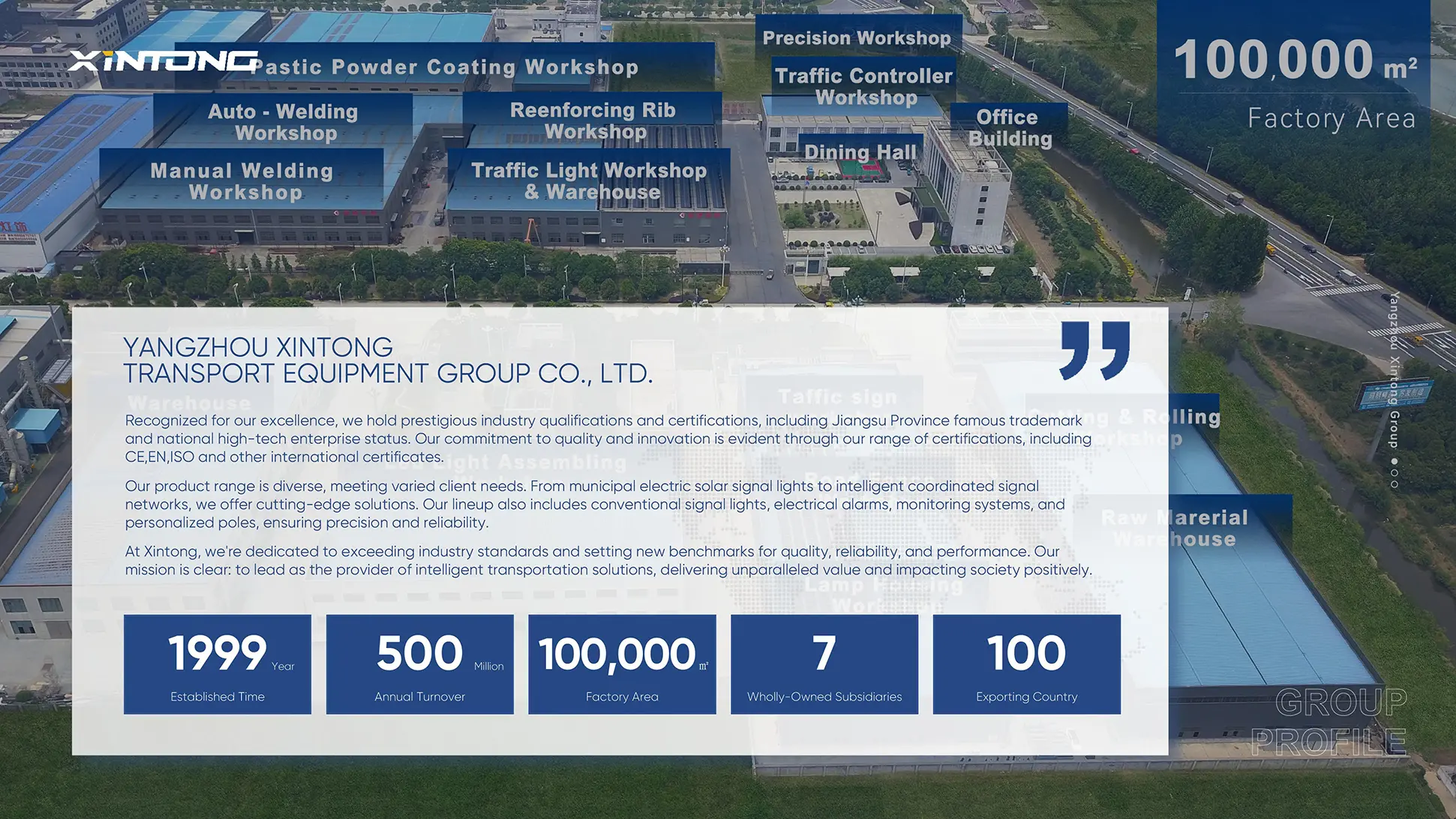
100,000 m² Integrated Manufacturing Infrastructure
Yangzhou Xintong Traffic Equipment Group Co., Ltd. has stood at the forefront of municipal steel fabrication and traffic safety infrastructure since 1999. Unlike assemblers who outsource critical components, we operate 7 specialized production workshops under one single administrative roof in Gaoyou, Jiangsu, China.
By controlling the total fabrication cycle from bare steel coil leveling to robotic welding, automated submerged-arc forming, full-immersion hot-dip galvanizing, and SMT optical pick-and-place, we eliminate third-party markup and maintain unbroken quality assurance traceable to ISO 9001 protocols.
| Stage | Production Process | Machinery & Quality Parameters |
|---|---|---|
| 01. Laser & Shearing | CNC high-precision plate cutting | 16-meter CNC tandem bending presses, fiber laser cutting (±0.5mm tolerance) |
| 02. Longitudinal Forming | Conical, octagonal, polygonal pole folding | Single-seam automated submerged arc welding (AWS D1.1 structural welding code) |
| 03. Hot-Dip Galvanization | Total internal/external zinc bath immersion | 450°C molten zinc bath conforming to ISO 1461 & ASTM A123 (≥86μm minimum) |
| 04. Electrostatic Coating | Thermosetting polyester powder baking | Automated multi-axis spray booth with 200°C curing ovens (RAL color match) |
| 05. Luminaire Assembly | SMT pick-and-place, potting & testing | Class-100,000 clean assembly lines, nitrogen reflow ovens, IP68 testing stations |
Certified Non-Destructive Quality Inspections
Every production batch undergoes strict quality control gates witnessed in-house or by third-party inspectors (SGS, Bureau Veritas, TÜV Rheinland, Intertek):
- Ultrasonic Weld Flaw Detection (UT) & Magnetic Particle Inspection (MPI).
- Magnetic eddy-current zinc coating thickness profiling.
- IESNA LM-79 integrating sphere photometrics and goniophotometer testing.
- Constant-temperature salt spray corrosion chamber testing (ASTM B117 >1,000 hrs).
Full-Spectrum Engineering Support: From Tender File to Job Site
We bridge the gap between architectural concept, municipal tender compliance, and field installation with dedicated structural and photometric engineering packages.
Photometric DIALux evo Simulations
Our senior lighting designers model roadway layouts, pedestrian footpaths, intersections, and port yards in DIALux evo to ensure exact compliance with international standards.
- Verification of average road luminance ($L_{avg}$ in $cd/m^2$) and overall illuminance ($E_{av}$ in lux).
- Calculation of overall uniformity ($U_0$) and longitudinal uniformity ($U_l$).
- Threshold increment ($TI\%$) control to eliminate hazardous driver glare.
Structural Wind-Load & FEA Calculations
Every customized column height (3m to 45m), bracket outreach, and photovoltaic sail area is engineered against cyclic aerodynamic drag and resonance phenomena.
- Governing standards: AASHTO LTS-6, Eurocode 3 (EN 1993), and BS EN 40-3-1/3.
- Verification of base flange thickness, stiffener gusset sizing, and weld stresses.
- Anchor bolt foundation depth, cage diameter, and civil concrete grade specifications.
PVSyst Solar Sizing & Autonomy Modeling
Eliminate under-designed solar street light configurations with rigorous thermodynamic energy generation and load consumption balance charts.
- Incorporation of NASA and Meteonorm meteorological solar radiation data.
- Accounting for temperature coefficients, soiling degradation, and wiring resistance losses.
- Guaranteed 3 to 7 consecutive overcast/monsoon autonomy days with zero lamp extinction.

International Standards & Comprehensive Export Certification
When entering government tenders funded by federal ministries or international agencies, compliance paperwork is as critical as mechanical performance. Xintong provides turnkey engineering dossiers ensuring zero friction during submittal reviews:
- Structural Steel Standards: EN 40-5, ASTM A36, ASTM A572 Grade 50, GB/T 700 Q235B, GB/T 1591 Q355B with mill certificates conforming to EN 10204 3.1.
- Corrosion Protection: ISO 1461, ASTM A123/A123M for hot-dip zinc coatings, ASTM D3359 cross-hatch adhesion for powder coating layers.
- Photovoltaic & Electrical Safety: IEC 61215, IEC 61730 (PV modules), IEC 62133, UN38.3, MSDS (Lithium battery safety), IEC 60598-1, IEC 60598-2-3 (Luminaires), CE, RoHS, CB certified.
- Export Documentation Readiness: Legalized Certificate of Origin (CO, Form E, Form A, EUR.1), SASO SABER registration, SONCAP, and customs-bonded commercial invoices.
Technology Roadmap: Next-Generation Solar Infrastructure
Investing in public infrastructure requires decade-long forward compatibility. Our R&D team is actively commercializing advanced clean-energy and smart grid integrations.
1. N-Type TOPCon & Perovskite Integration
Transitioning from P-type PERC to N-type TOPCon monocrystalline cells delivering >24.5% module efficiency. Lower temperature coefficients (-0.30%/°C) maintain superior electricity yields in extreme hot desert environments where legacy panels lose efficiency.
2. Sodium-Ion (Na-Ion) Thermal Battery Chemistries
Pioneering sodium-ion commercialization for projects in high-latitude Central Asia and Siberia. Na-ion batteries retain over 85% usable capacity at -35°C without energy-draining heating jackets, offering lower bill-of-materials and superior fire safety compared to ternary lithium.
3. AI-Driven Adaptive MPPT Controllers
Developing self-learning MPPT charge controllers equipped with neural network firmware. Controllers evaluate real-time weather forecasts via cloud mesh feeds, preemptively adjusting lumen output curves and battery depth-of-discharge (DoD) ahead of approaching storm fronts.
4. 5G Micro-Site Smart Infrastructure
Transforming street lighting columns into revenue-generating smart city assets. Structural columns feature internal conduit routing, modular RF-transparent radomes, and uninterruptible DC bus power supplies engineered to host 5G small cells, EV chargers, and edge AI cameras.
Explore Complete Structural & Photovoltaic Series for Global Deployment
From split-system highway lights to multi-function smart city octagonal columns, each unit is manufactured to order with project-specific wind calculations and foundation bolt sets.

XT-DT-1 Series Split-Type Solar Street Light
Engineered for highways and main arterials requiring high-wattage LED fixtures, custom tilt-angle solar brackets, and high-capacity battery autonomy.

Multifunctional Smart City Engineering Poles
Octagonal, conical, and square integrated structural columns engineered to house IoT base stations, CCTV security cameras, and environmental monitoring equipment.
PUBLIC TRANSIT Series Municipal High Mast Poles
Heavy-duty structural polygonal high masts designed for bus rapid transit (BRT) terminals, highway cloverleaf interchanges, and multimodal transit hubs.
Full-Series Conical & Octagonal Municipal Poles
Comprehensive portfolio of hot-dip galvanized conical and octagonal steel columns customizable from 4m to 14m for urban roadways and housing developments.
XT-YTH-9 Integrated Solar Street Luminaire
Featuring integrated aluminum die-cast construction, high-efficiency monocrystalline solar panels, and intelligent human-presence motion sensors.
XINTONG Extreme Condition Heavy-Load Steel Poles
Engineered for extreme dead-load and wind-load stress combinations including solar array attachments, decorative banners, and wind turbines.
URBAN-GRID Low Voltage Utility Steel Columns
Heavy-gauge Q355 structural steel utility poles with pre-punched cross-arms and stay-wire connections supporting low-voltage electrification networks.
AIRPORT-PORT Maritime Area High Mast Lighting
Polygonal hot-dip galvanized towers featuring double-drum winch lifting gears, lightning protection rods, and aviation obstruction warning beacons.
Frequently Asked Questions by Global EPCs & Tender Boards
Definitive engineering and commercial answers to resolve specification doubts, compliance inquiries, and manufacturing lead times.
Xintong is a verified manufacturer founded in 1999. We own and operate a 100,000 m² physical production base in Gaoyou City, Jiangsu Province, China. Our facilities feature 7 comprehensive industrial production workshops executing CNC shearing, tandem 16m plate bending, automatic longitudinal submerged-arc welding, complete hot-dip galvanizing baths, automated powder coating lines, and ISO Class-100,000 LED SMT cleanrooms. Procurement teams are invited to conduct on-site factory audits or schedule unannounced live video verification audits at any time.
Unlike standard street poles, a solar lighting column supports a substantial top-mounted surface area (the photovoltaic panel array), which acts as a dynamic aerodynamic sail. Our structural engineering department performs finite element wind load calculations according to AASHTO LTS-6 (Standard Specifications for Structural Supports for Highway Signs, Luminaires, and Traffic Signals) and EN 40-3-1/3. We calculate dynamic pressure ($q_z$), shape drag coefficients ($C_d$), gust response factors ($G$), and total overturning bending moments on the base plate. Steel shaft thickness (typically 3.0mm to 8.0mm in Q235B or Q355B steel), pole taper, base flange thickness, gusset stiffeners, and anchor bolt tensile yield strength are customized to withstand project-specific wind speeds up to 60 m/s (216 km/h).
The choice depends strictly on required photometric lighting classes and geographic latitude. All-in-One (Integrated) systems house the solar panel, battery, and luminaire in a unified compact chassis; they provide rapid, low-labor installation and lower wind drag, making them ideal for residential roads, campuses, parking areas, and tropical zones with abundant vertical zenith sunlight. However, their solar panel dimensions are constrained by the fixture body size. Split-Type solar street lights decouple the PV module, allowing oversized 250W to 550W panels to be tilted at the exact optimal azimuth and inclination angle for high-latitude regions. Split systems accommodate larger deep-cycle LiFePO4 battery banks and high-lumen luminaires (up to 180W LED, 36,000 lumens), making them the mandatory choice for multi-lane expressways, national highways, and low-sunlight winter zones.
Every structural steel pole is fully immersed in an acid bath for pickling and fluxing to completely remove surface scale, followed by complete immersion in a molten zinc bath held at 450°C (842°F) in accordance with ISO 1461, ASTM A123, or BS 729 standards. This forms a series of metallurgically bonded zinc-iron alloy layers covered by pure zinc, with a minimum average thickness of 86μm (up to 120μm upon tender request). For coastal or marine C5-M environments, we apply a duplex anti-corrosion system: the galvanized steel is sweep-blasted, primed with epoxy, and electrostatically coated with 100μm of architectural thermosetting polyester or fluorocarbon powder. This dual barrier delivers sacrificial cathodic galvanic protection combined with an impermeable barrier, delivering a maintenance-free service life exceeding 25 years.
To deliver an authoritative proposal, our engineering office requires: 1) Project Location: GPS coordinates or city name to extract historical solar irradiance ($kWh/m^2/day$) and local design wind speeds ($m/s$). 2) Roadway Profile: Road width, number of lanes, presence of a central median, pole spacing, and target lighting class (e.g., CIE M3, M4, or target lux level). 3) Operating Profile: Required working hours per night (e.g., 12 hours continuous or timed dimming profiles such as 4h 100% + 4h 50% + 4h 30%) and target autonomy days (typically 3 to 5 continuous overcast days). 4) Structural Preferences: Desired mounting height (6m, 8m, 10m, 12m), pole shape (conical, octagonal, tubular), single or dual outreaches, and finishing color (RAL code). 5) Total Quantities & Destination Port: To calculate optimized container load plans and Incoterm freight rates (FOB, CIF, CFR, DDP).