
Standardized & High-Tolerance Lighting Hardware
Explore municipal, high-mast, decorative, and distributed off-grid systems engineered strictly to AASHTO, ASTM, and EN technical requirements.

Best Series Decorative Street Light Pole
Configure Pole
OEM Multifunctional Smart City Poles
Configure Pole
Airport-Port Series High Mast Light
Configure Pole
Municipal Street Light Pole Series
Configure Pole
XT-YTH-9 All-In-One Solar System
Configure Pole
Urban Grid Steel Power Poles
Configure Pole
XT-DT-1 Split-Type Solar Pole
Configure Pole
XT-YTH-3 All-In-One Solar Pole
Configure PoleThe Global Commercial & Industrial State of Light Pole Contracting
Navigating regional technical mandates, supply-chain resilience, and engineering compliance in international infrastructure procurement.
The global infrastructure sector has transitioned from viewing exterior lighting poles as simple passive structural steel accessories to recognizing them as safety-critical, smart, and aerodynamic vertical engineering assets. Today, Engineering, Procurement, and Construction (EPC) contractors and municipal authorities operate under stringent regulatory mandates. In North America, the AASHTO (American Association of State Highway and Transportation Officials) LRFD Specifications for Structural Supports for Highway Signs, Luminaires, and Traffic Signals demand exact fatigue limit calculations and dynamic vortex-shedding resilience. Across the European Union, EN 40 standards govern structural design, material certification, and wind pressure resistances, alongside EN 12767 standards prioritizing passive safety and impact dissipation for vehicular occupants.
Simultaneously, regional climatic demands dictate specialized engineering choices. In the coastal and desert environments of the Gulf Cooperation Council (GCC), civil engineers face blistering heat, shifting fine-particulate sand abrasion, and ultra-corrosive marine salt atmospheres requiring ISO 12944 C5-M high-durability hot-dip galvanization coupled with thermosetting polyurethane barriers. Conversely, transit corridors in Central Asia and Nordic regions face sub-zero embrittlement where steel formulations must exhibit high Charpy V-notch impact toughness at -40°C.
Tier-1 Material Sourcing
Direct mill relationships ensure fully traceable Q235B and high-yield Q355B structural steel, conforming exactly to ASTM A36, ASTM A572 Grade 50, and EN 10025 S355JR requirements with certified 3.1 chemical and mechanical inspection documentation.
- No scrap-recycled inclusions
- Controlled silicon (Si < 0.04% or 0.15%–0.25%) for optimal zinc bonding
- High yield strength $f_y \ge 355\text{ MPa}$ for heavy-wind cross-sections
Corrosion Barrier Superiority
Standardized automated hot-dip galvanizing exceeds ASTM A123 and ISO 1461 mandates. Total molten bath submersion at 450°C creates metallurgical iron-zinc alloy layers providing internal and external electrochemical sacrificial protection.
- Typical coating thickness: 86–120 μm (610–850 g/m²)
- 3,000+ hour ASTM B117 salt spray verified dual-layer powder coating
- Zero pinhole guarantee on internal polygonal surfaces
Tender-Ready Engineering Files
We eliminate technical rejections in competitive municipal and EPC tenders by issuing complete design packages including DIALux photometric calculations, wind moment schematics, and anchor bolt base-plate finite element analysis (FEA).
- Detailed AutoCAD & SolidWorks 3D dimensional files
- Certified foundation reaction moments and uplift loads
- Direct engineering stamp sign-off compatibility
100,000 m² Direct Manufacturing Ecosystem
Eliminating intermediaries through vertically integrated steel fabrication, automated submerged arc welding, and automated surface treatment under one roof in Gaoyou, Jiangsu.
CNC Laser & Plasma Tapering
High-precision multi-axis fiber lasers ensure micron-accurate edge beveling and CNC press brakes form seamless conical, octagonal, or polygonal profiles up to 16 meters in a single pass.
Automatic Submerged Arc Welding
Longitudinal seams utilize automated Submerged Arc Welding (SAW) per AWS D1.1, ensuring 100% penetration, zero slag porosity, and optimal fatigue performance under fluctuating dynamic loads.
Full Dip HDG Galvanizing Bath
In-house 14-meter galvanizing kettles provide uniform flux pre-treatment and thermal molten immersion, generating permanent Fe-Zn intermetallic metallurgical alloy fusion layers.
Multi-Stage Destructive & NDT QC
Every shipment undergoes Ultrasonic Testing (UT), Magnetic Particle Inspection (MPI), galvanizing magnetic thickness verification, and tension-pull load verification with traceable calibration files.
Technical Benchmark & Specification Matrix
Standard mechanical characteristics across core structural categories. Tailored wall thicknesses, flanged anchor systems, and customized luminaire arms are manufactured to order.
| Pole Category | Typical Height | Material Grade | Section Geometry | Design Wind Velocity | Coating Specification |
|---|---|---|---|---|---|
| Municipal Arterial Pole | 6m – 12m | Q235B / Q355B (S355JR) | Conical / Octagonal Tapered | Up to 160 km/h (44.4 m/s) | HDG ISO 1461 + Polyester Powder |
| Expressway Double-Arm Pole | 10m – 14m | Q355B (ASTM A572 Gr 50) | Octagonal / Dodecagonal | Up to 180 km/h (50.0 m/s) | HDG min 86 μm + UV Polyurethane |
| High Mast Lighting Tower | 15m – 45m | Q355B / High Tensile Steel | 12 to 20-Sided Polygonal Slip-Joint | Up to 210 km/h (58.3 m/s) | Internal & External HDG >100 μm |
| Multifunctional Smart City Pole | 6m – 10m | Q235B / Q355B Extruded Section | Square / Octagonal Flanged Bay | Up to 150 km/h (41.6 m/s) | Duplex Powder Coating (RAL Specified) |
| Autonomous Solar Lighting Pole | 4m – 10m | Q235B Cold-Formed Tube | Round Conical / Stepped Tubular | Calculated per PV Sail Area | Corrosion Class C4/C5-M HDG Protection |
| Low Voltage Utility Distribution Pole | 9m – 15m | Q355B / High Yield Structural | Polygonal High-Taper Column | AASHTO Conductor Load Safety 2.5x | HDG Heavy Zinc >610 g/m² Bath |
Aerodynamic Fatigue Mitigation
Longitudinal polygonal geometry minimizes cross-wind vortex resonance. We design anchor base rings with internal gussets and finite element damping dampeners to prevent second-mode oscillation failure.
Foundation & Anchor Integrity
Supplied anchor bolt sets utilize high-tensile ASTM F1554 Grade 55 or Grade 105 threaded J-bolts, matched with dual leveling nuts, heavy lock washers, and complete template positioning frames.
Motorized Raising & Lowering Gear
For high mast towers above 20 meters, our internal raising and lowering mechanisms feature stainless steel multi-strand aircraft wire rope, dual fail-safe latching barrels, and IP66 drive units.
Macro Industry Turnkey Solutions
From single civil tenders to regional grid-scale rollouts, we engineer structural vertical assets that unify power, data telemetry, and illumination.
Smart Urban Small-Cell Infrastructure
Modern municipalities face crowded sidewalks and fragmented utility attachments. Our smart multi-functional poles incorporate modular raceways for 5G micro-base stations, edge-computing nodes, pan-tilt-zoom security optics, environmental air-quality sensors, and pedestrian push-to-talk emergency stations.
- Hidden internal cabling conduits with lockable IP65 service doors
- Structural capacity verified for combined EPA (Effective Projected Area)
- Optional level-2 EV charging integration in base sections
Logistics, Port Terminals & Aprons
Continuous marine freight handling and airport tarmac aprons require uniform high-lux horizontal illuminance without creating blinding glare for gantry operators or pilots. Our 20m to 40m polygonal high mast assemblies feature asymmetric floodlight head-frames configured via DIALux ray-tracing.
- High-salinity marine grade C5-M coatings with 316 stainless fasteners
- Ground-level winch maintenance systems for enhanced worker safety
- Precision lighting arrays matching ICAO and FAA elevation limits
Autonomous Off-Grid Rural Electrification
For rural highways, remote transit links, and islands where electrical grid extension is cost-prohibitive, our split and integrated solar systems eliminate miles of trenching, sub-stations, and high cabling investments. Engineered with deep-cycle LiFePO4 batteries and smart MPPT solar controllers.
- Autonomy ratings designed for 3 to 7 continuous rainy/overcast days
- Optimized solar panel tilt brackets engineered for regional sun-angles
- Integrated smart dimming profiles extending nocturnal operating duration
Global Project Deployments & Case Studies
Demonstrating civil reliability across maritime terminals, desert surveillance corridors, and high-altitude transport corridors.
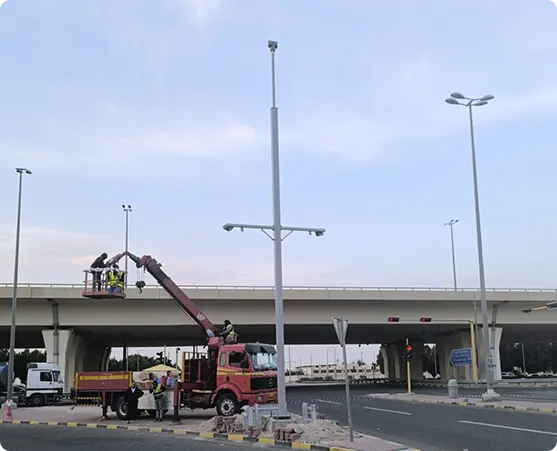
Cebu Baseport Terminal 2 & 4 High Mast Lighting
Supplied heavy-duty polygonal high mast systems engineered to withstand Category 5 typhoon gusts (over 200 km/h) in a harsh marine salt spray atmosphere. Equipped with specialized motorized lowering gear for streamlined maintenance during continuous port operations.
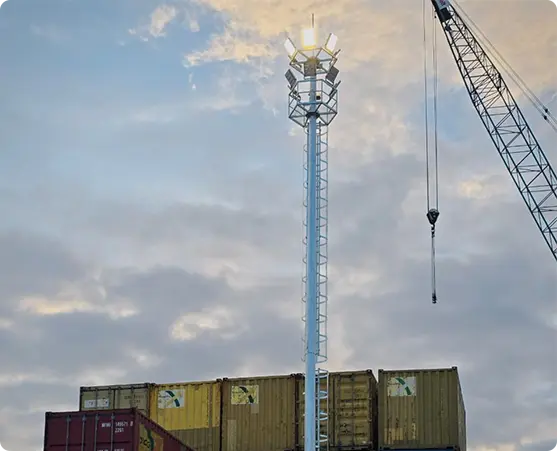
Surveillance CCTV & Perimeter Monitoring Poles
Engineered rigid, low-deflection octagonal camera poles to support high-magnification optical monitoring in extreme desert heat exceeding +50°C. Finished with duplex anti-sand-abrasion coatings to eliminate surface pitting and premature corrosion.
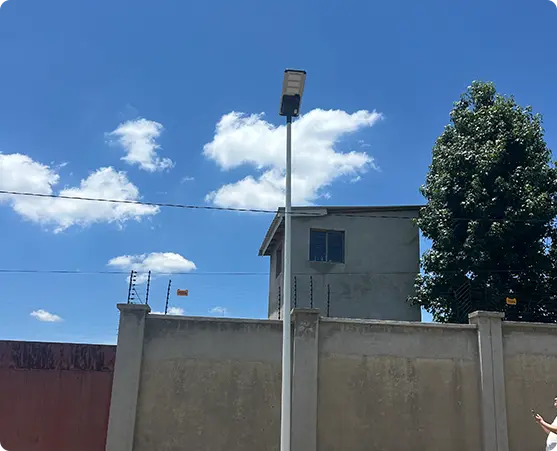
7m / 60W Integrated Off-Grid Solar Corridor
Delivered continuous, grid-independent illumination across municipal access corridors impacted by regional grid instability and load shedding. High-efficiency monocrystalline solar panels with LiFePO4 battery storage deliver reliable 365-night coverage.
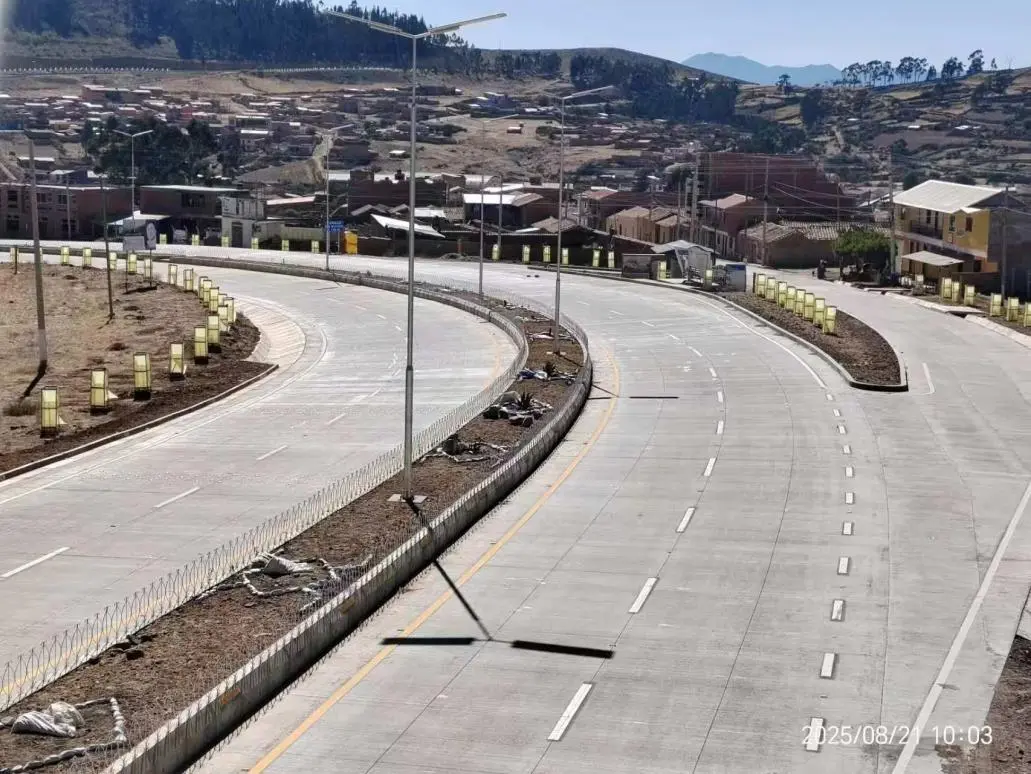
Chancay Port Multi-Lane Municipal Lighting
Custom-engineered tapered conical steel light poles equipped for heavy coastal humidity and dynamic vehicle wind buffeting along the critical arterial highway connecting the Chancay deep-water container hub.
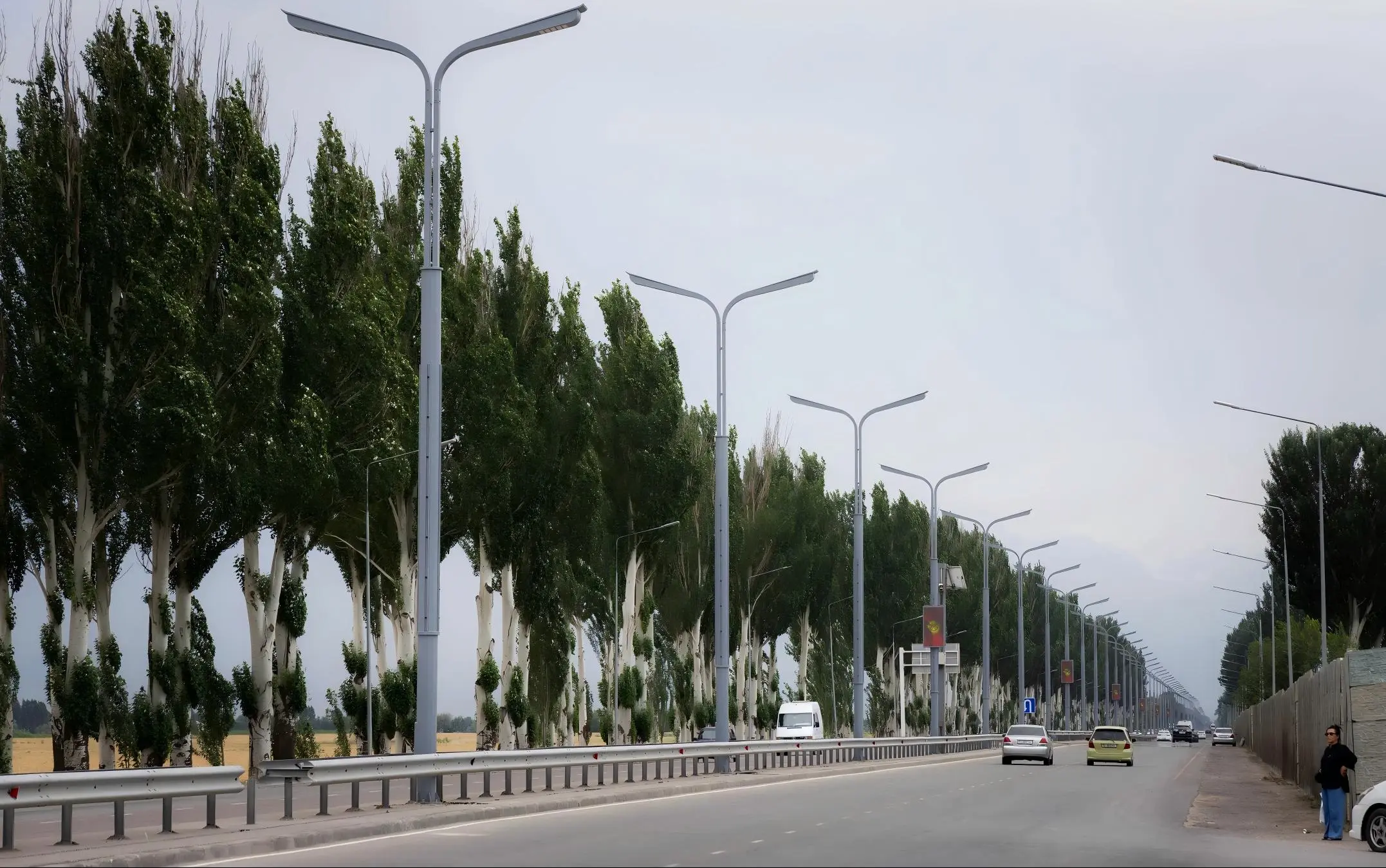
Manas International Airport Express Route
Manufactured double-arm hot-dip galvanized conical lighting poles engineered for extreme Central Asian freeze-thaw cycles (-35°C to +40°C), incorporating AASHTO-standard impact-absorbing shear breakaway bases.
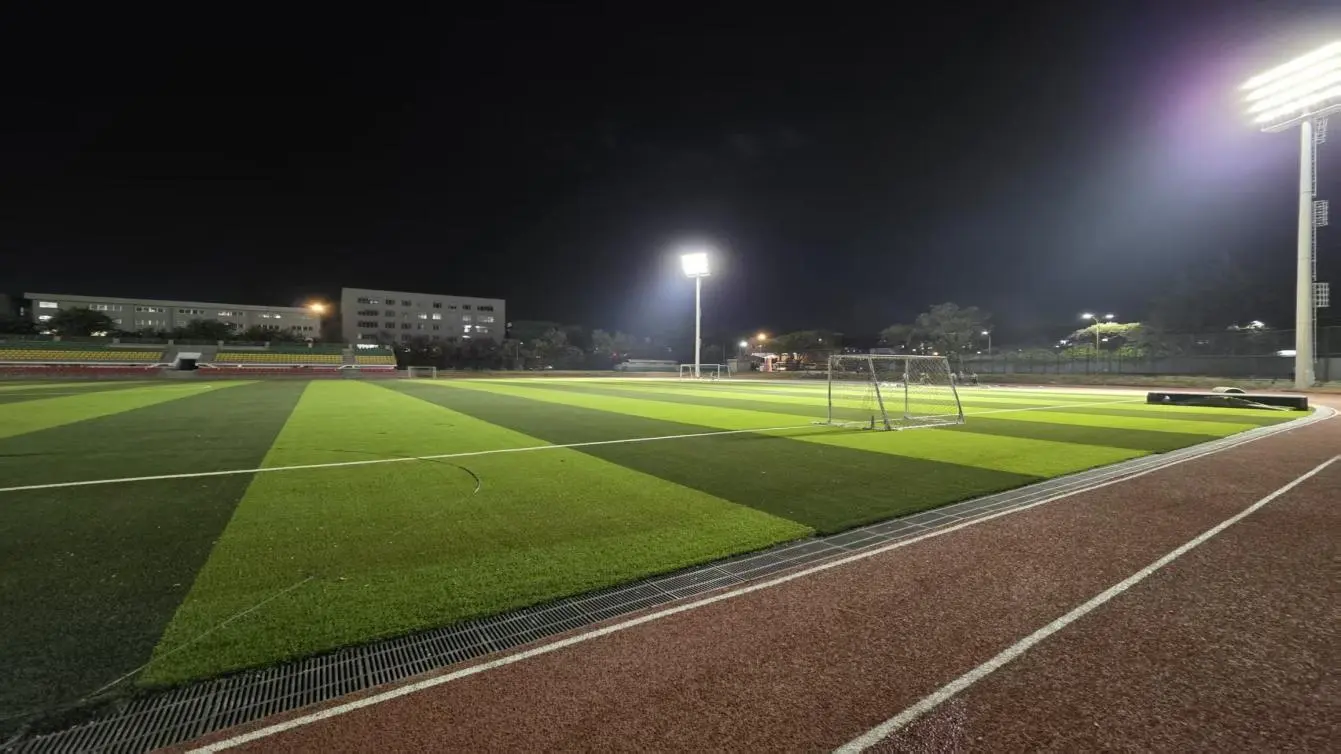
Polygonal Stadium & Athletics Track Lighting
Fabricated multi-tiered high mast towers with custom floodlight brackets precisely aimed according to DIALux simulations to satisfy international broadcast standards for lux uniformity without shadow banding.
Technology Roadmap & Future Outlook (2025–2035)
Anticipating structural engineering shifts toward circular economy steels, integrated structural health monitoring (SHM), and autonomous grid synchronization.
Low-Carbon Recycled Metallurgy
By integrating electric arc furnace (EAF) steel sourcing utilizing up to 85% scrap steel powered by renewable energy, we are driving down the embodied carbon dioxide footprint of structural steel poles to comply with upcoming EU Carbon Border Adjustment Mechanism (CBAM) benchmarks without compromising structural yield limits.
Structural Health Telemetry (IoT SHM)
Next-generation high masts will incorporate embedded tri-axial MEMS accelerometers and fiber-optic strain gauges. By transmitting real-time oscillation frequency and deflection stress data to a central cloud twin, civil maintenance operators can conduct predictive maintenance long before micro-fractures occur.
Self-Healing Nanocomposite Coatings
Advancing past traditional zinc galvanizing, our engineering roadmap explores graphene-infused topcoats and micro-encapsulated corrosion inhibitors that autonomously heal surface scratches caused by debris during violent coastal storms, extending life expectancy beyond 40 years without repainting.
Frequently Asked Questions by EPC Contractors & Specifiers
Direct, highly technical answers regarding structural codes, manufacturing standards, testing protocols, and project workflows.
Yangzhou Xintong Traffic Equipment Group is a verified direct manufacturer founded in 1999. We own and operate a 100,000 m² heavy manufacturing facility in Gaoyou, Jiangsu, China. Every phase—from raw sheet laser cutting, CNC bending, and automatic seam welding to full-immersion hot-dip galvanizing, electrostatic powder coating, and LED fixture assembly—is conducted in-house across our 7 dedicated production lines. EPC buyers and third-party inspectors (e.g., SGS, Bureau Veritas) are welcomed for on-site or live video facility audits.
We fabricate primarily from high-grade structural steels Q235B and Q355B, which cross-reference directly to international grades: ASTM A36, ASTM A572 Grade 50, and European EN 10025 S235JR and S355JR. With every export shipment, we supply certified EN 10204 Type 3.1 Material Test Reports (MTRs) documenting accurate carbon equivalents, tensile strength, yield points, and elongation percentages traceable back to the raw casting heat number.
Our structural design calculations follow the AASHTO Standard Specifications for Structural Supports for Highway Signs, Luminaires, and Traffic Signals and EN 40-3-1/3-3. Our engineers simulate total Effective Projected Area (EPA), dynamic vortex shedding, and gust factors up to wind speeds of 210 km/h (58.3 m/s). Finite element analysis verifies that the base-plate thickness, anchor bolt diameter, and circumferential weld joints remain well below structural yield limits under full mechanical deflection.
Poles are completely degreased, acid-pickled, fluxed, and fully submerged in a molten zinc bath maintained at 440°C–460°C per ASTM A123 and ISO 1461. This forms metallurgical intermetallic zinc-iron alloy layers providing both external and internal protection. Minimum coating thickness exceeds 86 μm (610 g/m²), and can be customized over 120 μm for aggressive marine environments (ISO 12944 C5-M). For architectural color matching, we apply electrostatic TGIC polyester powder coatings cured at 200°C for exceptional UV and salt-spray durability.
Yes. Our in-house engineering team provides end-to-end lighting calculations. When supplied with your road cross-section, lane count, pavement classification (e.g., CIE R1–R4), and target lux or luminance class (M1 to M6, P1 to P6), we build full 3D DIALux evo simulations. The generated report includes isolux contours, overall uniformity ($U_0$), longitudinal uniformity ($U_l$), and glare limitation ratings ($TI$), ensuring approval by municipal road authorities.
To produce an exact bid-ready submittal and quotation, please share: 1) Mounting height and arm outreach length; 2) Design wind speed or regional project location; 3) Number and weight of luminaires, fixtures, or auxiliary equipment (EPA calculation); 4) Pole shape preference (octagonal, round conical, square); 5) Power supply scheme (grid AC vs standalone solar PV autonomy days); and 6) Target delivery seaport and required Incoterms (FOB, CIF, DDP).
High-Performance Masts, Distribution & Municipal Poles
Review our heavy-load, sports illumination, smart municipal, and airport high-mast engineering models.
Stadium Series High Mast Light
Configure Pole
Heavy-Load High Strength Steel Pole
Configure Pole
Conical & Octagonal Municipal Poles
Configure Pole
Public Transit Series High Mast Poles
Configure Pole
Best Series Decorative Street Light
Configure Pole
Smart City Integrated Light Poles
Configure Pole
Harbor & Airport High Mast Tower
Configure Pole