
Engineered High Mast, Street Lighting & Utility Pole Series
Precision hot-dip galvanized structural assets deployed across 80+ countries. Manufactured in compliance with AASHTO LTS, EN 40, and ASTM A123 international standards.








The Engineering Calculus Behind Custom High Mast Heights
In large-area civil illumination, specifying the structural height of a high mast lighting tower is not an aesthetic compromise—it is a critical calculation dictated by the Inverse-Square Law (E = I × cosθ / d²), regional gust velocities, structural aerodynamic resonance, and the cutoff angles required to eliminate debilitating glare (Unified Glare Rating ≤ 22).
Yangzhou Xintong Traffic Equipment Group Co., Ltd., established in 1999, has engineered custom mast elevations from 15 meters to 50+ meters. Operating from a monolithic 100,000 m² facility in Gaoyou, Jiangsu, China, our civil and structural engineers bridge the divide between luminaire optical dispersion and structural shaft stability. A mismatch in height-to-load ratio creates either catastrophic vortex shedding fatigue or localized photometric blackout zones.
Effective Projected Area (EPA) Matching
Calculated head-frame wind resistance mapped against shaft taper gradients (1:50 to 1:80) to control maximum cantilever deflection under full gust loading.
Certified Q235B & Q355B Metallurgical Substrates
Silicon content restricted to < 0.04% or between 0.15%–0.25% (Sandelin curve control) to guarantee ductile, non-brittle zinc coating thickness exceeding 86–120 μm.
Aerodynamic Damping & Second-Order P-Delta Control
Polygonal profiles (12-sided, 16-sided, 20-sided) specifically dimensioned to break down von Kármán vortex streets and prevent transverse oscillation.
Standard & Custom Height Topologies Across Global Environments
Every project site dictates a unique interaction between target illuminance (lux), structural footprint constraints, and mounting elevation. We fabricate multi-section continuous conical or multi-faceted polygonal high masts matched to distinct functional applications.
15m – 18m Intermediate Masts
Primary Use: Multi-lane expressway toll plazas, municipal highway roundabouts, intermodal logistics staging yards, and freight rail spurs.
Structural Configuration: Single or two-section telescoping slip joint (Q235B/Q355B steel), 12-sided dodecagonal profile. Engineered to support up to 6×400W LED flood luminaires. Ideal for sites where civil budgets mandate maximum optical spread without introducing massive deep-piled anchor bolt assemblies.
20m – 25m Standard Heavy Masts
Primary Use: Major highway interchanges, classification rail yards, inland dry ports, municipal bus terminals, and mid-tier sports arenas.
Structural Configuration: Two-section slip joint assembly with minimum 1.5× overlap ratio. 16-sided hexadecagonal geometry significantly lowers transverse wind vortex vibration. Accommodates either an integrated internal motorized raising and lowering gear system or an accessible service ring platform.
30m – 35m Maritime & Logistics Towers
Primary Use: Deepwater container handling berths, multi-modal container yards, airport remote passenger aprons, and multi-tier interchanges.
Structural Configuration: Three-section polygonal design fabricated from heavy-gauge Q355B/Q355D structural plate. Base shaft diameters range between 650mm–750mm with flange plates reaching 28mm–35mm thickness to withstand bending moments exceeding 600 kN·m under extreme wind events.
40m – 50m+ Super High-Mast Structures
Primary Use: International transshipment ports, open-cast mineral mining operations, major international sports venues, and petrochemical terminals.
Structural Configuration: Three to four-section telescoping towers with hydraulic jacked slip joints or heavy flanged transitions. Equipped with dual-cable winch lifting mechanisms, redundant gravitational mechanical latches, lightning dissipation air terminals, and FAA/ICAO certified solar obstruction arrays.
Standard Engineering Design Matrix by Tower Elevation
Reference structural parameters for high mast poles engineered to AASHTO LTS-6 (Standard Specifications for Structural Supports for Highway Signs, Luminaires, and Traffic Signals) at basic wind speeds of 160 km/h (44.4 m/s) with 3-second gust factors.
| Nominal Height | Shaft Sections | Base / Top Diameter | Wall Thickness | Anchor Bolt Pattern | Lifting Mechanism | Standard Application |
|---|---|---|---|---|---|---|
| 15 Meters (50 ft) | 1 or 2 Sections | Ø 360mm / Ø 180mm | 5.0mm – 6.0mm | 6 × M24 (Gr. 8.8) | Fixed / Portable Winch | Toll Plazas & Urban Roundabouts |
| 20 Meters (65 ft) | 2 Sections | Ø 460mm / Ø 200mm | 6.0mm – 8.0mm | 8 × M30 (Gr. 8.8) | Internal Dual Winch | Freight Terminals & Rail Depots |
| 25 Meters (82 ft) | 2 Sections | Ø 540mm / Ø 220mm | 6.0mm – 8.0mm | 8 × M30 (Gr. 8.8) | Internal Dual Winch | Highway Cloverleaf Interchanges |
| 30 Meters (100 ft) | 3 Sections | Ø 650mm / Ø 260mm | 8.0mm – 10.0mm | 12 × M36 (Gr. 8.8) | Motorized Lowering / Ring | Container Terminals & Seaports |
| 35 Meters (115 ft) | 3 Sections | Ø 720mm / Ø 280mm | 8.0mm – 12.0mm | 12 × M36 (Gr. 8.8) | Motorized Lowering Gear | International Airport Cargo Aprons |
| 40+ Meters (130+ ft) | 3 to 4 Sections | Ø 820mm+ / Ø 300mm | 10.0mm – 14.0mm | 16 × M42 (Gr. 8.8) | Heavy Lowering / Ladder Cage | Major Sports Stadia & Open Pit Mines |
AASHTO Aerodynamic Modeling & Fail-Safe Winch Mechanics
Structural failure in tall slender masts originates from wind-induced harmonic resonance and cyclic stress concentrations. Xintong incorporates advanced finite element dynamic wind modeling alongside precision mechanical lowering subsystems.
Polygonal Aerodynamic Drag Suppression
Unlike circular shafts that experience severe vortex shedding across subcritical Reynolds numbers, our 12-sided and 16-sided polygonal profiles force boundary layer transition, converting laminar airflow into turbulent micro-vortices. This lowers the drag coefficient (Cd from 1.2 down to 0.75–0.85), dramatically suppressing vortex-induced cross-wind vibration and cyclic metal fatigue along longitudinal weld lines.
Dual-Drum Worm-Gear Raising/Lowering System
High mast maintenance must not depend on costly cherry pickers. Our self-locking, internal motorized winches utilize dual-drum planetary gear reductions with a minimum safety factor of 5:1. Twin independent stainless steel aircraft cables (AISI 316, 7×19 construction) hoist the luminaire carriage ring smoothly up the mast shaft, automatically engaging gravity-driven locking pawls at the head-frame.
Electrical Decoupling & Latching Mechanism
At maximum elevation, mechanical latching dogs relieve all static tension from the steel hoist cables, transferring the carriage dead weight directly onto the fixed structural head-frame. Heavy-duty multipin electrical connectors decouple during lowering and re-engage within hermetically sealed docking sockets upon raising, guaranteeing complete operator safety at ground level.
Gaoyou Supply Chain Resilience & Full-Stack Scale Economics
Gaoyou, in Jiangsu Province, stands as the global epicentre of outdoor steel infrastructure fabrication. Yangzhou Xintong leverages this dense industrial cluster to provide international EPC contractors with unprecedented procurement speed, structural raw-material traceability, and unrivaled cost-to-performance metrics.
By integrating laser plate profiling, tandem 1,200-tonne CNC press brake bending (handling up to 16-meter single sections), automated submerged arc longitudinal welding (SAW), and in-house hot-dip galvanization tanks under a single corporate umbrella, we eliminate supply chain bottlenecks and third-party markup.
Telescopic Nested Slip-Joint Packaging
Pole sections are engineered with calculated diameter taper gradients that allow multi-section shafts to nest inside one another during international ocean transit, lowering standard 40ft HQ container shipping volume by up to 45%.
Certified Mill Traceability & Testing
Every steel coil and plate shipment is accompanied by EN 10204 Type 3.1 inspection certificates. In-house ultrasonic testing (UT) and magnetic particle testing (MT) guarantee crack-free welds across high-stress circumferential base joints.
Continuous Hot-Dip Galvanizing Kettles
Our captive galvanizing facility processes full 14-meter pole segments in a single dip, adhering strictly to ASTM A123 / ISO 1461 standards to provide uninterrupted metallurgical zinc bonding for 30+ year service lives.
International Infrastructure Track Record Across 80+ Countries
From extreme desert heat and coastal typhoons to sub-zero continental freezes, Xintong high mast structures and solar utility poles deliver uncompromised photometric performance and civil safety.
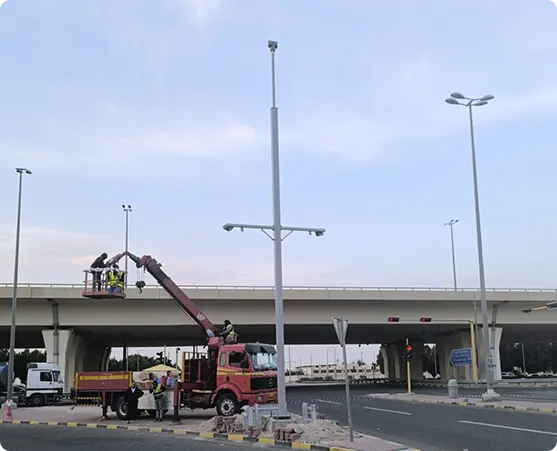
Cebu Baseport Terminals 2 & 4 High Mast Lighting
Engineered multi-tier 30m polygonal high mast assemblies designed to survive Category 5 typhoon gusts exceeding 240 km/h. Fitted with corrosion-proof marine grade C5-M coatings and high-lux asymmetrical maritime floodlights for round-the-clock container yard vessel handling.
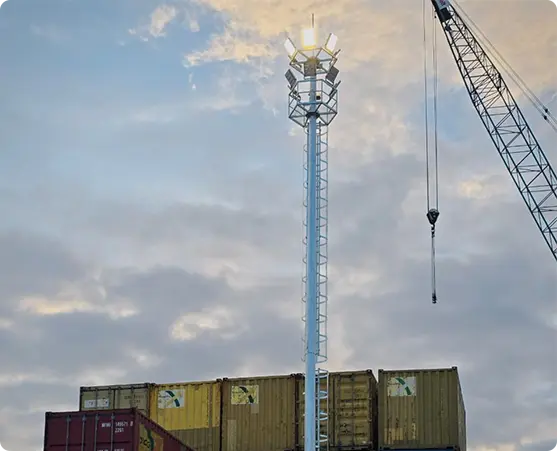
Desert-Resistant Surveillance & Highway Mast Network
Heavy-duty camera and illumination poles built to withstand continuous 55°C ambient desert temperatures, sandstorms, and thermal expansion fatigue. Features dual-stage thermoset polyester powder coating over hot-dip galvanization.
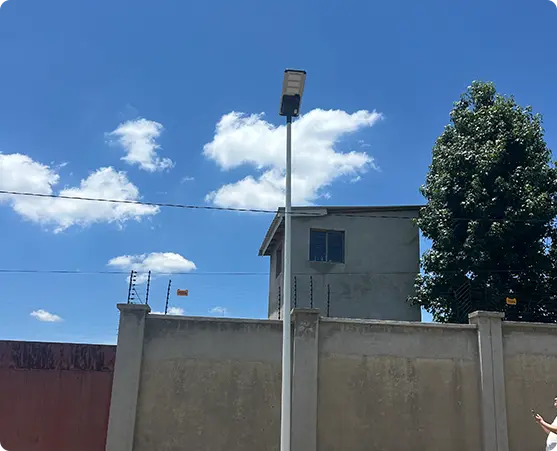
7-Meter 60W Integrated Off-Grid Arterial Lighting
Autonomous solar street lighting installations eliminating municipal dependence on unstable grid infrastructure during peak load-shedding cycles, delivering zero-interruption safety lighting across regional corridors.

Chancay Port Multi-Lane Municipal Access Road
Engineered split-system and hybrid lighting systems along the heavy-haul intermodal arterial connecting Peru's major maritime terminal, configured with custom brackets for optical cutoff compliance.
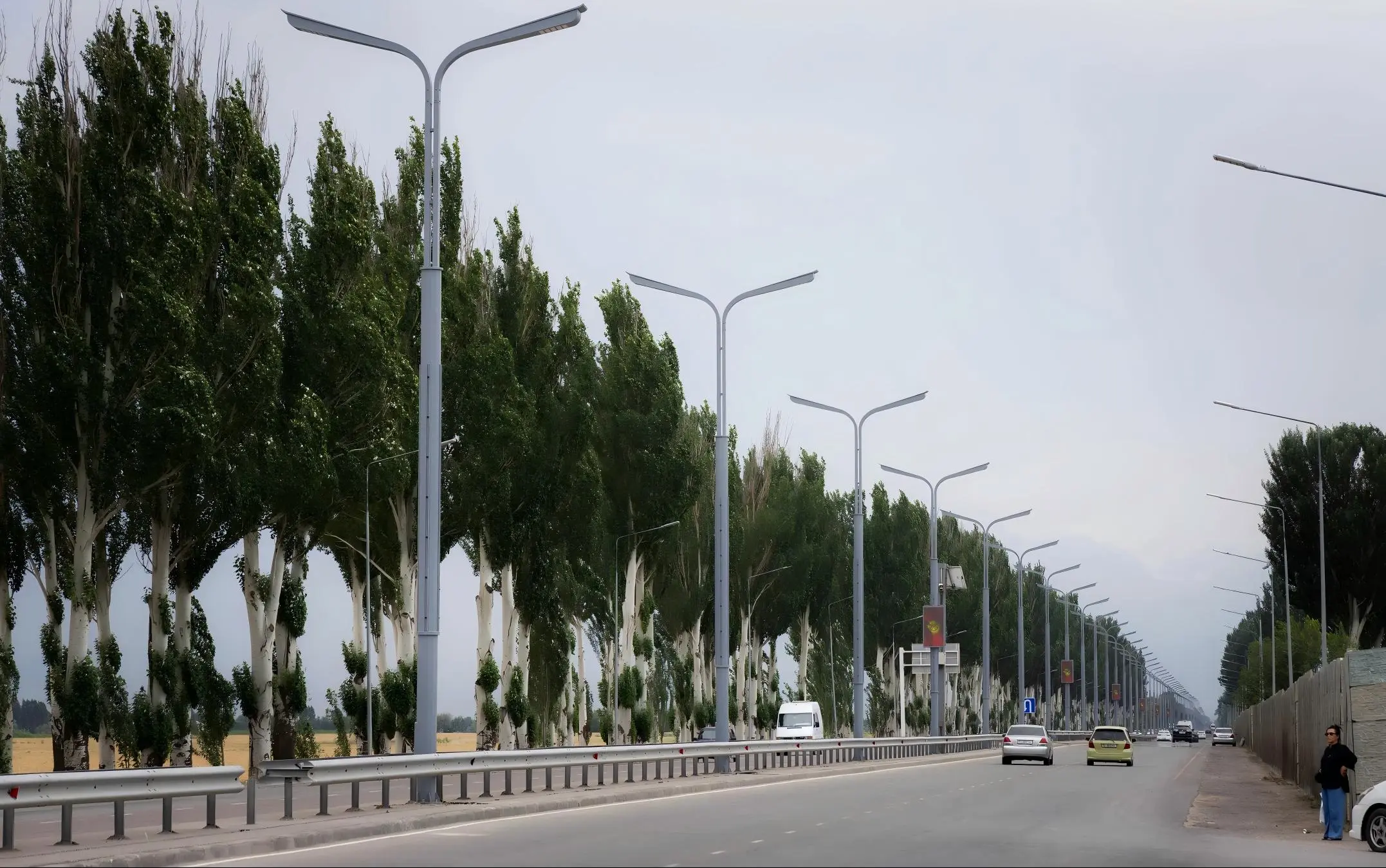
Manas International Airport to Bishkek Highway
Double-arm conical structural steel poles engineered with high impact toughness steels (Charpy V-notch tested at -40°C) ensuring absolute ductile stability across severe Central Asian continental winters.
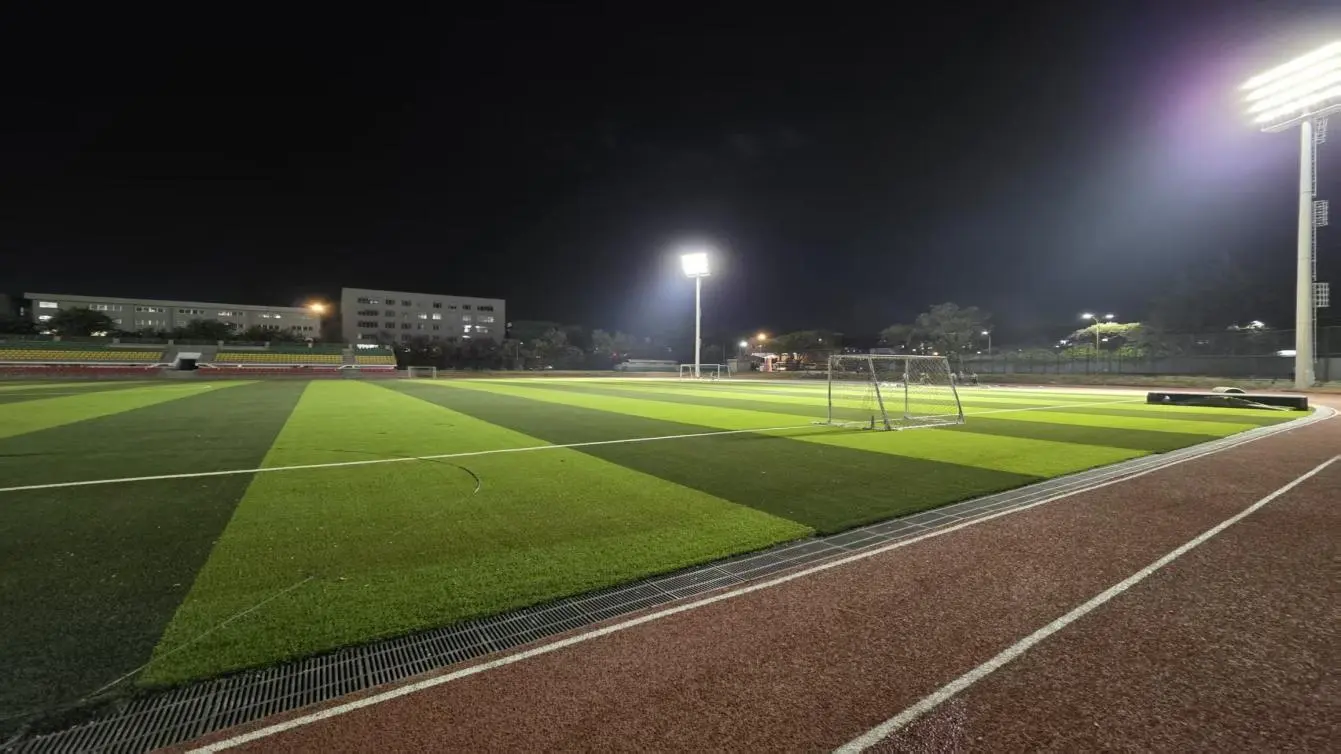
Olympic Athletic Stadium & Arena Floodlighting Masts
Custom 35-meter polygonal floodlighting towers with precision luminaire aiming head-frames engineered via DIALux simulation to meet FIFA and World Athletics Class II television broadcast uniformity requirements.
The Next Era: Structural Health Monitoring & Smart IoT Masts
High mast towers are transitioning from passive lighting poles into intelligent, self-monitoring municipal infrastructure nodes. Xintong is pioneering the integration of dynamic telemetry, smart city small-cell radios, and autonomous solar-hybrid microgrids.
IoT Structural Health Telemetry
Future high mast towers incorporate triaxial MEMS accelerometers, optical fiber strain gauges, and tilt inclinometers directly into base plates and upper slip joints. Real-time data streams alert municipal engineers to anchor bolt slackening, metal fatigue cycles, and abnormal foundation settlement long before physical deformation occurs.
Photometric AI Dimming & Zhaga Mesh
By adopting Zhaga Book 18 standard receptacles and ANSI C136.41 7-pin NEMA interfaces, our smart luminaires interface seamlessly with cloud central management platforms (CMS) via LoRaWAN, NB-IoT, or cellular mesh. Dynamic radar sensors reduce luminaire wattage during zero-traffic windows, extending LED driver life by 40% and shrinking annual carbon footprints.
Solar-Wind Hybrid Microgrid Masts
For remote highway junctions and mineral extraction zones lacking high-voltage grid connections, Xintong integrates vertical-axis helical wind turbines and wrap-around CIGS thin-film flexible photovoltaic modules onto the polygonal pole shaft. Coupled with lithium iron phosphate (LiFePO4) storage banks within the base cavity, these towers guarantee uninterrupted operation through 7 days of inclement weather.
Frequently Asked Questions for Project Engineers & Specifiers
Direct technical clarity regarding structural standards, site wind loads, telescopic slip joints, raising/lowering equipment, and factory export verifications.
- 15m to 20m: Selected for surface widths of 40m–70m (toll plazas, 4-way junctions).
- 25m to 30m: Selected for terminal corridors of 80m–130m where crane operations require minimum clearances.
- 35m to 45m+: Selected for vast open container terminals (150m+ span) to minimize the physical mast count, freeing critical ground area for reach stackers and automated guided vehicles (AGVs).
- Self-Locking Worm-Gear Winch: The reduction ratio prevents reverse drive; releasing the motor instantly locks the hoist drum in position.
- Mechanical Gravitational Latching Pawls: When raised to full height, heavy forged steel latch dogs automatically drop into high-strength docking pins on the head-frame. This completely unloads the stainless steel cables.
- Visual Indicator Flags & Microswitches: Color-coded visual flags visible from ground level confirm positive latch engagement before power is removed from the winch.
Standardized & Tailored Lighting Infrastructure Systems
Choose factory-direct reliability with certified mill test reports, comprehensive DIALux project simulations, and international tender documentation packages.
