
Engineered Power & Multi-Application Steel Poles
Precision-formed conical, octagonal, and multi-sided structural steel shafts configured for commercial power distribution, smart-grid feeder networks, and high-load municipal deployments.







The Evolution of Commercial Light Duty Power Poles: Structural Integrity & Grid Modernization
As municipal commercial centers, business parks, and decentralized industrial microgrids rapidly expand worldwide, commercial light duty power distribution poles are no longer basic tubular structural shafts. They have evolved into critical multi-load carrying nodes bridging low-voltage (LV) electrical distribution, intelligent public lighting, telecommunication arrays, and security sensor networks.
Material Science: Q235B vs. Q355B (ASTM A572 Gr 50)
Standard light-duty distribution applications demand an exact equilibrium between tensile ductility and yield strength. Our engineering team utilizes premium grade Q235B (minimum yield strength 235 MPa) for standard wind corridors and low-torsion cross-arm arrangements, and fine-grain micro-alloyed Q355B (minimum yield 355 MPa, equivalent to ASTM A572 Grade 50 / EN 10025 S355JR) for heavier conductor pulls, dead-end termination poles, and coastal gale regions up to 160 km/h design wind velocities.
Mechanical Torsion & Transverse Deflection Engineering
Unlike purely decorative street light columns, commercial light duty power distribution poles must withstand steady-state transverse conductor tension, ice-loading drag coefficients ($C_d$), dynamic wind flutter, and unbalanced lateral stresses at junction transitions. Our shafts are formed with unified longitudinal submerged arc seams (SAW), continuous conical tapers (typically 11–14 mm/m), or polygonal cross-sections that deliver superior moment of inertia ($I_x$) while restricting pole-top deflection within $L/100$ under full working load.
Corrosion Barrier: Full-Immersion Galvanizing (ISO 1461)
Field failure in commercial distribution infrastructure is predominantly driven by crevice corrosion at base plates and internal condensates inside non-ventilated shafts. Every Xintong pole undergoes chemical pickling, fluxing, and immersion into a molten zinc bath maintained at $445^\circ\text{C}–455^\circ\text{C}$ conforming strictly to ASTM A123 and ISO 1461. The resulting metallurgical bond yields internal and external zinc layers exceeding $86\,\mu\text{m}$ ($610\text{ g/m}^2$), impervious to coastal salt spray and chemical atmospheric fallout.
Navigating International Enterprise Procurement: Standards, Compliance & Risk Mitigation
EPC contractors, municipal utility directors, and industrial park developers encounter severe procurement friction when sourcing commercial light-duty power poles across borders. Understanding specification nuances prevents catastrophic project delays and tender disqualification.
Common Tender Hurdles in Utility Pole Sourcing
International tenders typically mandate compliance with overlapping and occasionally conflicting regional specifications. In North American and Middle Eastern markets, tenders strictly enforce AASHTO (Standard Specifications for Structural Supports for Highway Signs, Luminaires, and Traffic Signals) or ANSI C136. In European and Commonwealth regions, EN 40-3 and BS EN ISO 1461 dominate.
Frequent failure modes during bid evaluations include:
- Inadequate Base-Plate Stiffener Calculations: Fatigue cracking under cyclic wind vortex shedding when gussets are undersized.
- Omission of Conductor Pull Load Ratings: Specifying standard street lighting poles for low-voltage cross-arm electrification without accounting for conductor tension and ice accumulation.
- Insufficient Galvanizing Certification: Furnishing simple mill certificates instead of third-party ultrasonic thickness and magnetic test records.
- Non-Compliant Handhole Openings: Failing to reinforce access openings, which creates localized structural stress concentrations and shaft buckling.
The Xintong Compliance & Verification Protocol
Yangzhou Xintong Traffic Equipment Group eliminates engineering rejection through end-to-end submittal documentation. Every proposal package delivered by our export engineering desk is tender-ready and includes:
- Detailed CAD Structural Drawings: Pole shaft sections, base plate dimensions, foundation anchor bolt cage templates, and cross-arm connection details.
- FEA Structural Load & Wind Calculation Reports: Third-party verified calculations factoring local basic wind speeds ($V_{3s}$ or $V_{10m}$), gust response factors ($G$), and drag coefficients.
- DIALux Photometric Simulations: When poles are ordered with integrated commercial luminaire configurations, guaranteeing targeted lux and uniformity ($U_0$).
- Complete Quality Dossiers: Raw steel mill test certificates (EN 10204 3.1), non-destructive weld testing (NDT/UT), and zinc bath chemical spectrometry.
China Factory 4.0: Supply Chain Resilience, Automation & Scale Efficiency
Operating out of our 100,000 m² state-of-the-art production base in Gaoyou, Jiangsu—China’s premier infrastructure manufacturing hub—Xintong integrates raw structural steel processing to final containerization under a single roof.
16-Meter CNC Tandem Press Brakes
Precision polygonal cross-sections demand immense pressing tonnage without inducing internal micro-fissuring. Our twin 1,600-ton linked CNC press brake system produces continuous tapered poles up to 16 meters in a single continuous stroke, eliminating hazardous intermediate circumferential welds on standard heights.
Automated Submerged Arc Longitudinal Welding
Shaft seam welds are completed via high-speed automated submerged-arc welding machines with electronic seam-tracking. This guarantees full-penetration root passes and consistent weld profiles without porosity, undercut, or slag inclusion, fully compliant with AWS D1.1 structural welding requirements.
In-House Galvanizing & Duplex Electrostatic Coating
Unlike fabricators who outsource surface treatment, our on-site chemical treatment and hot-dip galvanizing kettles ensure zero exposure to oxidation. For harsh architectural or coastal applications, our automated Swiss Gema electrostatic powder line applies durable polyester coatings cured at $200^\circ\text{C}$.
Why In-House Vertical Integration Protects Your Bottom Line
By sourcing raw prime steel directly from top-tier mills (Baosteel, Shagang) and controlling forming, welding, galvanizing, and assembly within one unified 100,000 m² facility, Xintong eliminates third-party markups, eliminates logistics bottlenecks between processing sub-suppliers, and accelerates lead times by 35% compared to conventional supply networks.
✓ Pre-Shipment Inspection (PSI): Full buyer audit access via live digital HD video stream or on-site engineer verification.
✓ Optimized Export Bundling: Specialized nesting arrangements to minimize container cubic meter loss and avoid transit abrasion.
Global Commercial Electrification & Smart Infrastructure Trends
Decarbonization, distributed renewable microgrids, and electric vehicle (EV) fleet expansion are placing unprecedented mechanical and electrical demands on commercial power poles across primary economic corridors.
Grid Tie-Ins for Distributed Energy (DER)
Industrial complexes and business parks are transitioning from centralized power feeds to distributed rooftop solar and microgrid battery energy storage systems (BESS). Commercial light-duty poles serve as the critical conduit for secondary overhead feeders, step-down transformers, and distribution disconnects connecting local commercial arrays back to the municipal grid.
Integration of EV Charging & Utility Sub-Meters
Fleet depots and retail commercial parking lots are deploying dual-purpose poles engineered to handle higher amperage cable drops while hosting Level-2 AC vehicle chargers at the base. These require integrated weather-shielded service doors (IP65) and internal mounting rails for circuit breakers, surge protection devices (SPDs), and smart utility metering.
Multi-Tenant 5G & Smart City Densification
With the global rollout of millimeter-wave 5G networks, commercial poles represent valuable real estate. Our modular light-duty utility shafts are pre-engineered with internal cable raceways, concealed antenna shrouds, and dedicated structural brackets to support micro-radio units, public Wi-Fi, environmental sensors, and ANPR surveillance systems without visual clutter.
Field-Proven Deployment Across Global Environments
From tropical maritime ports in Southeast Asia to hyper-arid desert zones in the Middle East and sub-zero highways in Central Asia, Xintong commercial poles are proven across the world's most demanding climatic zones.
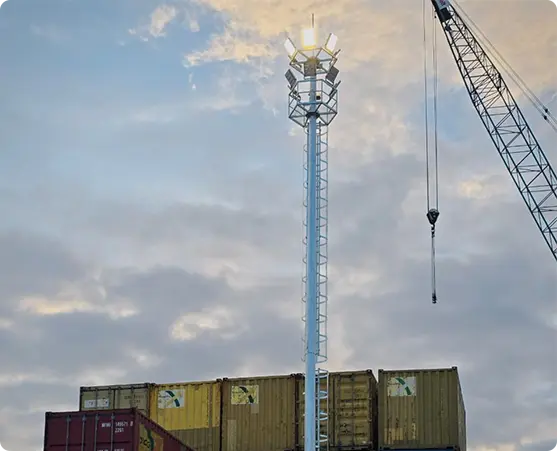
Cebu Baseport Terminals 2 & 4 Infrastructure
Heavy-duty polygonal mast and power distribution structures engineered to resist C5-M extreme marine corrosive exposure, typhoons up to Category 4, and continuous 24/7 container crane vibration stresses.
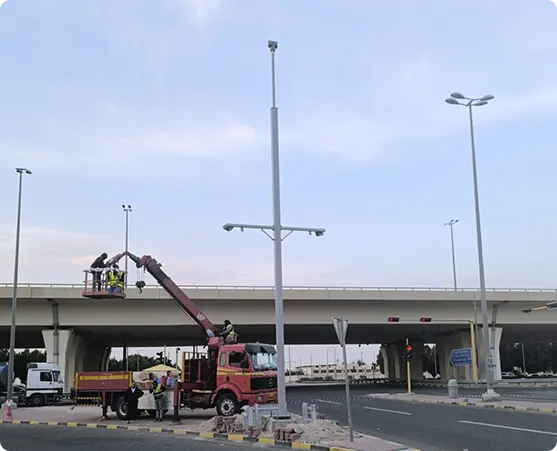
Highway Surveillance & Utility Power Feeds
Hot-dip galvanized and heat-reflective powder-coated camera and power poles manufactured to endure extreme desert surface temperatures exceeding $65^\circ\text{C}$ and intense abrasive sandstorms.
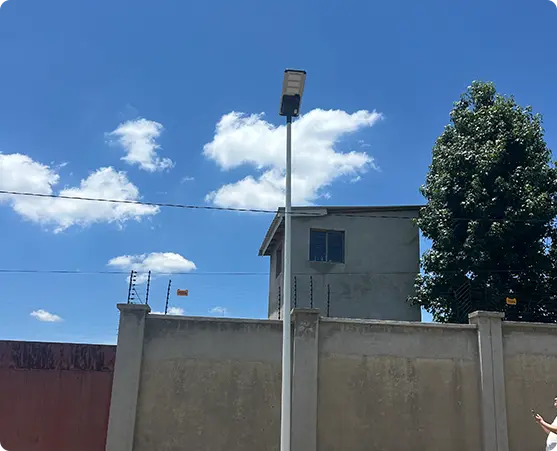
Commercial Corridor Off-Grid Electrification
Autonomous 7m solar and power poles designed to withstand high UV exposure and grid load-shedding cycles, providing uninterrupted arterial lighting and localized emergency low-voltage power supply.
Commercial Light Duty Power Pole Specification Guide
Standard structural parameters for engineer-of-record design planning. Custom pole heights, base flange dimensions, and specific load configurations are engineered upon project receipt.
| Series Configuration | Nominal Height | Shaft Geometry | Material Grade | Base Plate Thickness | Max Working Transverse Load | Corrosion Protection |
|---|---|---|---|---|---|---|
| URBAN-GRID LV-6M | 6.0 Meters (20 ft) | Conical / Octagonal | Q235B / ASTM A36 | 16 mm – 20 mm | 2.5 kN (562 lbf) | Hot-Dip Galv 86 µm min. |
| URBAN-GRID LV-8M | 8.0 Meters (26 ft) | Octagonal / 12-Sided | Q235B / Q355B | 20 mm – 22 mm | 3.8 kN (854 lbf) | ASTM A123 / ISO 1461 |
| COMM-TRANSIT 10M | 10.0 Meters (33 ft) | Tapered 12-Sided | Q355B / A572 Gr 50 | 22 mm – 25 mm | 5.2 kN (1,169 lbf) | Duplex Galv + TGIC Powder |
| COMM-TRANSIT 12M | 12.0 Meters (40 ft) | 12-Sided / 16-Sided | Q355B / S355JR | 25 mm – 28 mm | 7.0 kN (1,573 lbf) | Hot-Dip Galv 100 µm coastal |
| HEAVY-FEEDER 15M | 15.0 Meters (50 ft) | Polygonal (Slip-Joint) | Q355B / High-Strength | 28 mm – 32 mm | 9.5 kN (2,135 lbf) | Heavy-Duty Zinc Immersion |
Frequently Asked Engineering & Procurement Questions
Detailed technical answers addressing mechanical sizing, international standards compliance, wind load modeling, and factory procurement logistics.
Standard street light columns are engineered almost exclusively to resist vertical dead weight (the luminaire fixture and bracket arm) and lateral wind aerodynamic drag against the pole shaft. Conversely, commercial light-duty power distribution poles must withstand continuous mechanical dead-end and longitudinal conductor line tensions, unbalanced transverse wire pull, ice accretion loads, and torsional shock loads from fault currents or equipment vibration. This necessitates thicker nominal wall gauges (typically 4.0 mm to 8.0 mm vs. 3.0 mm), larger anchor bolt circle diameters, heavier base plates with reinforced radial stiffeners, and high-strength steels like Q355B (ASTM A572 Gr 50).
Our engineering office utilizes specialized structural finite element modeling compliant with AASHTO LTS, EN 40-3, and ASCE 7. We factor in site-specific basic 3-second gust wind speeds (e.g., 120 km/h, 160 km/h, or custom hurricane ratings up to 200 km/h), terrain exposure categories (B, C, or D for coastal zones), topographic factors, drag coefficients ($C_d$) based on polygonal or conical geometry, and total projected Effective Projected Area (EPA) of all mounted cross-arms, conductor drops, transformers, luminaires, and surveillance brackets to guarantee safety margins.
Every shipment dispatched from our Gaoyou factory includes a comprehensive Quality Dossier required by municipal audit inspectors: Mill Test Certificates (EN 10204 3.1) establishing the chemical composition and yield/tensile strength of the steel, hot-dip galvanizing coating thickness inspection certificates complying with ASTM A123 / ISO 1461, non-destructive welding test reports (NDT/UT), dimensional inspection sheets, and foundation anchor bolt installation torque guidelines.
Yes. As a true original equipment manufacturer (OEM), all cross-arm geometries (single, double, or multi-circuit low-voltage racks), transformer mounting platforms, and equipment access handholes are CNC-cut directly to customer drawings. Handholes are structurally reinforced with perimeter welded flanges to prevent shaft buckling, equipped with neoprene gaskets, earthing studs, and vandal-resistant tamper-proof stainless steel fasteners.
Standard prototype and engineering submittal CAD drawings are finalized within 48 to 72 hours. Standard container orders (100 to 500 units) generally undergo cutting, CNC press-brake forming, automatic welding, hot-dip galvanizing, and inspection within 15 to 25 working days. Our strategic supply chain partnerships with regional steel producers and our own integrated hot-dip zinc facility allow us to reliably accommodate rapid-turnaround utility emergency replacement tenders.
Integrated Systems: From Distribution Columns to High Mast Towers
Review our specialized infrastructure product lines. From distributed solar lighting and heavy-load transmission poles to stadium floodlight towers, select a category to view specifications or request an engineer-reviewed tender proposal.


Consult an Export Project Structural Engineer
Eliminate non-responsive trading intermediaries. Transmit your project bill of quantities (BOQ), tender specifications, or design drawings directly to our engineering division in Gaoyou, Jiangsu. Receive an engineered technical review, finite element confirmation, and a factory-direct commercial proposal within 24 working hours.
Technical Proposal Submittal Checklist
For the most expedited proposal turnaround, please specify the following structural parameters with your inquiry:
- Nominal mounting height & shaft geometry (Conical, Octagonal, Square)
- Local design basic wind speed (m/s or km/h) & terrain category
- Low-voltage circuit load (conductor type, tension force, dead-end vs intermediate)
- Mounting accessories (cross-arm spans, luminaire brackets, camera mounts)
- Surface finish (Standard hot-dip galvanizing vs RAL architectural powder-coat)
- Total quantity, delivery schedule, and destination port (FOB / CIF / DDP)