

Municipal Engineering Poles
Conical, octagonal, and cylindrical designs optimized for urban arterials, highway networks, and municipal road infrastructure.
Configure SpecificationsExplore our export-ready municipal, split-solar, integrated all-in-one, and heavy-load structural systems fabricated under strict quality controls in our 100,000 m² smart plant.
Conical, octagonal, and cylindrical designs optimized for urban arterials, highway networks, and municipal road infrastructure.
Configure Specifications
Integrated luminaire, LiFePO4 storage, and mono PV module for residential accessways, perimeter security, and rural electrification.
Configure Specifications
High-efficiency split solar street lighting engineered for prolonged autonomy in low solar irradiance corridors and high-wind environments.
Configure Specifications
High-capacity structural distribution poles designed to bear combined overhead conductors, street lighting, and telecom lines.
Configure Specifications
Heavy-duty polygonal high mast towers with motorized lowering gears designed for interchanges, transit hubs, and toll junctions.
Configure Specifications
Structural masts reaching 15m to 40m engineered to withstand offshore typhoon wind loads across maritime container terminals and aprons.
Configure Specifications
Smart city architectural pillars integrating IoT base stations, CCTV security nodes, environmental micro-sensors, and EV chargers.
Configure Specifications
Reinforced-wall high-yield structural columns calculated to withstand Category 5 hurricanes and extreme wind pressure envelopes.
Configure SpecificationsIn modern municipal roadway tenders and coastal infrastructure specifications, the transition from conventional galvanized steel to structural 6000-series aluminum alloy has evolved from an aesthetic choice to an economic imperative.
For decades, hot-dip galvanized steel poles (fabricated using Q235B or Q355B structural grades) have served as the standard workhorse for municipal lighting. However, in regions classified under ISO 9223 as C4 (High), C5 (Very High Marine/Industrial), and CX (Extreme Offshore), the standard zinc barrier coating of 86 μm begins depleting at rates exceeding 4.2 to 8.4 μm per year. This accelerates the emergence of ferrous corrosion within 10 to 15 years, necessitating abrasive blasting, field repainting, and eventual structural decommissioning.
In contrast, custom structural aluminum light poles engineered with magnesium-silicon architectural alloys (Al-Mg-Si) instantly form a self-passivating, insoluble aluminum oxide (Al₂O₃) ceramic nanolayer when exposed to atmospheric oxygen. This barrier is chemically stable across a broad pH spectrum (4.5 to 8.5) and is virtually immune to chloride-induced pitting, delivering continuous field operation for over 50 years without cathodic maintenance.
While the initial ex-factory procurement expenditure for precision-extruded aluminum columns is marginally higher than equivalent tubular steel, life-cycle financial modeling demonstrates a 38% to 52% reduction in lifecycle capital expenses:
| Performance Parameter | Extruded 6063-T6 Aluminum | High-Strength 6061-T6 Aluminum | Hot-Dip Galvanized Q235B Steel | Hot-Dip Galvanized Q355B Steel |
|---|---|---|---|---|
| Yield Strength (Rp0.2) | 170 – 214 MPa | 240 – 276 MPa | 235 MPa | 355 MPa |
| Ultimate Tensile Strength (Rm) | 215 – 245 MPa | 290 – 310 MPa | 370 – 500 MPa | 470 – 630 MPa |
| Density & Self-Weight | 2.70 g/cm³ (Ultralight) | 2.70 g/cm³ (Ultralight) | 7.85 g/cm³ (Heavy) | 7.85 g/cm³ (Heavy) |
| Marine Atmospheric Corrosivity (C5) | Naturally Immune (Passivated Al₂O₃) | High Marine Resilience | Degrades 4–8 μm Zn/Year | Degrades 4–8 μm Zn/Year |
| Recyclability & Residual Value | > 95% Secondary Scrap Value | > 95% Secondary Scrap Value | Moderate Scrap Value | Moderate Scrap Value |
| Target Engineering Applications | Urban arterials, parks, pedestrian walkways | Heavy-load smart masts, wind turbines | Low-cost rural electrification | Heavy transmission, high masts (>30m) |
A deep engineering overview of how Xintong fabricates high-integrity aluminum poles from virgin metallurgical ingots to finished, site-ready structural assets.
Our shafts are fabricated from primary A00 aluminum billets extruded through 3,600-ton hydraulic presses to generate single-piece seamless tubular profiles. For tapered poles, cold CNC roll spinning establishes a continuous linear conical or octagonal taper with consistent wall thickness from the base anchor plate to the luminaire tenon.
To achieve peak structural mechanical ratings (T6 temper), shafts undergo continuous vertical solution quenching at 530°C followed by controlled artificial aging in multi-zone convection ovens at 175°C. This homogenizes the Mg₂Si precipitate phases, maximizing yield strength while retaining ductile rupture resistance under dynamic wind buffet forces.
Structural base plates are cast from A356 alloy or CNC milled from 6061-T6 structural plate. Circumferential dual-pass fillet welding is completed by automated multi-axis robotic pulse-MIG setups utilizing ER5356 aluminum-magnesium filler wire, completely eliminating cold laps, hydrogen porosity, and micro-fissuring at high-stress base joints.
Standardized internal aluminum extrusion channels accommodating modular internal busbars, micro-trench cable runs, 5G microcell cooling ducts, and flush IP67 service doors.
Transitioning to 100% renewable-powered hydro/solar smelters and certified 85%+ post-consumer scrap remelting, cutting embodied carbon below 3.2 kg CO₂e/kg aluminum.
Integration of microencapsulated corrosion inhibitors in electrophoretic clear coats that automatically crosslink upon surface gouging or stone impact along high-speed expressways.
Embedded fiber-Bragg grating (FBG) strain sensors and resonant piezoceramic nodes monitoring dynamic fatigue cycles, anchor bolt pre-load, and foundation settlement in real time.
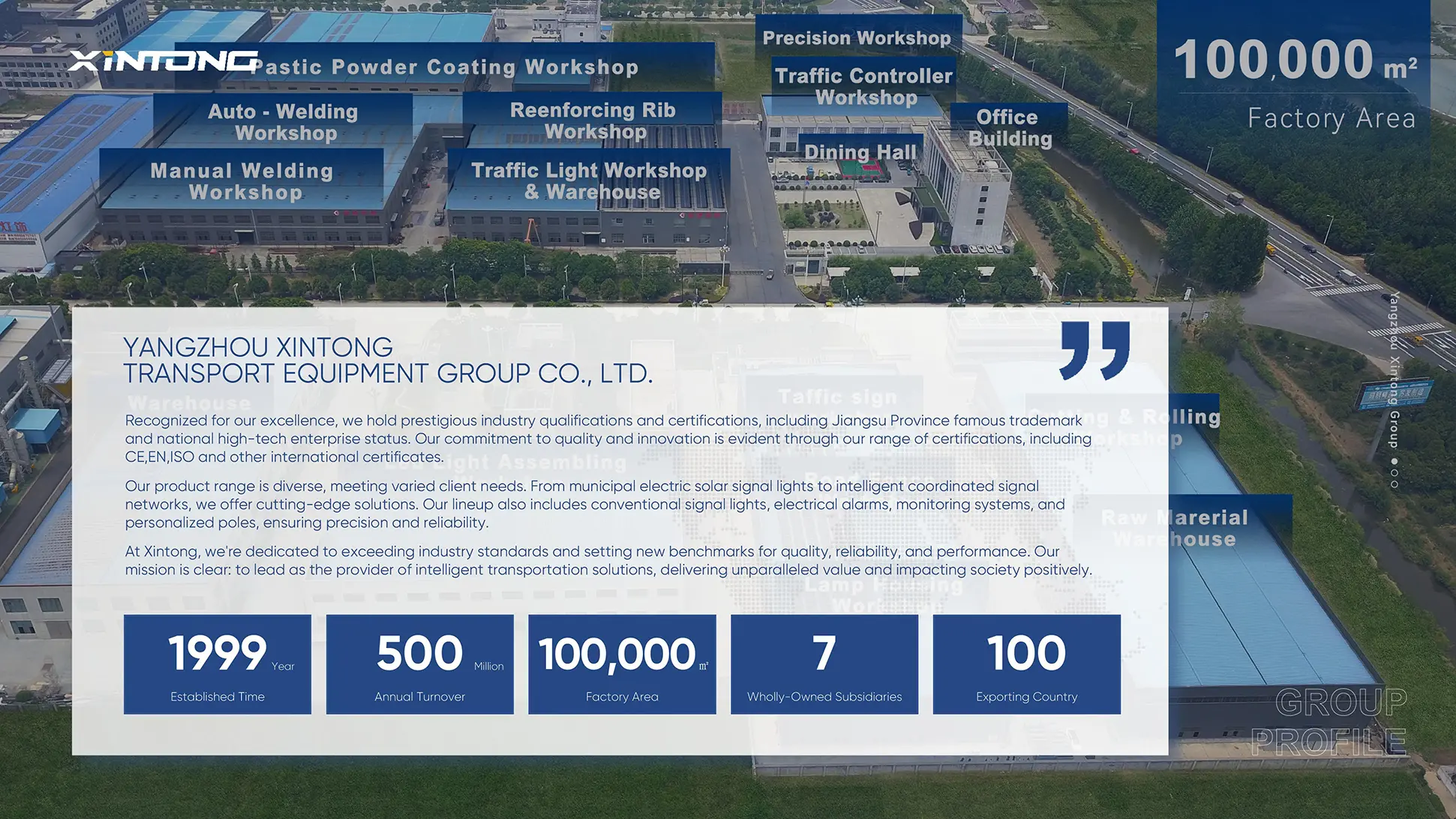
Situated in the Guoji Industrial Concentration Area of Gaoyou City, Jiangsu Province—China’s world-renowned lighting equipment manufacturing cluster—Yangzhou Xintong Traffic Equipment Group Co., Ltd. has refined end-to-end industrial pole manufacturing since 1999.
Our centralized 100,000 m² mega-plant hosts seven synchronized production lines spanning primary aluminum billet cutting, seamless heavy extrusion, CNC conical roll tapering, robotic submerged-arc and MIG welding, computerized anodizing baths, and dual automated polyester powder coating chambers. By keeping every critical engineering process in-house, we eliminate outsourcing dependencies, preserve strict dimensional tolerances, and secure complete control over production schedules.
Direct inland waterway and express highway links to the deep-water maritime ports of Shanghai and Ningbo allow our logistics department to coordinate high-cube container consolidation, roll-on/roll-off shipping, and bulk break-bulk vessels with zero transshipment bottlenecks.
From high-salinity maritime container yards in the tropics to high-vibration alpine expressways, Xintong custom aluminum assemblies are purpose-tailored to site-specific environmental variables.
Challenge: Continuous salt-laden fog, airborne sodium chloride concentrations above 300 mg/m²·day, and Category 4-5 typhoon gusts in maritime hubs like Cebu Baseport (Philippines) and Chancay Port (Peru).
Engineered Solution: Architectural Grade I (25 μm) clear or bronze anodized 6063-T6 tapered columns fitted with marine-grade 316 stainless steel hardware and internal rubber moisture isolation gaskets.
Challenge: Direct sun exposure causing metallic surface temperatures to exceed 75°C, high diurnal thermal cycling (ΔT = 45°C), and severe abrasive silica sandstorms across Kuwait, Saudi Arabia, and the UAE.
Engineered Solution: Superdurable thermoset TGIC-free polyester powder coating (AAMA 2604/2605 compliant) applied over a chromate-free zirconium conversion base to stop chalking, gloss loss, and abrasive micro-erosion.
Challenge: City centers requiring multifunctional integration without visual clutter—co-locating 5G microcell transmitters, CCTV security cameras, EV chargers, and traffic signal cantilevers.
Engineered Solution: Multi-cavity extruded aluminum columns featuring concealed modular T-slots. These enable quick adjustments of luminaire brackets, IoT sensor housings, and digital signage without on-site drilling.
Our senior in-house application engineers prepare turnkey submittal dossiers configured to satisfy the technical review boards of national ministries of transport and global EPC joint ventures.
Every lighting pole design is backed by detailed structural calculations under AASHTO LTS-6 (Standard Specifications for Structural Supports for Highway Signs, Luminaires, and Traffic Signals) or EN 40-3-1/3-2/3-3. Our engineers quantify maximum bending moments, extreme gust response factors, shear capacities, and deflections under project wind speeds ranging from 120 km/h to over 240 km/h.
We provide full-scale DIALux lighting simulations evaluating street profile cross-sections, pole spacing, overhang, tilt angle, and optical distributions (Type II, Type III, Type IV). Our submittal packages confirm road illuminance (lux), roadway luminance (cd/m²), overall uniformity (U₀), longitudinal uniformity (Ul), and threshold increment (TI% glare limits) to comply with EN 13201 or IESNA RP-8 guidelines.
Shipments leave our Gaoyou plant accompanied by EN 10204 Type 3.1 chemical composition and tensile mechanical mill test certificates. In-house inspection protocols cover dye penetrant weld crack testing, ultrasonic wall thickness verification, eddy-current anodizing/coating thickness checks, and 1,000-hour ASTM B117 neutral salt spray test documentation.
Direct technical answers to questions commonly evaluated by municipal specification directors, highway design consultants, and EPC procurement estimators.
Extruded aluminum alloy poles (6063-T6 or 6061-T6) offer permanent corrosion resistance via a naturally forming passive oxide barrier, eliminating periodic zinc repainting in coastal or industrial atmospheres. Aluminum weighs approximately 65% less than carbon steel, substantially reducing container shipping costs and eliminating heavy crane rentals during site erection. In addition, aluminum maintains strong post-consumer scrap value and meets passive safety breakaway crash requirements.
Aluminum alloy 6063 provides superior surface extrudability, exceptional anodizing response, and clean aesthetic lines, with a typical yield strength around 170-214 MPa. It is the global standard for decorative, conical, and octagonal street lighting poles up to 12 meters. Alloy 6061-T6 contains higher concentrations of magnesium and copper, delivering yield strengths up to 240-276 MPa. This makes it ideal for heavy-load applications, high-wind corridors, and tall multifunctional smart towers carrying multiple accessories.
Mounting follows two primary methods: base plate mounting (flange mounted) or direct burial (embedded root). Base-plate models feature heavy structural aluminum base plates welded circumferentially inside and outside to the shaft, secured to the concrete footer using high-tensile hot-dip galvanized or stainless steel anchor bolts (J-bolts) with double leveling nuts. Direct burial poles include an embedded depth (typically 10-15% of total length plus 0.5m) with a sealed polyurethane sleeve to prevent galvanic soil reactions.
Yes. Structural integrity is dictated by engineering cross-section, base diameter, wall thickness, and alloy temper rather than density alone. Our finite element analysis (FEA) engineers dimension base diameters and wall thicknesses (typically 3.0mm to 8.0mm) to support combined wind loads, luminaire projected areas (EPA), and bracket deadweights under AASHTO LTS-6 or EN 40 standards, regularly certifying survival under wind speeds up to 240 km/h (66.7 m/s).
For high-salinity coastal environments, Class I architectural clear or bronze sulfuric acid anodizing (coating thickness ≥ 18-25 μm) creates an exceptionally hard, integral sapphire-like oxide layer that cannot flake or peel. Alternatively, thermoset polyester or fluoropolymer (PVDF) powder coating compliant with Qualicoat Class 2 or AAMA 2604/2605 offers superior UV gloss retention, chemical resistance, and an expansive spectrum of RAL architectural colors.
For standard conical and octagonal aluminum poles, baseline tooling is pre-configured, allowing prototype verification runs within 7 working days and full 40ft container dispatch within 18-25 calendar days. Bespoke architectural profiles or multifunctional smart pole assemblies requiring dedicated extrusion dies typically require an initial 10-day die fabrication cycle. We maintain flexible project-based MOQs tailored to municipal tender contracts.
Direct contact between aluminum and dissimilar metals (such as standard carbon steel) in the presence of an electrolyte causes accelerated galvanic corrosion. Xintong resolves this by utilizing only 304 or 316 marine-grade stainless steel fasteners, combined with non-conductive, UV-stabilized neoprene or EPDM isolation washers and nylon bolt sleeves. Base plates installed over steel anchor studs incorporate dielectric insulating gaskets to completely isolate dissimilar metals.
Absolutely. We routinely host on-site engineering and quality audits from international third-party certification bodies, including SGS, Bureau Veritas, TÜV Rheinland, and Intertek. Project managers and EPC quality inspectors can observe raw billet verification, ultrasonic testing, weld inspections, and loading inspections in person or via scheduled high-definition live video feeds.
Explore our comprehensive lineup of municipal, floodlighting, high-mast, and architectural decorative assemblies ready for international deployment.

Bespoke landscape and heritage street lighting poles combining architectural aesthetics with high-grade aluminum corrosion performance.
Configure Specifications
High-power LED floodlight towers featuring customizable head-frames designed around precise DIALux athletic aiming diagrams.
Configure Specifications
Single and double-arm tapered poles engineered to meet international roadway lighting classes and strict deflection thresholds.
Configure Specifications
High-lumen integrated solar lighting system built for university campuses, public parks, industrial parks, and perimeter roads.
Configure Specifications
Standardized municipal poles offering single-seam or seamless finishes, tailored anchor bolt circles, and corrosion-proof base skirts.
Configure Specifications
Optimized mounting structures engineered to minimize effective projected wind area (EPA) for high-efficiency integrated solar luminaires.
Configure Specifications
Dual-bracket structural columns with top-mounted swivel PV cradles oriented for maximum solar radiation harvest in northern latitudes.
Configure Specifications
Extruded aluminum smart poles equipped with internal cable guides, access raceways, and discrete exterior mounting channels for 5G smart city networks.
Configure SpecificationsBypass conventional sales delays. Send your road cross-section parameters, Bill of Quantities (BOQ), or tender specifications directly to our engineering team for immediate review, CAD drafting, and structural calculations.
Factory Address: Guoji Industrial Concentration Area, Suiqiao Town, Gaoyou City, Jiangsu Province, China.
Global Footprint: 500,000+ units across 80+ countries including Middle East, Central Asia, Southeast Asia, South America & Africa.