
Flagship High Mast & Structural Pole Series
Direct factory supply from our 100,000 m² Gaoyou industrial complex. Serialized production meets certified custom engineering for global EPC highway, port, transit, and sports lighting tenders.

Custom XINTONG High Strength Light Pole Series
Custom XINTONG Full Series Municipal Street Light Poles

Best XT-DT-1 Series (Split Type) Solar Street Light

OEM PUBLIC TRANSIT Series Municipal High Mast Poles

Buy XINTONG Municipal Street Light Pole Series
High-Quality STADIUM SERIES High Mast Light

OEM XT-YTH-9 Series (All-In-One) Solar Pole
OEM AIRPORT-PORT SERIES High Mast Light
The Mechanics of High Mast Lowering Systems: Precision Engineering & Operational Safety
High Mast Lowering Systems (HMLS) constitute a vital segment of critical industrial civil and electrical infrastructure. Operating at mounting heights between 18 meters to over 50 meters, these systems replace permanent aerial access ladders or recurring mobile cherry-picker crane operations with an automated, ground-level serviceable luminaire carriage.
As an ISO 9001, ISO 14001, and ISO 45001 certified manufacturing group based in Gaoyou, Jiangsu, China, Yangzhou Xintong Traffic Equipment Group Co., Ltd. (founded 1999) engineers these complex assemblies with tight tolerances. Our integrated mechanical lifting systems employ positive mechanical 3-point docking barrel locks, dual independent stainless steel wire cables (SUS304/SUS316), and fail-safe self-locking worm-gear motorized winches.
By integrating structural steel taper calculations with multi-cable tension equalizers, Xintong high masts resolve dangerous lateral wind vortex shedding while protecting maintenance teams from working at height. Every assembly comes backed by traceable mill test certificates, complete DIALux photometric simulations, and comprehensive AASHTO / EN 40 structural calculation sheets.
Core Mechanical Sub-Assemblies
- Head Frame Crown Assembly: Hot-dip galvanized cast aluminum/structural steel pulley cluster with deep-grooved, copper-impregnated graphite self-lubricating bronze bushings or SUS316 ball bearings.
- Positive Mechanical Docking Latch: Precision gravity-trip or spring-loaded mechanical latches relieve tension from hoist cables when fully raised, preventing permanent cable strain and fatigue elongation.
- Dual-Drum Fail-Safe Winch: Motorized and manual dual-speed worm-gear drive equipped with secondary centrifugal brakes to prevent runaway descent even under accidental electric failure.
- Integrated Quick-Disconnect Power Harness: Multi-pole electrical pin connectors automatically de-energize the carriage during lowering and seat into heavy-duty silver-plated terminals upon locking.
Engineered for Harsh Industrial Climates & Heavy Logistics
Explore how Xintong high mast lowering systems and specialized poles perform across global maritime terminals, airport flight lines, multi-tier interchanges, and remote arid environments.
Maritime Seaports & Container Terminals
Operating under ISO 12944 C5-M ultra-corrosive marine environments, seaport masts face relentless saltwater fog and typhoons. As deployed at Cebu Baseport Terminals 2 & 4 in the Philippines, our 30m–40m polygonal high masts use double-dip hot galvanizing (minimum 100 µm zinc thickness) combined with marine-grade 316 stainless steel winches, sealed IP66 floodlights, and positive latching carriages that operate smoothly despite heavy humidity and coastal gale loads.
International Airport Aprons & Runways
Airfield aprons demand zero Foreign Object Debris (FOD) risk, exact glare control conforming to ICAO Annex 14 requirements, and rapid ground serviceability without deploying tall boom trucks inside taxiway obstacle limitation surfaces (OLS). From the Manas International Airport – Bishkek Highway corridor down to air freight aprons, Xintong masts provide cut-off optics with motorized carriages lowered within 12 minutes for quick lamp or ballast replacement.
Multi-Level Highway Interchanges & Toll Plazas
Closing highway lanes to bring in elevated crane platforms costs thousands of dollars per hour and disrupts regional traffic. High mast lowering systems installed in cloverleaf interchanges allow lone field technicians to drop the luminaire ring safely onto a localized ground maintenance pad, complete LED retrofits, test circuit continuity, and hoist the ring back into its locked position within standard off-peak windows.
Stadiums & Olympic Sports Fields
International athletic competitions demand rigorous vertical and horizontal illuminance uniformity without shadows or flickering. In our stadium and athletics track projects in Ethiopia, Xintong engineered custom polygonal masts carrying up to 36 high-output 1000W LED floodlights on precision aiming head-frames. Computer-modeled structural rigidity ensures that luminaire targeting angles remain locked within <0.5° deviation even in gusting crosswinds.
Arid Corridors & High-Heat Desert Environments
High ambient operating temperatures (surpassing +55°C) and blowing sand cause abrasive wear and thermal breakdown in inferior hoisting systems. Installed across surveillance monitoring and traffic pole networks in Kuwait and the Middle East, our lowering assemblies integrate IP66 enclosed winches, pressurized labyrinth-sealed cable pulleys, and specialized heat-reflective electrostatic polyester powder coatings over galvanized substrates.
Off-Grid Industrial Ports & Resource Corridors
For remote logistic nodes such as the Chancay Port access routes in Peru and municipal electrification initiatives in South Africa, our high masts and solar pole series (XT-YTH and XT-DT series) interface with auxiliary off-grid solar generators and hybrid energy storage, providing perimeter illumination and automated carriage deployment in regions where utility grid access is unfeasible or prone to rolling blackouts.
Global Commercial Status: Lifecycle Economics & TCO Modeling
How modern high mast lowering systems systematically eradicate operational hazards, high crane rental premiums, and protracted roadway closures over a 25-year design horizon.
| Evaluation Parameter | Fixed Platform High Mast (Climbing Ladder) | Fixed Mast (Requires Mobile Crane / Bucket Truck) | Xintong Motorized High Mast Lowering System |
|---|---|---|---|
| Routine Maintenance Access | Manual climber with safety harness & rail | Requires 40m+ hydraulic bucket truck rental | Ground-level lowering via built-in motorized winch |
| Personnel Fall Risk (OSHA/HSE) | High risk; continuous working-at-height exposure | Moderate risk; working from suspended basket | Zero fall-from-height risk (100% ground level) |
| Average Maintenance Turnaround | 4 to 6 hours per mast (2–3 certified climbers) | Requires lane closure & 3 to 5 hours on-site | 30 to 45 minutes total turnaround time |
| Operational Expenditure (25-Yr OpEx) | Very High (Specialized certified high-altitude labor) | Extreme (Heavy machinery mobilization & traffic permits) | Minimal (Standard 2-person ground crew) |
| Traffic Disruption & Road Closures | Minor lane impact | Major highway lane or terminal gate shutdown | Zero disruption; confined within pole footprint |
| Total Cost of Ownership (TCO) | Baseline benchmark | +45% to +80% higher lifecycle costs | 62% lower total lifecycle expenditure |
Safety Compliance Without Compromise
Eliminates climbing liabilities under OSHA 1910.269, European standard EN 12464-2, and UK HSE Working at Height Regulations 2005. Maintenance personnel perform all wiring, LED fixture cleaning, and driver module diagnostics standing firmly on the foundation apron.
Drastic Capital Payback Velocity
While lowering mechanisms represent a marginally higher initial capital outlay compared to bare steel shafts, the avoidance of even two crane mobilizations per year generates full capital payback within 24 to 36 months of deployment.
Long-Term Asset Protection
Automatic mechanical docking ensures hoist ropes remain completely de-tensioned during standard lighting operation. This mechanical lock halts tension creep, protects the steel core from cyclical fatigue, and extends cable replacement intervals to 10+ years.
Why Global EPC Contractors Source High Masts from Gaoyou, Jiangsu
Yangzhou Xintong Traffic Equipment Group represents the pinnacle of China’s high-precision pole manufacturing corridor. Founded in 1999 and encompassing an expansive 100,000 square meter intelligent manufacturing park, we operate complete end-to-end industrial workflows under one roof. By eliminating sub-contractor handoffs, we guarantee metallurgy integrity, structural precision, and unwavering shipment schedules for large-scale international tenders.
16-Meter CNC Tandem Press Brakes
Single-stroke cold forming of 12-sided, 16-sided, and 20-sided polygonal structural shafts up to 16mm wall thickness in standard lengths, minimizing circumferential girth welds.
Submerged Arc Longitudinal Welding
Automated twin-wire submerged arc welding (SAW) achieving full weld penetration (>85% throat thickness) validated via Ultrasonic (UT) and Magnetic Particle (MT) flaw inspections.
Full-Immersion Hot-Dip Galvanizing
Our on-site 15m zinc bath delivers complete internal and external metallurgical zinc diffusion in full compliance with ASTM A123, ISO 1461, and BS 729 (86 to 110 µm layer).
Dual-Speed Precision Winch Assembly
In-house machining and assembly lines for worm-gear mechanical winches, incorporating torque-limiting slip clutches and individual load-test certification before packing.
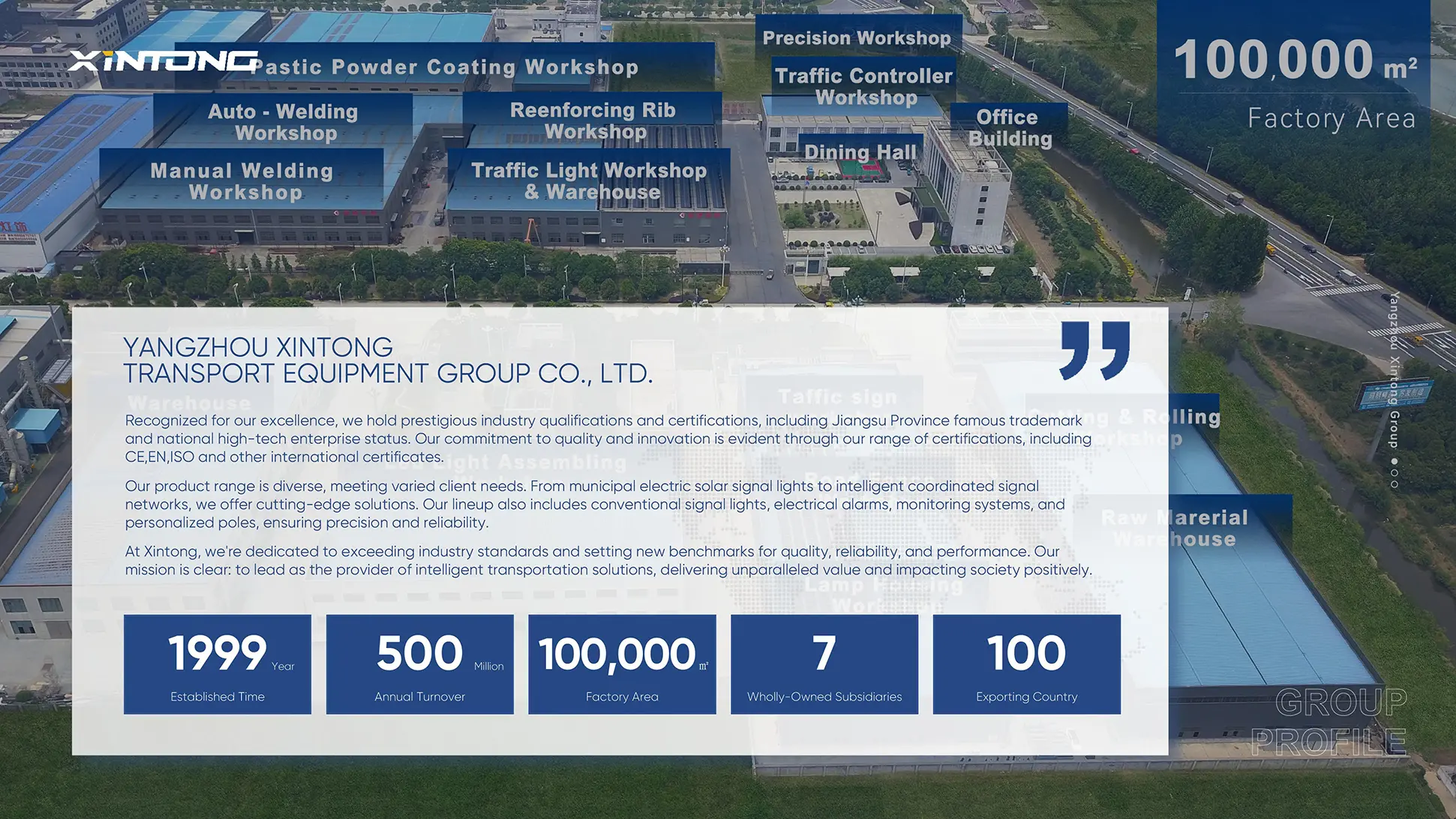
Gaoyou Industrial Concentration Area, Suiqiao Town, Jiangsu, China. Equipped with 7 fully automated production lines, dedicated testing laboratories, and ISO/CE/EN documentation archives open for third-party client inspections (SGS, TÜV, Bureau Veritas).
Technological Roadmap: The Evolution of Intelligent High Masts
Where structural mechanics converge with edge IoT telemetry, robotic maintenance, and renewable microgrids. Here is how Xintong engineering is redefining large-area infrastructure.
IoT Smart Latching & Telemetry
Integrating digital proximity sensors, strain-gauge load cells, and Bluetooth/LoRaWAN modules directly into the head frame crown. Engineers receive real-time alerts verifying latch engagement status, carriage leveling, and wire cable tension balance right on handheld maintenance tablets.
Tuned Mass Dampers & VIV Suppression
For tall 35m–50m masts positioned in coastal wind corridors, vortex-induced vibration (VIV) can trigger second-mode resonant fatigue. Xintong incorporates internal tuned mass dampening (TMD) pendulums and aerodynamic polygonal contours that suppress structural oscillations by up to 78%.
Hybrid Solar-Battery Storage Integration
Coupling motorized masts with distributed high-capacity LiFePO4 battery modules nestled safely inside the wide polygonal base compartment. Combined with split-type high-efficiency PV arrays (XT-DT series), these hybrid systems maintain critical security lighting during grid failures.
Autonomous Robotic Inspection Crawlers
Development of magnetic and pulley-guided crawler fixtures capable of scaling the shaft to conduct non-destructive eddy-current weld testing and ultrasonic thickness surveys without unseating the main lighting carriage or requiring tower dismounting.
Global Standards Compliance & Localized Tender Documentation
International tenders require absolute transparency in structural engineering, aerodynamic load factors, and material traceability. Xintong provides complete engineering submittal dossiers verified by licensed structural engineers.
Structural & Wind Standards
Engineered to meet national design codes across North America, Europe, the Middle East, and APAC:
- AASHTO LTS: Standard Specs for Structural Supports for Highway Signs & Luminaires
- EN 40-3 & EN 1993 (Eurocode 3): Steel structural calculation & verification
- TR No. 7: High Masts for Lighting and CCTV (Institution of Lighting Professionals)
- ASCE 7-16: Minimum Design Loads & Associated Criteria for Buildings & Structures
Material & Coating Specifications
Traceable raw material procurement and rigorous anti-corrosion barrier metallurgy:
- Primary Steels: Certified Q235B, Q355B, Q355D, ASTM A572 Grade 50, S355JR
- Galvanizing: ASTM A123 / ISO 1461 with minimum 86 µm average zinc coat
- Topcoat: AkzoNobel electrostatic architectural polyester powder (EN ISO 12944)
- Fasteners: Grade 8.8 hot-dip galvanized or SUS304/SUS316 stainless bolts
EPC Engineering Deliverables
Pre-bid and execution phase documentation packages generated within 24 to 48 hours:
- Finite Element Analysis (FEA): Stress concentrations & anchor bolt reactions
- DIALux Photometric Studies: Lux isolux contours, GR glare ratings & uniformity
- CAD Civil Packages: Foundation cage reinforcement & stub design
- Quality Records: Third-party weld inspection, galvanizing & mill test sheets
Proven Infrastructure Deliveries Across 80+ Countries
Review recent international case studies where Xintong high masts and structural poles delivered structural resilience, compliant lighting performance, and long-term operating cost savings.
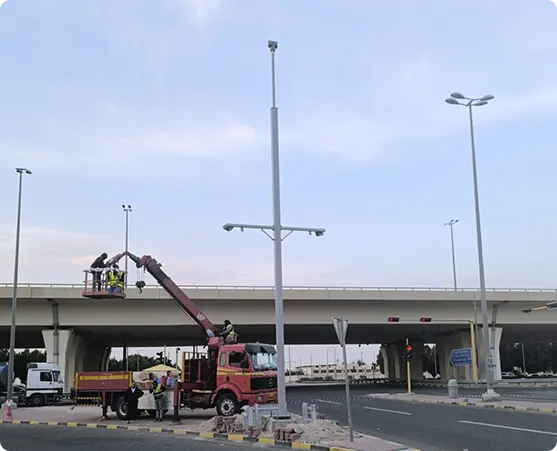
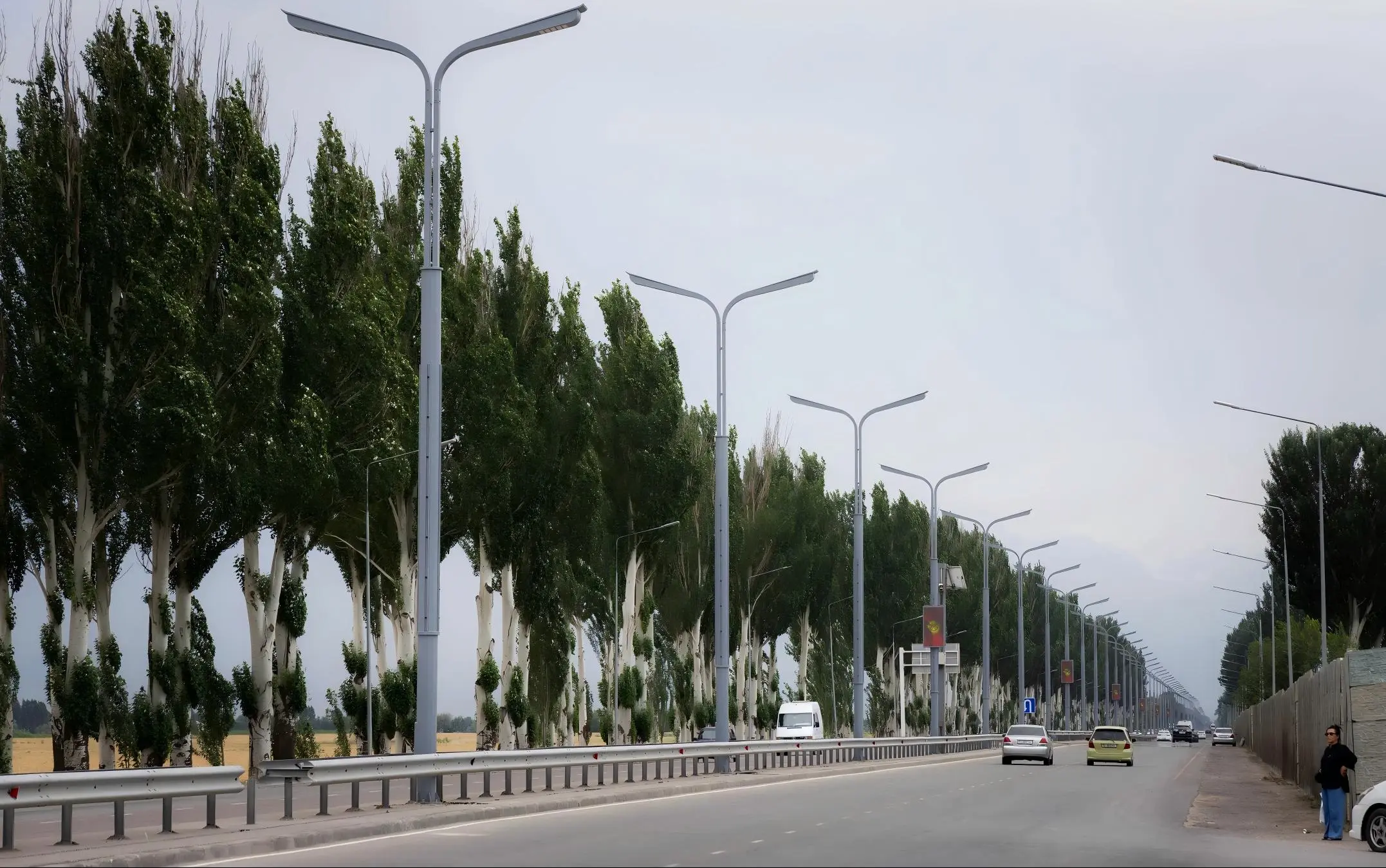
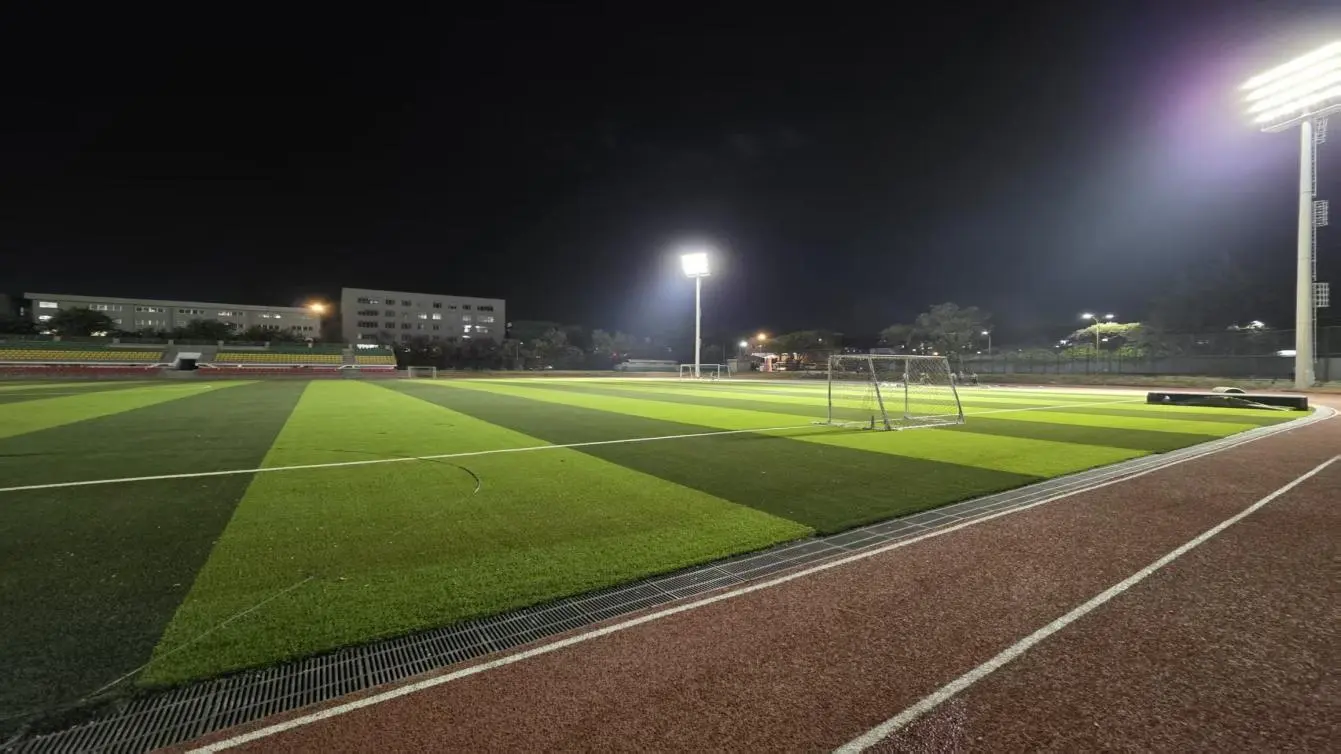
Municipal, Distribution & High Mast Infrastructure
Explore our complete portfolio covering heavy industrial masts, smart city multifunctional poles, distribution utility pylons, and off-grid solar illumination arrays.
Buy XINTONG Municipal Street Light Pole Series
High-Quality STADIUM SERIES High Mast Light
OEM XT-YTH-9 Series (All-In-One) Solar Fixture
OEM AIRPORT-PORT SERIES High Mast Light

Buy XT-YTH-3 Series (All-In-One) Solar Pole

Best Series Decorative Street Light Pole

High-Quality URBAN-GRID Series Steel Power Poles

OEM XINTONG Multifunctional Smart City Light Poles
Frequently Asked Engineering & Procurement Questions
Detailed technical answers to common queries submitted by consulting engineers, EPC procurement officers, and municipal project directors.
Are you a direct manufacturing factory or an export intermediary?
Yangzhou Xintong Traffic Equipment Group is a direct manufacturer established in 1999. Our 100,000 m² heavy industrial production base in Gaoyou, Jiangsu houses 7 comprehensive production lines: CNC steel shearing, 16m hydraulic press braking, SAW longitudinal welding, dedicated hot-dip galvanizing baths, automated powder spray coating, and precision assembly lines for mechanical winches and luminaires. Clients are welcome to conduct on-site factory audits or arrange real-time live video inspections.
How does the mechanical positive latching mechanism work on high masts?
Our lowering system features a mechanical 3-point positive docking lock located in the head frame crown assembly. When the luminaire carriage reaches maximum elevation, guided latching barrels mechanically engage with high-tensile stainless steel locking pins. Reversing the winch releases hoist cable tension completely. This transfer of load onto the structural shaft prevents continuous wire rope stress, eliminates fatigue stretching, and acts as a mechanical fail-safe against cable failure.
What international engineering standards govern your high mast design?
We manufacture to AASHTO Standard Specifications for Structural Supports for Highway Signs, Luminaires, and Traffic Signals, EN 40-3, Eurocode 3 (EN 1993), and UK Technical Report No. 7. Hot-dip galvanizing complies strictly with ASTM A123, ISO 1461, and BS 729. With each export shipment, Xintong delivers original mill test certificates (EN 10204 3.1), ultrasonic weld inspection records, zinc coating thickness validation, and engineer-stamped structural calculation reports.
How are the mast shafts designed against extreme wind speeds and vortex shedding?
Shafts are designed as 12, 16, or 20-sided polygonal cross-sections fabricated from high-yield Q355B/D structural steel. Polygonal geometries disrupt lateral vortex street formation far better than cylindrical profiles. Our structural engineering department models finite element stress distributions and natural frequencies to ensure the first and second vibration mode vortex resonance occurs well outside local 50-year return period design wind gusts (engineered up to 260 km/h).
What anti-corrosion systems do you apply for coastal marine (C5-M) installations?
For maritime ports, offshore container logistics centers, and coastal roadways, we utilize an advanced duplex anti-corrosion barrier system. Steel shafts undergo chemical pickling followed by hot-dip galvanizing to achieve an average zinc layer thickness of 86 µm to 120 µm. A secondary pre-treatment and electrostatic thermoset polyester powder coating is applied (AkzoNobel or equivalent, 100+ µm) to guarantee 25+ years of zero-maintenance structural longevity.
What project parameters are required to generate a tender-ready DIALux simulation?
To produce an authoritative photometric calculation report and structural proposal, please supply: target area dimensions or CAD DWG drawings, target average illuminance (lux) and overall uniformity ratio (Uo), mounting height limitations, local 3-second design wind speed (m/s), preferred luminaire distribution (CCT, Ra, optics), utility supply voltage, and any local municipal tender specification criteria.
Initiate Your Technical Review & Tender Bid Calculation
Engage directly with our factory structural and electrical engineering department. Bypass generic sales agencies and obtain immediate tender compliance support, customized CAD drawings, bill of quantities (BOQ) cost optimization, and photometric DIALux models.
Verified Corporate Registry & Manufacturing Site
- Corporate Entity:
- Yangzhou Xintong Traffic Equipment Group Co., Ltd.
- Industrial Plant Address:
- Guoji Industrial Concentration Area, Suiqiao Town, Gaoyou City, Jiangsu Province, China
- Production Capability:
- 100,000 m² Facility · 7 Automated Production Lines · 500+ Staff · In-House Galvanizing
- Tender Qualifications:
- EN 40 · ASTM A123 · AASHTO LTS · ISO 9001 / 14001 / 45001 · CE Compliant