
High-Mast & Specialized Infrastructure Luminaires
Direct factory-engineered systems manufactured in accordance with EN 40, ASTM A123, and AASHTO structural criteria. Explore our specialized container yard, airport apron, and municipal engineering lighting assemblies.

Designed specifically for intermodal container yards, maritime quays, and airport aprons with motorized raising and lowering systems.
Ultra-high wattage floodlighting head-frames engineered for severe glare control, extensive reach, and uniform foot-candle coverage.

Thickened Q355B low-alloy structural steel certified for high-velocity coastal typhoon corridors and heavy wind-load applications.

Octagonal and square profiles accommodating OCR container cameras, IoT sensors, environmental monitors, and 5G nodes.
Polygonal steel masts for multimodal freight terminals, dry port interchanges, and major logistics marshaling yards.
Single and double arm configurations tailored for port internal access corridors, customs check zones, and gate facilities.

Integrated monocrystalline PV with LiFePO4 storage for perimeter security boundaries where trenching is unfeasible.

Hot-dip galvanized external lighting poles offering continuous durability under salt-spray maritime atmospheric environments.
Container Terminal Photometrics & Structural Mechanics
Modern container terminals require sophisticated optical modeling to eliminate deep shadow canyons between multi-tiered container stacks while preventing debilitating glare for crane operators and haulage drivers.
The High-Mast Challenge in Deep-Sea Port Yards: Intermodal freight terminals present some of the most unforgiving industrial operating environments on earth. Operating continuous 24/7/365 vessel turnaround schedules, automated container terminals (ACTs) and traditional logistics yards rely heavily on high mast lighting systems (typically 25m to 40m in height) to deliver uniform horizontal and vertical illuminance across expansive staging lanes.
Unlike standard highway illumination, container yard lighting must pierce the steep vertical chasms formed by container stacks stacked 4-high to 6-high (10.4m to 15.6m). Poor photometric planning produces high-contrast shadow pockets where Rubber-Tired Gantry (RTG) operators, Rail-Mounted Gantry (RMG) drivers, and reach stacker operators lose critical depth perception, creating hazardous conditions during container slotting and twistlock engagements.
Photometric Engineering Threshold: Top-tier international port specifications mandate a maintained horizontal illuminance ($E_h$) of 30 to 50 lux across container storage blocks, rising to 50–100 lux in designated interchange transfer zones, with an overall uniformity ratio ($U_0 \ge 0.40$). Crucially, the glare index must remain rigorously controlled ($GR < 45$) to safeguard crane driver lines of sight.
Yangzhou Xintong Traffic Equipment Group Co., Ltd., founded in 1999, addresses these rigorous parameters through integrated DIALux ray-tracing simulation, custom CNC tandem press-brake metal forming, and in-house hot-dip galvanizing, transforming structural steel plates into certified high-mast assets installed across 80+ countries worldwide.
Key Terminal Optical & Mechanical Requisites
A high-performance container yard lighting infrastructure demands a synthesis of three core disciplines:
- 01 Asymmetric Forward-Throw Photometry: Precise batwing or asymmetric optical lens distributions that push light deep between container slots while cutting off high-angle spill light toward nearby waterways and airport flight corridors.
- 02 Dynamic Wind-Load Deflection Stability: Polygonal structural shafts (16-sided or 18-sided) calculating first and second-mode vortex shedding to avoid luminaire vibration fatigue under coastal typhoons.
- 03 Ground-Level Maintenance Access: Internal electromechanical hoisting winches with stainless steel wire ropes (AISI 316) and positive latching head assemblies that eliminate mobile crane rental during fixture servicing.
High Mast Technical Parameters & Structural Specs
Comparison of factory-standard polygonal masts configured for container terminals, maritime berths, and intermodal logistics zones.
| Mast Class | Typical Height | Shaft Geometry | Steel Grade | Wind Rating | Lifting System | Luminaires |
|---|---|---|---|---|---|---|
| CY-HM-25M | 25 Meters | 12 to 16-Sided Telescopic | Q355B / ASTM A572 Gr 50 | Up to 160 km/h | Motorized Raising/Lowering | 6 – 8x 600W LED |
| CY-HM-30M | 30 Meters | 16 to 18-Sided Polygonal | Q355B / Q355D Low Temp | Up to 180 km/h | Dual-Drum Winch + Auto Latch | 8 – 12x 800W LED |
| CY-HM-35M | 35 Meters | 18 to 20-Sided Polygonal | Q355B / EN 10025 S355JR | Up to 200 km/h | Mechanical Docking Latch | 12 – 16x 1000W LED |
| CY-HM-40M (Heavy) | 40 Meters | Multi-Flanged Polygonal | High Yield Q355 / Q460 | Typhoon Grade (240 km/h) | Internal Fixed Ladder/Cage or Winch | 16 – 24x 1200W LED |
Integrated Macroscopic Terminal Lighting Architecture
Container terminal performance is measured in TEU (Twenty-foot Equivalent Unit) moves per hour. Lighting is not an aesthetic afterthought—it is a critical industrial utility engineered around yard geometry and crane logistics.
Automated Terminal (ACT) Optimization
Next-generation container terminals operating Automated Stacking Cranes (ASC) and Automated Guided Vehicles (AGV) utilize customized dual-tier lighting profiles: low-intensity ambient baseline for LiDAR and vision navigation systems, automatically scaling up during manual intervention.
Anti-Corrosive C5-M Marine Protection
Marine port yards endure extreme electrolytic conditions: airborne salt crystals, sulfuric diesel exhaust, and high humidity. Our masts receive dual-layer protection: internal and external hot-dip galvanizing to ASTM A123 (>86 μm) followed by marine epoxy intermediate and polyurethane topcoats.
Optical Cutoff & Anti-Spill Glare Shields
Navigational channel safety mandates strict non-interference with maritime vessel bridge visibility. Our LED luminaires feature asymmetric lenses with integrated mechanical louvers to guarantee absolute upward light ratios (ULR = 0%) and zero back-spill into marine fairways.
Vertically Integrated Manufacturing in Jiangsu, China
Operating from our 100,000 m² heavy-fabrication facility in Gaoyou, Yangzhou Xintong Group delivers end-to-end quality control, from raw Baosteel plate forming to automated multi-stage galvanizing and photometric testing.
CNC Precision Plasma Cutting
High-definition CNC underwater plasma cutting systems process prime Q235B and Q355B coils up to 25mm thickness with sub-millimeter taper tolerances.
2,000-Ton Tandem Press Brake
Dual tandem computerized bending machines press continuous single-seam polygonal segments up to 14 meters in length, maximizing structural strength and minimizing transverse joints.
Submerged Arc Longitudinal Welding
Automated continuous submerged-arc welding machines deliver full-penetration longitudinal welds, followed by ultrasonic non-destructive testing (NDT) to prevent structural cracking.
Total Immersion Galvanizing Bath
Integrated 15-meter galvanizing bath executes degreasing, pickling, fluxing, and molten zinc immersion at 450°C, ensuring internal and external corrosion resistance exceeding 25+ years.
Global Enterprise Sourcing & Tender Requirements
What international EPC contractors, port authorities, and terminal operators (including PSA, DP World, APM Terminals) demand when qualifying high mast suppliers.
Structural Design Norms
Masts engineered according to AASHTO Standard Specifications for Structural Supports for Highway Signs, Luminaires, and Traffic Signals, or European Standard EN 40-3. Calculations account for 3-second gust wind speeds up to 60 m/s with full luminaire EPA (Effective Projected Area) loading.
Photometric Verification Files
Procurement teams require verifiable DIALux lighting design models (.IES / .EULUMDAT) adhering to EN 12464-2 (Lighting of Outdoor Workplaces - Container Terminals) and IES RP-37-15. Detailed simulations must prove target lux, uniformity ratios, and low Glare Rating (GR).
Third-Party FAT & Material Traceability
Full Factory Acceptance Testing (FAT) documentation, including Mill Test Certificates (MTC) EN 10204 Type 3.1, magnetic zinc coating thickness reports, cross-hatch paint adhesion tests, weld NDT records, and third-party inspection audits (SGS, Bureau Veritas, TÜV).
Global Infrastructure Case Studies & Proven Installations
Demonstrated operational reliability across major maritime terminals, municipal arteries, and harsh climatic environments.
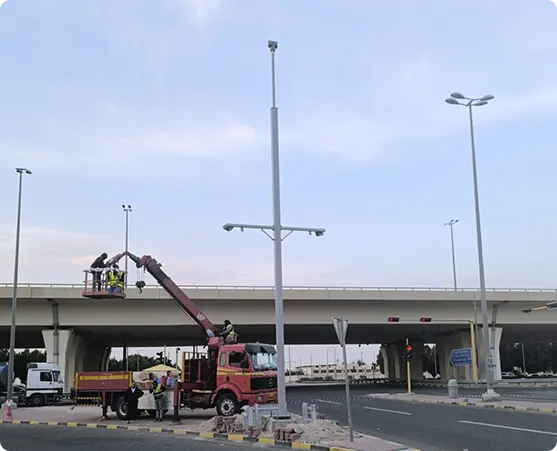
Cebu Baseport Terminal 2 & 4 High Mast System
Manufactured and supplied customized 30-meter polygonal high-mast lighting towers equipped with raising and lowering gear, engineered to withstand Western Pacific typhoon seasons while ensuring continuous cargo handling operations.
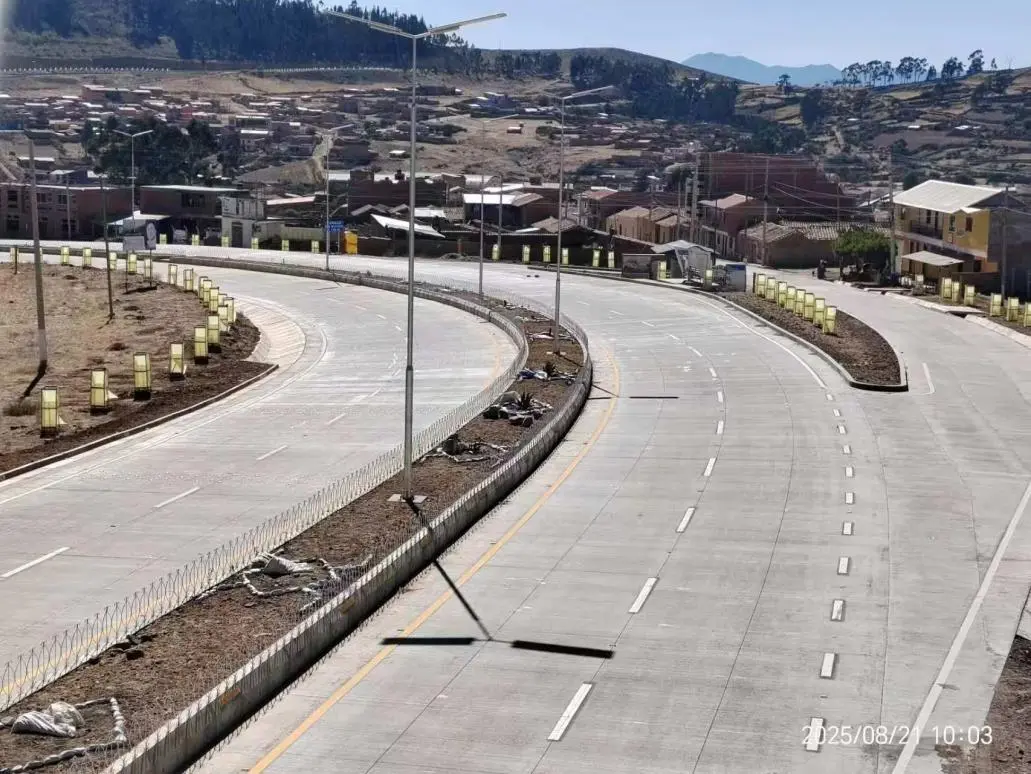
Chancay Megaport Logistics Corridor Lighting
Supplied heavy-duty municipal and perimeter lighting poles engineered for high-salinity coastal conditions serving the primary intermodal transport artery of South America's most modern deep-water shipping hub.
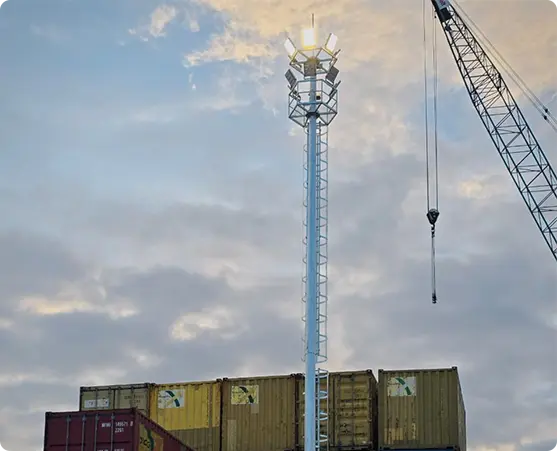
Desert Freight Security & Camera Mast Systems
Engineered structural camera poles and high mast perimeter platforms built with thermal dissipation enhancements and sandstorm-resistant seals to ensure round-the-clock freight customs surveillance.
Next-Generation Smart Port High Mast Systems (2026–2035)
The convergence of automated terminal logistics, carbon-neutral port mandates, and IoT infrastructure is transforming container yard lighting towers from static steel poles into active digital assets.
TOS-Integrated Adaptive Dimming
Direct API synchronization with Terminal Operating Systems (such as Navis N4, CyberLogitec, or Tideworks). Lighting levels dynamically ramp up across designated container blocks only when work orders are scheduled for specific crane gangs, slashing overall port electricity consumption by up to 45%.
Port Edge Multi-Sensor Integration
Transforming high mast crowns into elevated communication nodes. In addition to LED luminaires, masts integrate long-range LiDAR sensors, optical character recognition (OCR) container scanning arrays, anemometer wind alert relays, and private 5G industrial small cells for automated terminal fleets.
Microgrid & Solar-Hybrid Buffers
Decoupling container terminal lighting from vulnerable municipal power grids. Future port masts are engineered to interface with local clean energy microgrids, integrating modular DC-bus solar arrays and localized energy storage for uninterrupted emergency operations during brownouts.
Container Yard High Mast Lighting FAQ
Comprehensive answers to technical, commercial, and logistical queries submitted by port engineers, EPC project directors, and procurement managers.
Are you a direct manufacturing factory or an export intermediary?
Xintong is an established manufacturer founded in 1999. We operate an owned 100,000 m² industrial production base in Gaoyou, Jiangsu Province, China. Our facilities feature 7 dedicated heavy-industry lines covering steel plate cutting, tandem bending, longitudinal welding, full-immersion hot-dip galvanizing, electro-static coating, and LED / solar system assembly. International clients are welcomed to audit our facility in person or via live video audits.
What international standards and structural codes do your masts adhere to?
Our structural high masts, street light poles, and power transmission shafts are engineered to EN 40, ASTM A123 / A153, AASHTO, and ISO 9001 / ISO 14001 certifications. Calculations are verified for wind-load limits, deflection factors, and seismic forces according to the local building codes of your project destination. Material mill certificates (Q235B, Q355B, Q355D) are issued with every export batch.
Do you supply complete turnkey systems or only individual mast poles?
We provide full-scope turnkey solutions. Beyond the structural steel mast and internal raising/lowering winches, our in-house engineering team provides complete optical simulation packages (DIALux IES studies), luminaire fixtures, smart central control nodes, lightning protection assemblies, foundation template cages, anchor bolts, and remote or on-site commissioning supervision.
What technical parameters are needed for an accurate high-mast quotation?
To produce an authoritative structural calculation and photometric model, we require: container yard CAD layout or area dimensions, container stacking height (e.g., 1-over-4 or 1-over-5), target average lux ($E_{av}$) and uniformity ($U_0$), local design wind speed (m/s or km/h), power supply voltage and frequency, whether raising-and-lowering or fixed head-frame is specified, and delivery Incoterms.
How do you guarantee corrosion protection in aggressive C5-M marine climates?
Container yard masts are fabricated from high-grade structural steel and completely submerged into an automated hot-dip galvanizing bath at 450°C, producing a metallurgical zinc-iron alloy coating with a minimum thickness of 86–100 μm. For coastal marine ports, we apply an optional duplex coating system comprising an epoxy intermediate barrier coat and aliphatic polyurethane topcoat delivering 25+ years of anti-corrosion protection.
How does the motorized raising and lowering mechanism operate safely?
Our raising and lowering system features an internal self-braking worm gear winch driven by an integrated or portable electric tool. The luminaire ring is hoisted by multi-strand AISI 316 stainless steel aircraft cables. Upon reaching the top of the mast, a mechanical latching mechanism automatically locks the ring into the head assembly, transferring all static weight away from the cables during normal operation.
Can your optical systems minimize glare for crane and reach-stacker drivers?
Yes. Glare control in container terminals is essential to prevent operator blinding. We utilize precision asymmetric optical lenses with sharp forward cut-off angles combined with internal honeycomb louvers. This confines the beam strictly to container blocks and access lanes, maintaining a Glare Rating of GR < 45 in full compliance with EN 12464-2 outdoor industrial standards.
What warranty coverage and after-sales support do you extend internationally?
We provide standard 5 to 10-year comprehensive warranties covering structural shafts, hot-dip galvanizing adherence, raising-and-lowering mechanical winches, and LED luminaires. In the event of a warranty claim, factory-direct component replacements and technical dispatch support are coordinated promptly via our dedicated global export project office.
Heavy-Duty Commercial, Solar & Utility Pole Systems
Complete project-scale supply of municipal street poles, off-grid split-type solar infrastructure, and high-voltage steel power distribution shafts.

Independent PV panel mounting with custom battery storage engineered for high-latitude regions and long autonomy requirements.

Low-voltage steel power distribution poles engineered for container terminal sub-stations and yard electrical distribution networks.

Rapid deployment standalone solar luminaire for perimeter boundaries, checkpoints, and remote security gates.

Aesthetic architectural lighting columns designed for terminal administrative complexes, passenger ferry terminals, and plazas.
Heavy-gauge octagonal and polygonal steel masts engineered for high-altitude apron floodlighting and logistics yards.
Large cross-arm head-frames engineered for asymmetrical floodlights with full aiming degree calibrations.
Flanged base plates and high-tensile anchor bolt assemblies designed to resist severe seismic and storm surges.
Turnkey municipal lighting columns for railway container yards, dry ports, and highway interchanges.
Consult Directly with Our Export Engineering Team
Send your project tender specifications, CAD layout drawings, or Bill of Quantities (BOQ). Our structural engineers and DIALux lighting specialists will provide an engineering design review, structural wind-load calculation, and tender-ready commercial quotation within 24 hours.
Tender Submittal Guarantee
- Full DIALux 3D Lighting Simulations
- AASHTO / EN 40 Wind-Load Calculations
- ASTM A123 Hot-Dip Zinc Coating Reports
- Independent Third-Party FAT Audits
- Up to 10-Year Factory Comprehensive Warranty