
Factory-Direct IEC Certified Solar Luminaires & Engineering Poles
Explore serialized solar lighting systems and structural steel light poles manufactured to EN, ASTM, and AASHTO standards. Verified for harsh wind loads, severe temperature cycling, and long-term off-grid autonomy.

Buy XT-YTH-3 Series (All-In-One) Exporter, Exporters

OEM XT-YTH-9 Series (All-In-One) Factory, Factories

Best XT-DT-1 Series (Split Type) Manufacturer, Factories

Buy XINTONG Municipal Street Light Pole Series Factories, Exporter

OEM XINTONG Multifunctional Light Poles Integrated Design, Octagonal, Conical & Square Poles

Custom XINTONG High Strength Light Pole Series: Engineered for Extreme Conditions & Heavy Loads

OEM PUBLIC TRANSIT Series Municipal High Mast Poles Manufacturers, Supplier

Best Series Decorative Street Light Pole Manufacturers, Manufacturer
Enterprise Procurement Dynamics: Transitioning to IEC Utility-Grade Solar Assets
In municipal, sovereign, and cross-border EPC infrastructure developments, commercial off-the-shelf (COTS) solar lighting carries fatal total-cost-of-ownership (TCO) liabilities. Realizing a 25-year structural service life demands rigorous alignment with International Electrotechnical Commission (IEC) standardization.
Systemic Risk Mitigation
Non-certified luminaires frequently suffer from thermal runway in lithium chemistries, accelerated lumen depreciation (L70 at <15,000 hours), and galvanic degradation across weld seams. Sourcing from accredited IEC factories transforms lighting procurement into an audited capital asset with predictable OPEX curves.
- Elimination of uncertified pouch cell thermal failures
- Third-party audited Type Test Reports (ILAC / CNAS)
- Traceability of heat-number chemical metallurgy
Bankability & Multilateral Tenders
Concessionary funding mechanisms, including the World Bank, Asian Development Bank (ADB), AfDB, and Islamic Development Bank (IsDB), stipulate strict compliance with IEC benchmarks. Bids lacking verified photometric distributions, luminaire safety certificates, or ISO 1461 galvanization proofs face prompt technical disqualification.
- Pre-cleared submittal packages for rapid EPC approval
- Guaranteed compliance with AASHTO / EN 40 structural limits
- Verified 10-year holistic factory warranty architectures
LCoL Optimization Strategy
Evaluating the Levelized Cost of Light (LCoL per lumen-hour) demonstrates that higher upfront investments in Tier-1 IEC solar lighting generate net capital savings within 28 to 36 months via zero grid trenching, zero cabling infrastructure, and reduced maintenance dispatch cycles.
- 100% elimination of transformer and underground cable runs
- Smart MPPT efficiency >99% with adaptive dimming logic
- Reduced field labor through plug-and-play modularity
Essential IEC Regulatory Matrix for Global Municipal Tenders
Procurement authorities must ensure that technical submittals decouple luminaire ratings, photovoltaic generation, energy storage cells, and structural poles into verifiable test standard compliance:
| Subsystem | Harmonized Standard | Mandatory Test Criteria | Infrastructure Impact & Engineering Significance |
|---|---|---|---|
| LED Luminaire Head | IEC 60598-2-3 / IEC 62722-2-1 | Photometric performance, electrical insulation, endurance testing, thermal cycling up to +55°C. | Guarantees 190–210 lm/W system efficacy and eliminates driver breakdown from continuous ambient highway heat. |
| PV Generation | IEC 61215 / IEC 61730 | Mechanical load test (5400 Pa snow, 2400 Pa wind), PID resistance, UV exposure, damp heat testing. | Prevents micro-cracks and delamination in monocrystalline modules, ensuring 85% power retention at Year 25. |
| Lithium Battery Storage | IEC 62133-2 / IEC 62619 | Overcharge safety, short circuit abuse, mechanical drop, thermal shock, forced internal discharge. | Precludes hazardous fire hazards; validates Grade-A LiFePO4 cells delivering >4,000 deep cycles @ 80% DoD. |
| Mechanical Enclosure | IEC 60529 / IEC 62262 | Ingress protection IP66/IP68; mechanical impact rating IK09/IK10 (20 Joules kinetic impact). | Guarantees hermetic sealing against heavy sandstorms, tropical typhoons, and vandalism across public right-of-ways. |
| Galvanized Steel Pole | ISO 1461 / EN 40-5 / ASTM A123 | Batch zinc coating thickness (≥86 μm), tensile/yield metallurgical stress tests (Q235B/Q355B). | Ensures ductile resilience against catastrophic fatigue failure under sustained 60 m/s Category-5 hurricane wind events. |
Macro-Industry Solutions for Harsh Environmental Operating Theaters
A standard lighting blueprint cannot survive disparate geographical stressors. Yangzhou Xintong engineers custom configurations calibrated against regional climate vectors, dust deposition rates, ambient temperatures, and localized wind shear.
Arid & High-Heat Deserts
Deployment: MENA Region, GCC, Sahara Corridors.
Ambient conditions exceeding +50°C trigger severe battery degradation and thermal throttling. Systems incorporate thermally decoupled battery chambers buried sub-surface or shielded beneath PV modules, combined with high-tilt self-clearing PV angles to shed desert dust accumulations without sand abrasion damage.
- Operating thermal envelope: -20°C to +65°C
- Hydrophobic anti-dust glass nano-coatings
Maritime Ports & Saline Coasts
Deployment: Seaports, Maritime Terminals, Island Highways.
High relative humidity paired with airborne chlorides quickly attacks inferior steel and die-cast alloys. We employ ISO 12944 C5-M marine-grade anti-corrosive coating over hot-dip galvanized steel, marine-anodized ADC12 aluminum luminaire housings, and 316-grade stainless steel fasteners.
- 1,500+ hours neutral salt spray resistance
- Pressure-equalizing Gore® breather valves
Monsoon & Typhoon Corridors
Deployment: Southeast Asia, Philippines, Caribbean Basins.
Sustained cyclonic forces impose high aerodynamic drag and vibration strains on bracket assemblies. Posts utilize octagonal and conical geometries manufactured from high-yield Q355B structural steel, substantiated by dynamic finite element analysis (FEA) to endure 60 m/s wind gusts.
- Submerged arc welding with full penetration
- Reinforced anchor bolt baseplates (up to 30mm)
Sub-Zero Alpine & Continental
Deployment: Central Asian Steppes, High-Latitude Arterials.
Lithium chemistries cannot safely accept recharge current below 0°C without lithium plating and fatal internal degradation. Our systems integrate intelligent thermal BMS architectures with integrated internal silicone heating elements and split-tilt solar orientation for maximum low-winter solar yield.
- Cold-charge protection down to -40°C
- Steep 45°–60° snow-shedding angle engineering
Engineering Roadmap: High-Efficiency Photovoltaic & Smart IoT Integration
The progression of off-grid infrastructure is defined by solid-state components, high-density cell chemistry, and automated machine-to-machine telemetry. Explore Xintong's technological roadmap spanning 2026 through 2030.
Next-Gen PV Generation (TOPCon & HJT)
Moving beyond standard p-type PERC, Xintong has standardized on N-Type TOPCon and Heterojunction (HJT) bifacial solar modules. These cells exhibit significantly lower temperature coefficients (-0.30%/°C vs -0.38%/°C) and superior diffuse-light absorption in cloudy and overcast regions, raising daily energy capture by 18–24%.
- Cell conversion efficiency ≥24.8%
- Bifacial energy gain from ground albedo (up to 15%)
- Double-glass anti-microcrack encapsulation
Automotive Grade LiFePO4 & Smart BMS
We mandate brand-new Grade-A Lithium Iron Phosphate (LiFePO4) prismatic cells. Driven by multi-tier internal Battery Management Systems (BMS), each cell pack is safeguarded against over-voltage, deep discharge, high-current draw, and uneven internal thermal loading, sustaining over 4,000 deep cycles.
- 4,000+ lifecycle cycles at 80% Depth of Discharge
- Real-time cell-balancing algorithm
- Dual mechanical and thermal isolation barriers
Smart IoT & Cloud Central Management
Empowering municipal authorities through Zhaga Book 18 and ANSI C136.41 7-pin standard interfaces. Integrated LoRaWAN, NB-IoT, and 4G LTE cellular modules transmit critical runtime metrics—including panel voltage, battery state of charge (SoC), temperature, and diode integrity—to municipal operations centers.
- Dynamic traffic-responsive autonomous dimming
- Proactive fault detection and maintenance dispatch
- DarkSky-compliant zero upward lumen spill lenses
A 100,000 m² Dedicated Manufacturing Complex You Can Audit
From initial plate uncoiling and CNC laser beveling to high-amperage submerged arc welding, full-immersion hot-dip galvanization, and automated luminaire SMT assembly, Yangzhou Xintong maintains unified single-roof quality control in Gaoyou, Jiangsu.
Metallurgical Traceability
Every lighting pole, high mast tower, and power distribution post is cold-formed from certified primary Q235B, Q355B, and ASTM A572 Grade 50 structural steel. In-house mechanical and chemical testing verifies yield strength, elongation properties, and carbon equivalence before processing.
- EN 10204 3.1 Traceable Inspection Certificates
- Hydraulic press brake: 16-meter single-stroke capability
Corrosion Barrier: ISO 1461 Hot-Dip Galvanizing
Fabricated steel structures undergo multi-stage immersion pickling and fluxing before immersion in a 450°C molten zinc kettle (14-meter length capacity). This forms an indestructible metallurgical zinc-iron alloy barrier layer inside and outside the shaft wall, guaranteeing 25+ years of maintenance-free service.
- Zinc coating thickness ≥86 μm (exceeding ASTM A123)
- Electrostatic TGIC polyester powder finish in RAL hues
Optical, Photometric & DIALux Engineering
Our dedicated engineering department conducts complete DIALux simulations to balance illuminance requirements (lux), uniformity ratios (Uo), and threshold increments (TI). Production quality is validated by Class-A goniophotometers, integrating spheres, and ultrasonic weld thickness testers.
- Full IES and EULUMDAT files provided with each bid
- Ultrasonic non-destructive weld testing (NDT)
Proven Performance Across Sovereign Ports, Highways & Public Utilities
From deep-water container terminals to high-altitude international airport highways, Xintong infrastructure components fulfill contractual delivery milestones and technical illumination specs worldwide.
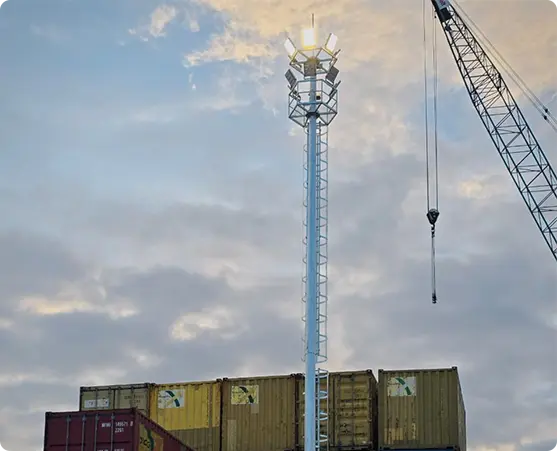
Cebu Baseport Terminal 2 & 4 Container Yard Illumination
Manufactured and shipped customized polygonal 30-meter high mast lighting systems with motorized raising and lowering crowns. Designed to resist harsh maritime typhoon wind gusts and saline air corrosion for 24/7 port logistics handling.
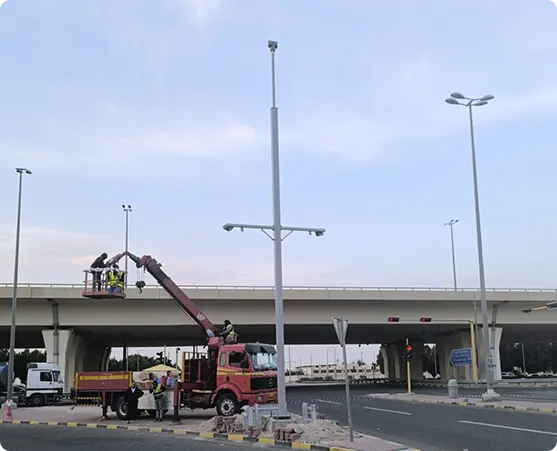
Desert Corridor Surveillance & Smart Highway Columns
Engineered heavy-duty polygonal surveillance and lighting poles engineered to accommodate continuous solar power feeds and heavy optical camera payloads amidst searing desert temperatures exceeding +55°C and severe sandstorms.
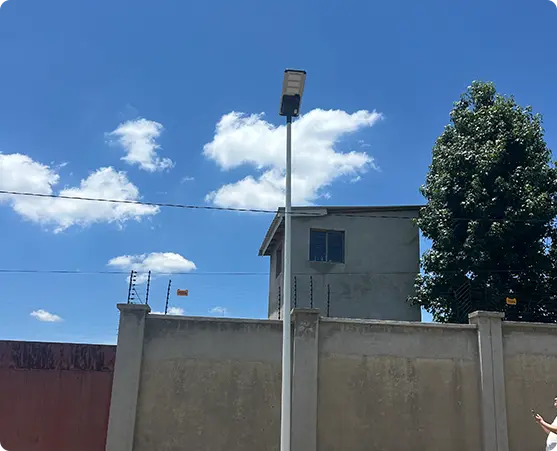
Off-Grid Roadway Resilience: 7m / 60W Solar Deployments
Executed large-scale deployment of integrated solar street lights to maintain traffic safety throughout municipal sectors during nationwide utility load-shedding events, delivering reliable autonomy without reliance on regional grid power.
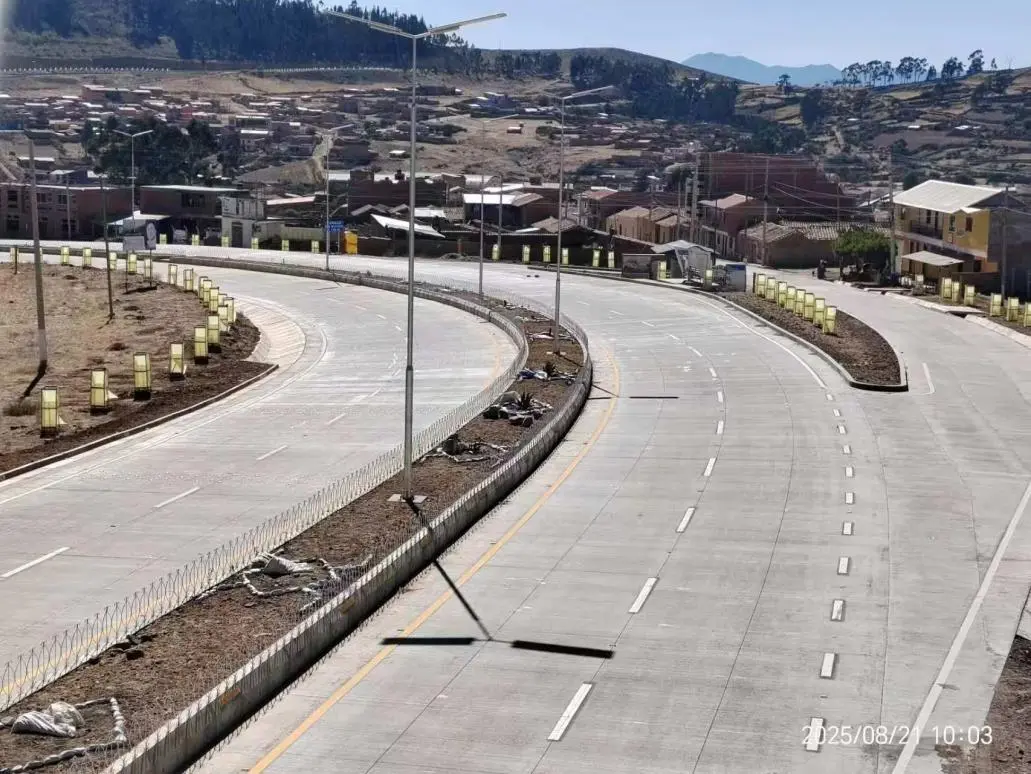
Deep-Water Port Logistics Corridor Lighting
Supplied independent off-grid solar roadway lighting systems flanking the newly constructed logistics arterial corridors of Chancay Port, ensuring clear visibility for heavy multi-axle freight movement under humid coastal conditions.
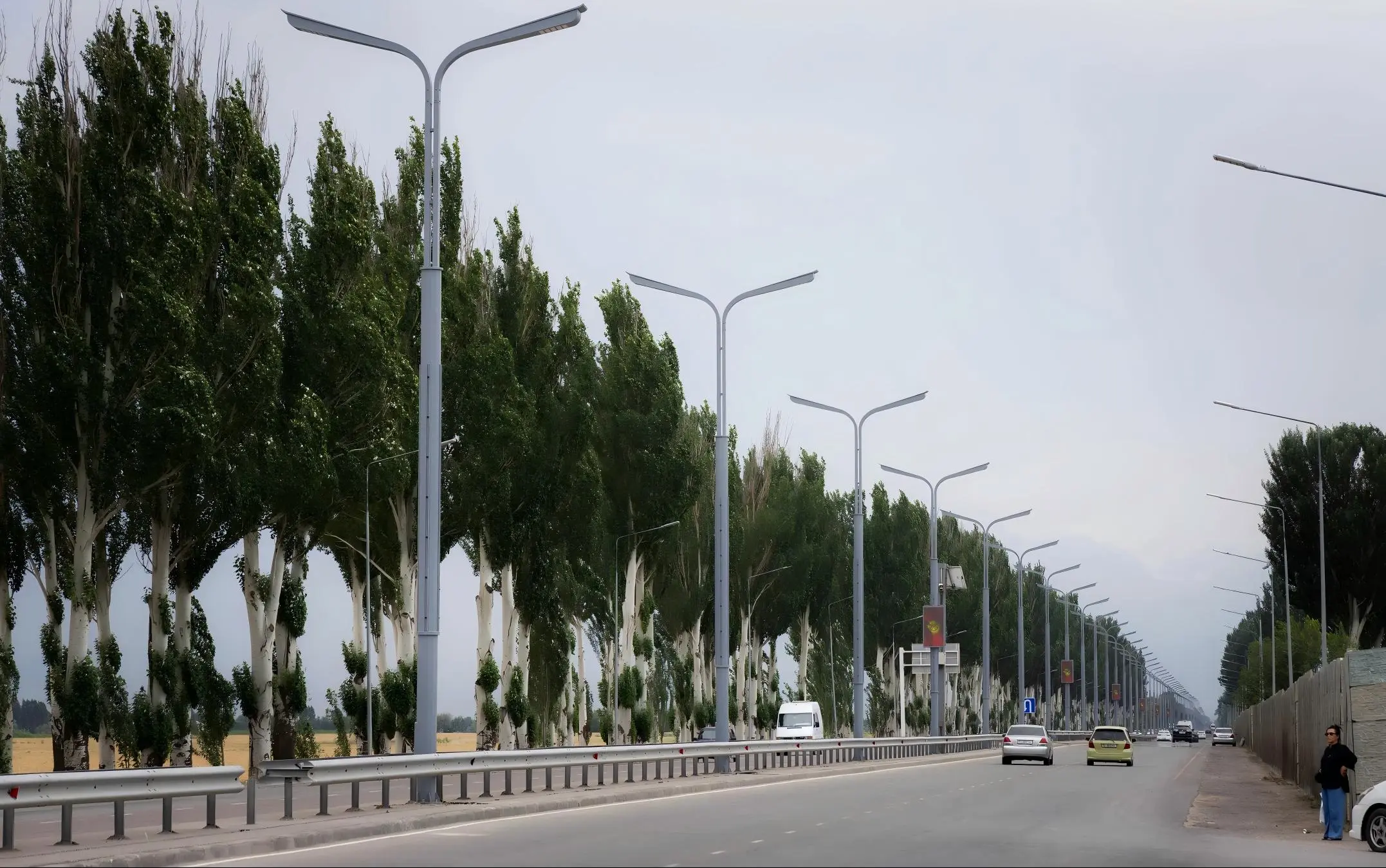
Manas International Airport to Bishkek Highway Project
Delivered customized double-arm hot-dip galvanized conical steel light poles engineered to endure severe continental frost, mechanical snow removal impacts, and high seasonal temperature differentials along a high-speed airport arterial.
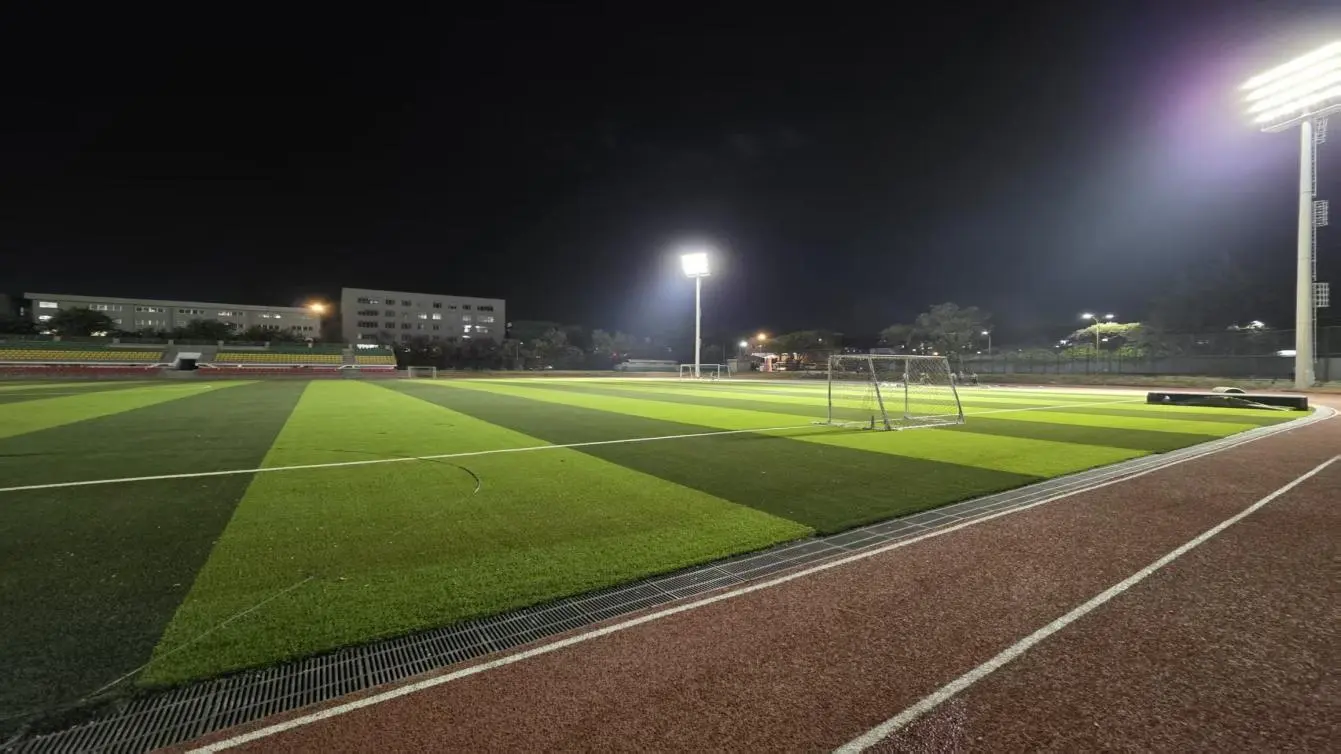
National Stadium & Athletics Track High Mast Lighting
Designed and manufactured polygonal floodlighting towers featuring custom headframes, delivering uniform glare-controlled lux distribution across the athletic grounds in full alignment with international sporting federation illumination standards.
Streamlined EPC Compliance, Documentation & Localized Execution
Tenders are often delayed by incomplete technical compliance submittals. Yangzhou Xintong supplies a turnkey technical documentation binder tailored to your local transport authority, ensuring first-round submittal approvals.
Full CAD & 3D Modeling
Parametric drawings covering base plates, anchor bolt patterns, flange connections, and cross-arm geometries. Provided in DWG, DXF, and STEP formats for seamless integration into municipal BIM models.
Structural Wind Calculations
Finite element wind load reports calibrated against local design gust velocities (from 35 m/s to 60 m/s), factoring in EPA (Effective Projected Area) of solar arrays, luminaire head, and camera payloads.
Customs & Export Compliance
Comprehensive export documentation services including SASO/SABER (Saudi Arabia), SONCAP (Nigeria), Certificate of Origin (Form E, Form F, EUR.1), and third-party inspection certifications via SGS, BV, or Intertek.
Foundation & Geotech Sizing
Civil foundation schematics tailored to local soil bearing capacities ($q_a$). Includes recommended rebar cages, concrete embedment depths, and high-tensile Grade 8.8 galvanized anchor bolt kits.
Technical & Procurement FAQ: Certified Solar Lighting Infrastructure
Detailed engineering explanations answering the structural, electrical, and photometric inquiries raised by overseas consulting engineers, procurement directors, and municipal tender boards.
Are you a direct manufacturing factory or an export intermediary?
Yangzhou Xintong is a verified manufacturer founded in 1999. We own and operate a 100,000 m² production complex in Gaoyou, Jiangsu Province, China. Our facilities feature 7 comprehensive production lines dedicated to steel uncoiling, tandem CNC bending, automatic submerged arc welding, hot-dip galvanization, electrostatic spray coating, and robotic LED/solar module assembly. Sourcing directly eliminates middleman markups and gives you direct engineering access.
How do you calculate battery capacity and autonomy during consecutive rainy days?
Autonomy sizing follows the formula: $B_{Ah} = (P_L \times T_h \times D_{aut}) / (V_{sys} \times DoD \times \eta_{temp})$, where $P_L$ is luminaire wattage, $T_h$ nightly run hours, $D_{aut}$ required overcast autonomy days (typically 3 to 5), $V_{sys}$ system voltage (12.8V or 25.6V), $DoD$ battery depth of discharge (80% for LiFePO4), and $\eta_{temp}$ thermal degradation factor. This ensures zero lighting interruptions even under extended monsoon periods.
What prevents lithium battery degradation under extreme desert heat (>50°C)?
We deploy three structural thermal management strategies: First, utilizing high-stability LiFePO4 chemistry with chemical decomposition thresholds above 270°C. Second, mounting the battery housing with physical air gaps underneath the solar panel or utilizing sub-surface underground polymer vaults to maintain an ambient operating envelope between 20°C and 35°C. Third, our proprietary BMS executes adaptive charging current derating when internal cell probes detect temperatures >55°C.
How do Xintong steel poles achieve an audited 25-year structural design life?
Structural longevity is achieved through certified chemical metallurgy (Q235B / Q355B steel conforming to EN 10025) and hot-dip galvanization according to ISO 1461 and ASTM A123. The entire fabricated shaft is pickled and submerged in 450°C molten zinc, forming an iron-zinc alloy coating with minimum 86 μm thickness. This provides both cathodic and physical barrier protection against atmospheric oxidation, further enhanced by optional UV-stabilized architectural powder coating.
What is the engineering difference between All-in-One and Split-Type configurations?
All-in-One (Integrated) units house the PV panel, LiFePO4 pack, smart MPPT controller, and LED array within a single casing—ideal for rapid installation on residential streets, campuses, and 4m–8m mounting heights with low wind drag. Split-Type systems decouple the solar panel and battery from the luminaire head, allowing independent angle orientation toward optimal solar vectors and accommodating larger PV panels (>300W) and battery capacities for 8m–12m expressways and multi-lane arterials.
What technical inputs are required to generate an audited tender proposal?
To produce an authoritative technical submittal and DIALux photometric design, our engineering team requires: (1) Road cross-section geometry, lane widths, and setback distance; (2) Target lighting class (e.g., M1–M5 per EN 13201 or IES RP-8) or target lux level; (3) Project site coordinates (for peak sun hour PSH analysis); (4) Local design wind speed ($V_{des}$ in m/s); (5) Desired mounting height and autonomy days; and (6) Required delivery Incoterm and destination port.
Heavy Mast Towers & Municipal Steel Infrastructure
Review our specialized high mast towers, utility power transmission columns, and municipal lighting pole series available for factory-direct container dispatch.
Custom XINTONG Full Series Municipal Street Light Poles Conical, Octagonal & Customizable Poles

High-Quality URBAN-GRID Series Urban Low Voltage Steel Power Distribution Poles
High-Quality STADIUM SERIES High Mast Light Factory, Exporter
OEM AIRPORT-PORT SERIES High Mast Light Manufacturer, Supplier
Buy XT-YTH-3 Series (All-In-One) Exporter, Exporters
OEM XT-YTH-9 Series (All-In-One) Factory, Factories
Best XT-DT-1 Series (Split Type) Manufacturer, Factories
Buy XINTONG Municipal Street Light Pole Series Factories, Exporter
Verified Manufacturer Profile
Yangzhou Xintong Traffic Equipment Group Co., Ltd. engages directly with international procurement teams, general EPC contractors, and sovereign infrastructure developers. Engage our senior technical staff for your bill of quantities (BOQ) review, DIALux photometric design studies, and factory audit scheduling.