
Featured Municipal Lighting Series (Top Direct Selections)
Engineered for extreme moisture resistance, high-salinity coastal exposure, and continuous all-night autonomous illumination across high-traffic arterials and rural utility grids.

Best XT-DT-1 Series (Split Type) Manufacturer

High-Quality URBAN-GRID Series Steel Poles

Buy XT-YTH-3 Series (All-In-One) Exporter

Buy XINTONG Municipal Street Light Pole Series

Best Series Decorative Street Light Pole

OEM PUBLIC TRANSIT Series High Mast Poles
OEM AIRPORT-PORT SERIES High Mast Light

OEM XT-YTH-9 Series (All-In-One) Factory
Waterproof Solar Street Lighting: Global Infrastructure Shift & Ingress Defense
Decentralized off-grid illumination has transitioned from simple rural electrification to high-capacity municipal expressways, maritime ports, and industrial logistics corridors. However, environmental ingress remains the single greatest point of premature field failure.
Thermal "Pumping" & Moisture Infiltration
Standard IP65 luminaires often fail within 12 to 24 months not from rain volume, but from the cyclic pressure differentials created by diurnal heating. During peak sun, internal luminaire temperatures reach 70°C. Sudden tropical downpours induce rapid cooling, creating negative vacuum pressure that sucks damp air and humid vapor through standard silicone seals.
- Causes micro-condensation on internal optics
- Accelerates driver solder joint electrochemical migration
- Triggers BMS over-current shutdown in humid air
ePTFE Breathable Membrane Defense
Xintong integrates dual-stage expanded Polytetrafluoroethylene (ePTFE) acoustic vents rated for IP68/IP69K environments. These specialized venting plugs allow gas molecules to exchange freely, preventing internal vacuum build-up while permanently barring liquid water, fine dust, and salt crystals.
- Pressure equalization prevents gasket deformation
- Continuous humidity reduction prevents lens fogging
- Zero maintenance requirements over 25+ years
Hermetic Cable Glands & Sealed Monocoques
Water siphoning along multi-strand copper cables is an industry-wide blindspot. Our luminaires utilize integrated polyamide compression glands with molded inner silicon grommets, backed by nitrogen-pressurized ultrasonic enclosure welding for drivers and Grade-A LiFePO4 cells.
- Eliminates capillary action along wiring harnesses
- Potting resin encapsulating the MPPT circuit boards
- Full immersion endurance up to 1.5m submersed
Gaoyou Lighting Ecosystem: Unrivaled Supply Chain Speed & Efficiency
Gaoyou in Jiangsu Province produces more than 70% of the world's municipal street light poles and integrated infrastructure. Yangzhou Xintong Traffic Equipment Group leverages this concentrated supply ecosystem to deliver audited technical quality at lower CapEx.
Full-Chain Vertical Integration
By owning every process from raw Q235/Q355 steel decoiling, automated tandem press brake longitudinal bending (up to 16 meters in a single stroke), submerged arc welding (SAW), to internal hot-dip galvanizing kettles, Xintong eliminates third-party manufacturing markups and guarantees 100% batch traceability.
Zinc-Bath Immersion to ASTM A123
Our in-house galvanizing line maintains a molten zinc bath at precisely 450°C. Cleaned steel masts receive an iron-zinc alloy diffusion layer exceeding 86 microns (610 g/m²). This metallurgical bond provides complete sacrificial anti-corrosion protection inside and out, verified for over 25 years of harsh outdoor service.
Lead Time & Tender Logistics Compression
Clustered component ecosystems allow rapid SMT assembly of LED engine boards, in-house LiFePO4 battery pack assembly with automated spot welding, and pre-wired anchor cage manufacturing. Large municipal orders of 2,000+ units ship in 18 to 22 business days, drastically outperforming regional overseas assembly hubs.
Localized Environments & Mission-Critical Application Engineering
Off-the-shelf commercial lights quickly fail when exposed to specialized regional stressors. Xintong engineers tailor system specs to local meteorological, solar irradiance, and geological realities.
Coastal Marine & Port Corridors (C5-M ISO 12944)
High air salinity and persistent ocean mist corrode die-cast aluminum alloys and zinc hardware rapidly. In ports like Cebu (Philippines) and Chancay (Peru), Xintong specifies marine-grade low-copper aluminum (AlSi10Mg), fluorocarbon exterior powder coating, 316 stainless steel external screws, and double-dipped galvanized poles withstand salt-spray exposure up to 3,000 hours.
High Ambient Desert & Dust Storm Corridors (MENA Region)
Ambient temperatures reaching 55°C, high ultraviolet index, and fine abrasive sand demand strict IP66 dust-tight enclosures. For Kuwait, Saudi Arabia, and UAE highways, we deploy high-temperature LiFePO4 cells capable of operating without capacity loss up to 65°C, combined with low-angle self-shedding solar glass and sand-tight cable ports.
Tropical Monsoon & Typhoon Belts (160 - 240 km/h Windloads)
Southeast Asia and Caribbean islands endure recurring Category 4 and 5 cyclones paired with prolonged monsoon cloud cover. We calculate pole base-plate thickness, anchor bolt embedment depth, and mast wall sizing using ANSYS finite-element stress analysis. Split-type configurations allow independent panel pitch and lower total drag coefficients.
Sub-Zero Winter Corridors (Central Asia & Eastern Europe)
Projects such as the Manas Airport to Bishkek highway in Kyrgyzstan face severe sub-zero temperatures down to -35°C. Traditional lithium batteries lose 70% of their charge efficiency in freezing conditions. Xintong integrates intelligent self-heating BMS thermal blankets that utilize PV surplus to keep lithium cells within optimal charging zones.
Architectural Topology Comparison: All-in-One vs. Split-Type vs. Masts
Choosing the correct structural topology depends directly on required road lux classes (EN 13201 M1-M5), pole spacing, local sunshine hours, and foundation mechanics.
| System Architecture | Ingress Rating | Optimal Height | Wind Load (EPA) | Battery Capacity | Primary Municipal Use |
|---|---|---|---|---|---|
| XT-YTH Integrated (All-In-One) | IP66 / IP67 Hermetic | 4m – 8m | Lowest (Low Drag) | Integrated LiFePO4 (Up to 120Ah) | Residential roads, industrial parks, rural corridors |
| XT-DT Split-Type Solar System | IP67 Fixture / IP68 Battery | 8m – 12m | Medium (Requires Rigidity) | External LiFePO4 (Up to 300Ah) | Multi-lane highways, national expressways, ring roads |
| Municipal High Mast Systems | IP66 Floodlights | 15m – 40m | High (Multi-Section Mast) | Grid-Tied or Hybrid Storage | Seaports, highway interchanges, airport aprons |
| Multifunctional Smart Mast | IP66 Multi-Compartment | 6m – 12m | Medium-High (Per Sensors) | Hybrid Solar / Low-Voltage Grid | Smart cities, 5G micro-sites, public surveillance |
Industry Trends: The Next Generation of Solar Infrastructure
The solar street lighting market is rapidly moving past simple on/off photocells. Five major technological breakthroughs are dictating global tender specifications today.
N-Type TOPCon & Bifacial Glass
Standard P-type PERC cells are being replaced by N-type TOPCon modules delivering up to 23.5% cell efficiency with lower annual degradation (<0.4%). Combined with bifacial rear-glass harvesting ground-reflected albedo light, total daily power yield jumps by 12% to 25%, particularly in concrete and coastal environments.
Adaptive MPPT Dynamic Algorithms
Modern Xintong controllers utilize High-Speed Perturb and Observe (P&O) MPPT microchips achieving 99.6% tracking speed. In cloudy or partially shaded environments, our algorithms recalculate power curves every 2 milliseconds to maximize micro-current charging that traditional PWM circuits fail to harvest.
IoT Centralized Cloud Management
Streetlights act as distributed nodes in smart cities. Using NB-IoT, LoRaWAN, and 4G micro-gateways, operators track individual battery state-of-health (SoH), adjust lighting levels dynamically based on real-time traffic volume, and receive automated email alerts for lens cleaning or luminaire maintenance.
Grade-A LiFePO4 Thermal Safety
Thermal safety is paramount. Prismatic LiFePO4 cells with ceramic separator coatings offer inherently stable chemical properties that resist thermal runaway up to 270°C. Coupled with intelligent multi-stage balancing BMS, our storage packs maintain over 80% remaining capacity after 4,000 deep cycles (10+ years).
Bespoke Optical Distribution (Batwing Lenses)
Eliminating dark zones between poles requires precision PMMA optical lenses. Our Type II and Type III batwing light distributions widen light spread across the roadway while minimizing upward glare, satisfying Dark Sky International regulations and allowing pole spacing to expand from 25m to 35m, cutting project costs by 20%.
Circular Economy & Modular Upgrades
Municipal procurement contracts now mandate easy repairability. Xintong designs follow modular plug-and-play standards: LED optical engines, MPPT controllers, and battery modules can each be independently serviced or replaced in under 5 minutes without dismounting the heavy structural mast.
Field-Verified Deployments Across Ports, Highways & Cities
From the arid deserts of Kuwait to deep-water ports in Peru and highway networks in Kyrgyzstan, Xintong infrastructure delivers dependable illumination under audited EPC standards.
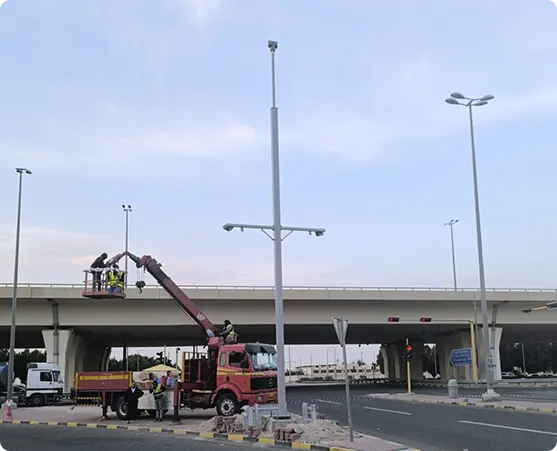
Cebu Baseport Terminals 2 & 4 (Philippines)
Supplied 30-meter polygonal high mast towers with motorized lowering systems. Designed to resist Category 5 typhoon gusts and continuous marine salt spray, providing seamless 24/7 container yard logistics lighting.
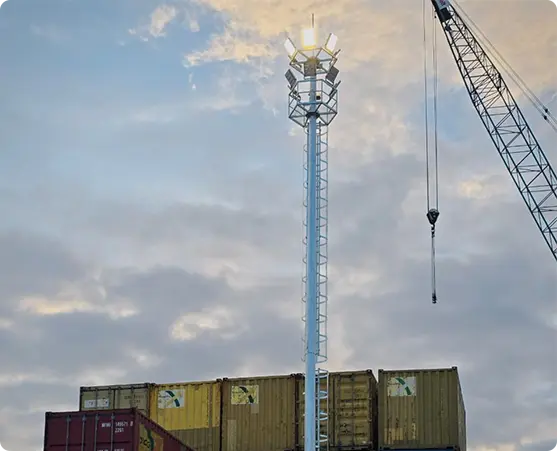
Public Safety Desert Corridor (Kuwait)
Delivered IP66-sealed camera monitoring and solar mast structures built to withstand 55°C ambient desert heat, sudden sandstorms, and extreme ultraviolet degradation with specialized powder coats.
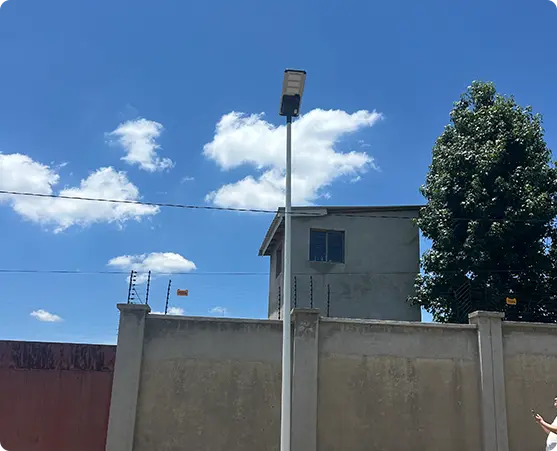
Rural Utility & Road Electrification (South Africa)
Engineered 7m 60W integrated solar lights with tamper-proof brackets to safeguard municipal road illumination against relentless utility grid load-shedding and battery theft attempts.
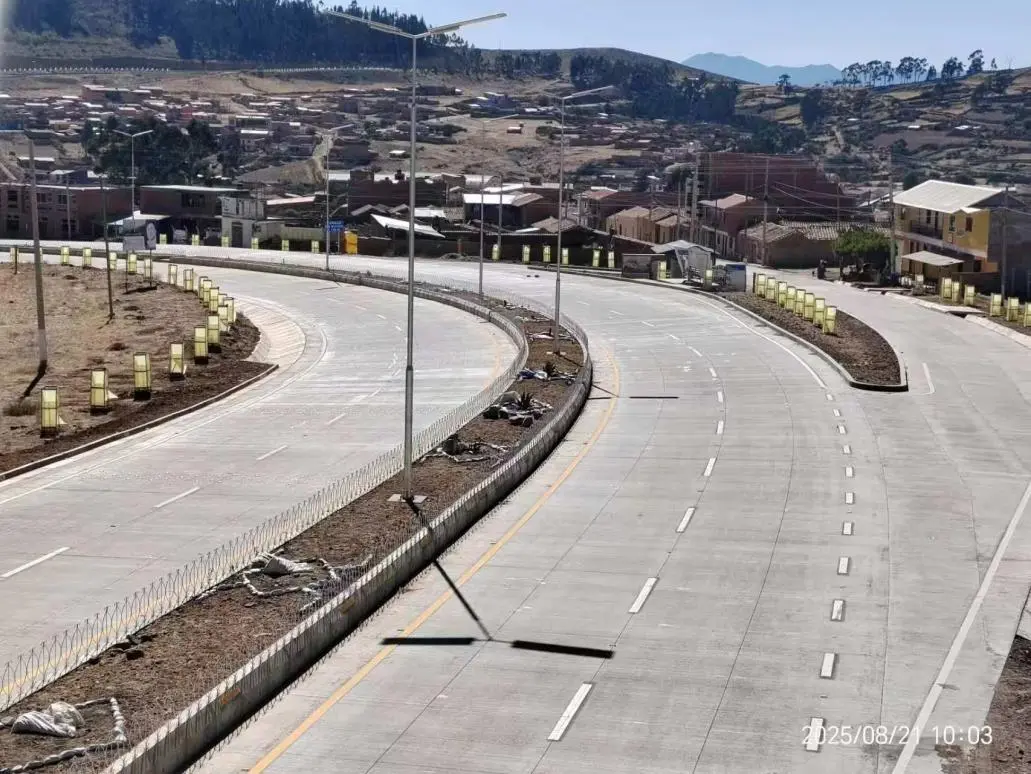
Chancay Port Arterial Corridor (Peru)
Off-grid solar lighting specified for access corridors connecting South America's major new deep-water container terminal, achieving EN 13201 class M3 uniformity without expensive electrical cabling.
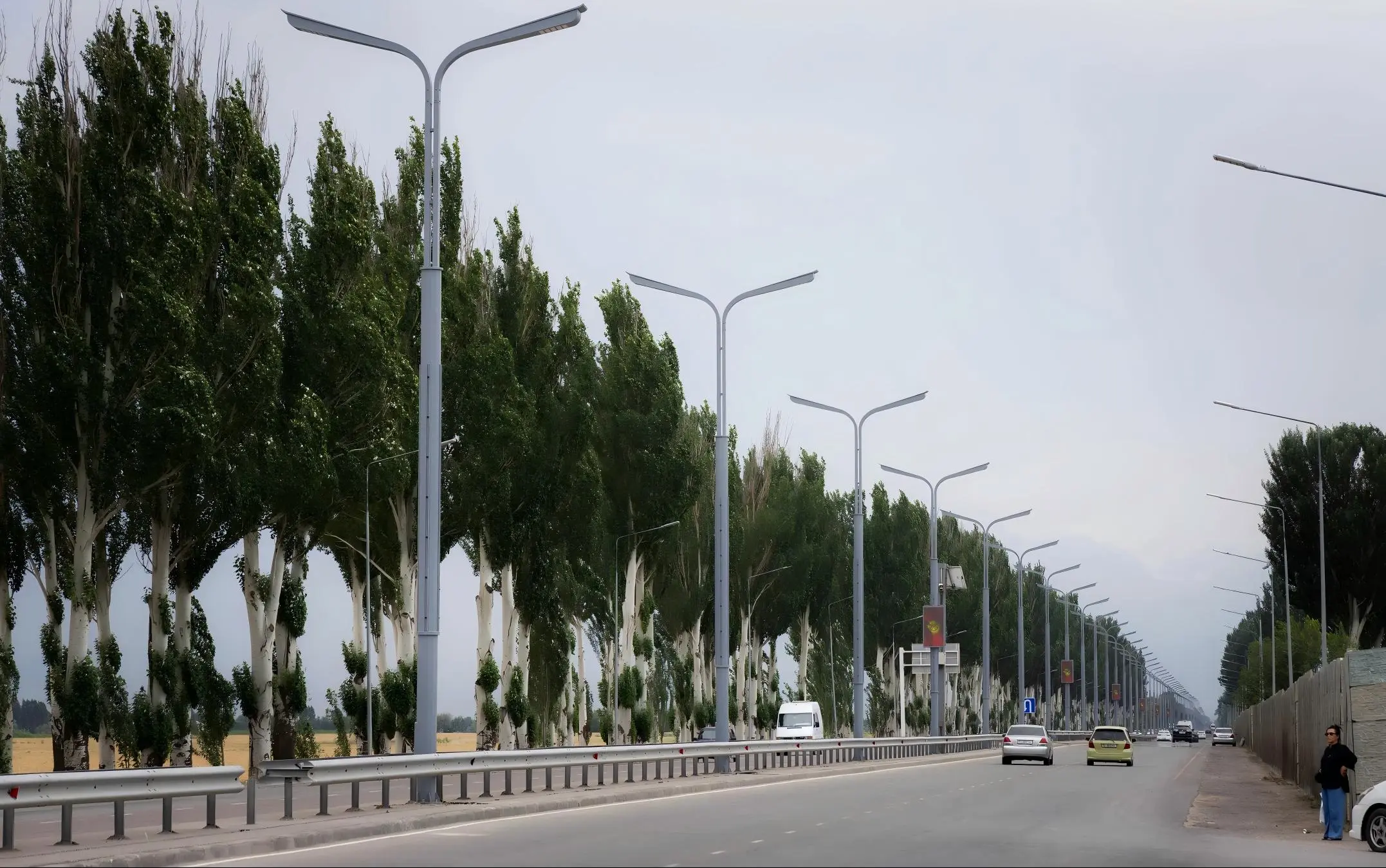
Manas Airport Highway Arterial (Kyrgyzstan)
Hot-dip galvanized conical double-arm steel poles and high-output luminaires engineered for sub-zero Central Asian winters (-35°C), high snowfall accumulations, and strict roadway uniformity standards.
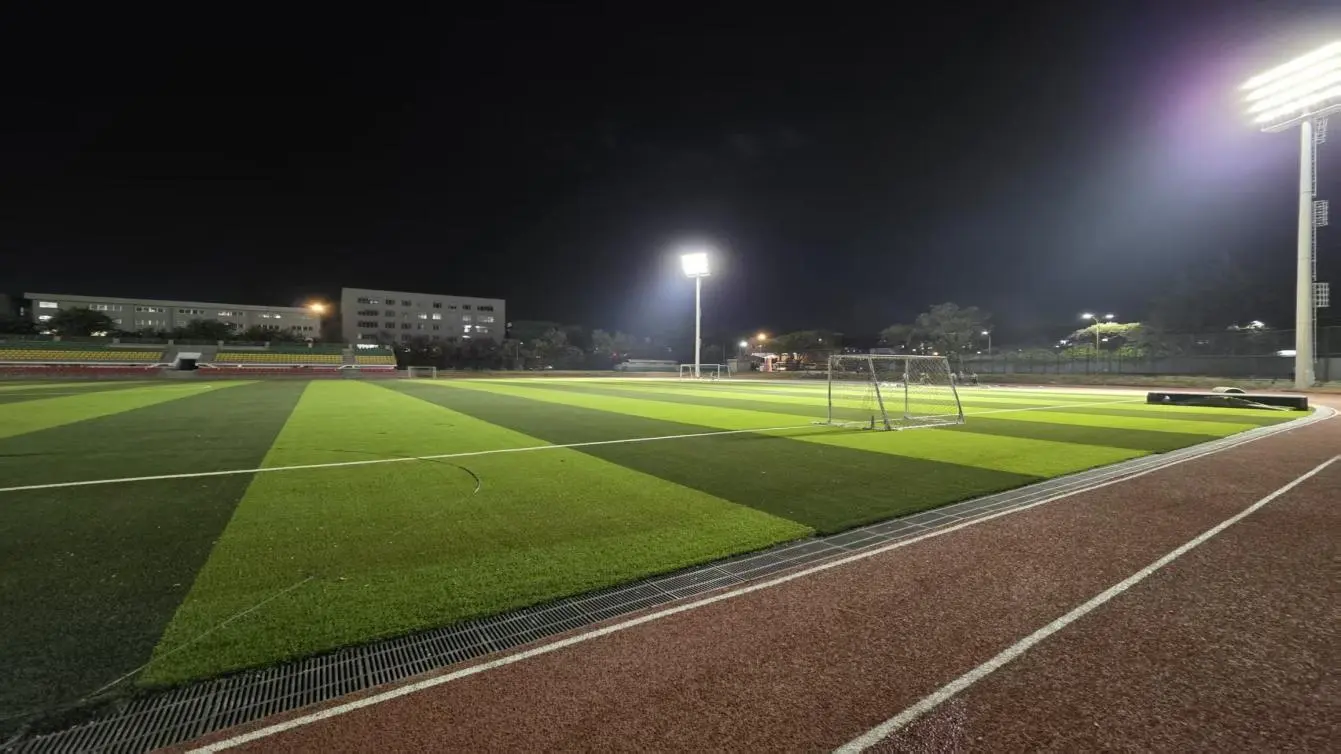
National Stadium & Track Lighting (Ethiopia)
High-flux floodlighting masts with custom head-frames designed around detailed DIALux photometric simulations, ensuring even lux coverage across competition athletic tracks and stadium seating.
EPC Tender Submission Checklist: Engineering Prerequisites
When tendering for multilateral development bank (World Bank, ADB) and national transport department contracts, procurement teams must demand rigorous documentation to prevent contract disqualification.
1. Structural Mast Compliance
Verification of EN 40-3 or AASHTO LTS-6 finite element calculations. Require mill test certificates for Q235/Q355 grade steel, ISO 1461/ASTM A123 galvanizing batch reports, and weld ultrasonic testing (UT) logs.
2. Photometric DIALux Validation
Independent IES LM-79 and LM-80 test reports verifying LED chip lifetime (L70 > 100,000 hrs at 85°C). Demanded submittals must include genuine DIALux simulation files matching target road widths, setbacks, and lux levels.
3. Ingress & Submersion Testing
Certified laboratory test reports for IP66, IP67, and IP68 according to IEC 60598-1 standards. Visual proof of continuous internal silicone gasket seals, breathable ePTFE membranes, and hermetic cable gland glands.
4. Lithium Cell UN38.3 & MSDS
Safe ocean transport requires UN38.3 vibration, shock, and altitude simulation certification. Demand genuine Grade-A cell brand documentation (EVE, CATL, or equivalent) and dual-protection BMS circuit architecture.
5. Autonomous Sizing Simulation
Solar radiance calculations based on NASA Surface Meteorology or PVGIS data. The system must guarantee at least 3 to 5 continuous days of overcast/rainy autonomy without depleting batteries past their safe DoD.
6. Factory Direct Auditing Access
Eliminate shell trading firms. Ensure the manufacturing partner allows third-party physical inspections (SGS, Bureau Veritas, TÜV) or live real-time video audits across the raw cutting, welding, galvanizing, and assembly lines.
Complete Project Series & Steel Mast Infrastructure (Bottom Portfolio)
Explore Xintong's heavy-duty high mast assemblies, high-strength extreme-climate poles, and smart city multi-sensor integrated structures designed for tender qualification.
High-Quality STADIUM SERIES High Mast Light

Custom High Strength Light Pole Series
Custom XINTONG Municipal Street Light Poles

OEM XINTONG Multifunctional Light Poles
Best XT-DT-1 Series (Split Type) Manufacturer
High-Quality URBAN-GRID Series Steel Poles
Buy XT-YTH-3 Series (All-In-One) Exporter
Buy XINTONG Municipal Street Light Pole Series
Frequently Asked Questions: Waterproof Solar Street Lighting Engineering
In-depth answers to critical technical questions raised by international EPC consultants, municipal municipal engineers, and certified project contractors.
Are you a manufacturing factory or a trading company?
Xintong is an original equipment manufacturer (OEM/ODM). Established in 1999, we own and operate a 100,000 m² heavy production campus in Gaoyou City, Jiangsu Province, China. Our facilities house 7 full-stack production lines: heavy steel plate CNC decoiling, 16-meter longitudinal press brakes, robotic submerged arc welding, direct immersion hot-dip galvanizing kettles, electrostatic powder coating lines, and ISO Class 8 LED and solar cleanroom assembly. Project buyers and third-party inspection firms (SGS, BV, Intertek) are encouraged to audit the plant on site or via real-time live video feeds.
What is the technical difference between IP65, IP66, IP67, and IP68 in solar lighting?
IP65 confirms basic defense against low-pressure water jets but remains vulnerable to vacuum thermal-breathing during rainstorms. IP66 certifies protection against violent sea waves and high-pressure water jets (100 kPa at 3 meters). IP67 certifies immersion protection in water up to 1 meter depth for 30 minutes, critical for low-lying flood-prone regions. IP68 guarantees permanent continuous submersion beyond 1 meter under specified pressure. Xintong luminaires achieve true IP66 to IP68 hermetic sealing by deploying continuous fluorosilicone gaskets, ePTFE pressure-equalizing breathers, and resin-potted electronics.
How do you guarantee steel pole structural safety and anti-corrosion for 25+ years?
All Xintong lighting masts, transmission poles, and high masts are fabricated from structural Q235B or Q355B low-alloy carbon steel with certified mill test reports. Following longitudinal single-pass welding, poles undergo mechanical cleaning, pickling acid baths, and full immersion hot-dip galvanizing per ASTM A123 / ISO 1461. The resulting metallurgical zinc coating layer averages 86 to 105 microns in thickness. Optional electrostatically cured architectural polyester or fluorocarbon powder coating adds a secondary UV-resistant barrier compliant with ISO 12944 C5-M extreme marine ratings.
Why do cheap LiFePO4 batteries fail in tropical environments, and how does Xintong solve this?
Many consumer-grade solar lights use second-life (recycled) automotive cells or volatile NMC/ternary lithium chemistry with substandard BMS boards. At ambient temperatures above 45°C, these degrade precipitously or experience catastrophic thermal runaway. Xintong specifies only Tier-1 brand-new Grade-A prismatic Lithium Iron Phosphate (LiFePO4) cells. Our patented BMS features dual thermal probes, high-voltage cutoffs, active cell balancing, and deep-discharge protection, guaranteeing 4,000 cycles at 80% Depth of Discharge (DoD) even in desert ambient heat.
What project parameters are required to generate an accurate DIALux proposal?
To deliver compliant submittal engineering documentation, our engineering team requires: (1) Road cross-section drawing (number of lanes, carriageway width, central reservation, sidewalk dimensions); (2) Target lighting class according to EN 13201 (e.g., M1, M2, M3, P1) or target average lux and uniformity ratio; (3) Preferred pole height, overhang, and boom tilt angle; (4) Local geographic coordinates for NASA irradiance modeling; and (5) Design wind gust speed requirements (m/s or km/h).
How do Xintong solar luminaires handle 5 consecutive days of heavy rain or monsoon conditions?
Autonomy is calculated scientifically rather than through estimated battery sizing. We match solar module peak watt generation (Wp) and battery amp-hour capacity (Ah) to calculate the worst-case month (lowest peak sun hours). Additionally, our smart MPPT controllers execute automated multi-stage power-down logic: when battery reserves drop below 40%, the system automatically throttles output to 30% during midnight hours or transitions to microwave Doppler occupancy sensing (100% brightness upon vehicle detection, 20% standby), preserving illumination across extended cloud cover.
Direct Consultation with Xintong Factory Project Engineers
Bypass intermediary agents. Submit your Bill of Quantities (BOQ), tender drawings, or photometric criteria directly to our Gaoyou engineering department for immediate review and manufacturer quotation.
Verified Factory Corporate Information
Legal Corporate Name: Yangzhou Xintong Traffic Equipment Group Co., Ltd.
Manufacturing Address: Guoji Industrial Concentration Area, Suiqiao Town, Gaoyou City, Jiangsu Province, China
Direct Sales / Project Engineering: +86 178 5195 5363
Official Engineering Email: [email protected]
Technical Scope: Steel Lighting Poles (4m-12m), High Masts (15m-45m), IP67/IP68 Solar Street Lights, Power Distribution Poles, Smart City Systems.
Immediate Proposal Submission Checklist
To receive a tender-ready technical dossier within 24 business hours, please include:
- Intended Application: Highway, Port, Arterial, or Residential
- Roadway Width (m) & Required Pole Mounting Height (m)
- Grid Tied (AC 220V/110V) or Off-Grid Solar Power System
- Target Local Wind Speed Resistance (e.g., 140 km/h or 40 m/s)
- Estimated Quantity, Target Delivery Port & Incoterm (FOB/CIF)