
Standardized Infrastructure & Municipal Series
Precision-manufactured structural masts, hot-dip galvanized conical shafts, and solar-integrated configurations designed for global municipal tenders and extreme environmental resilience.

OEM AIRPORT-PORT SERIES High Mast Light Manufacturer, Supplier
View Technical Specs
Buy XINTONG Municipal Street Light Pole Series Factories, Exporter
View Technical Specs
Best XT-DT-1 Series (Split Type) Manufacturer, Factories
View Technical Specs
Best Series Decorative Street Light Pole Manufacturers, Manufacturer
View Technical Specs
OEM XINTONG Multifunctional Light Poles Integrated Design Smart City Poles
View Technical Specs
Custom XINTONG Full Series Municipal Conical & Octagonal Street Light Poles
View Technical Specs
Buy XT-YTH-3 Series (All-In-One) Integrated Solar Pole Exporter
View Technical Specs
Custom XINTONG High Strength Heavy-Load Wind-Resistant Pole Series
View Technical SpecsIndustry Trends Shaping Modern Solar Street Light Pole Engineering
The global solar street light pole manufacturing sector is traversing an intense technological transition—shifting from basic utilitarian structural supports toward intelligent, aerodynamically optimized renewable energy nodes.
1. Aerodynamic Dynamic Balancing & High-Yield Metallurgy
Modern solar pole engineering faces higher mechanical stresses due to top-heavy photovoltaic sail areas and windward battery housing. Industry leaders have transitioned from traditional basic carbon steels to low-alloy high-strength grades such as Q355B and ASTM A572 Grade 50. By pairing polygonal geometric cross-sections (octagonal, dodecagonal, and conical) with Finite Element Analysis (FEA), modern designs significantly dampen vortex shedding and wind-induced oscillations under typhoon-force gusts exceeding 160 km/h (45 m/s).
2. Confluence of Smart City IoT & Distributed Edge Grid
The contemporary pole is no longer an isolated luminaire support; it serves as vertical real estate for municipal IoT infrastructure. As municipal authorities execute Smart City deployments, solar poles integrate micro-cell 5G transceivers, environmental particulate sensors, optical surveillance cameras, and bidirectional EV emergency charge stations. This evolution demands internally segregated wire raceways, high-durability flush service access panels, and certified electromagnetic shielding to prevent harmonic interference between MPPT controllers and telemetric radio boards.
3. Circular Metallurgy & Carbon Border Adjustment Compliance
International infrastructure financing consortia—including the World Bank, Asian Development Bank (ADB), and European Investment Bank—now mandate cradle-to-gate Life Cycle Assessments (LCA) and Environmental Product Declarations (EPD). Steel poles manufactured utilizing electric arc furnace (EAF) processing with traceable scrap steel input achieve up to a 38% lower embodied carbon footprint compared to blast-furnace routes, giving tier-one Chinese manufacturers like Xintong a pronounced competitive edge in carbon-regulated sovereign tenders.
Global Enterprise Procurement Demands & Evaluation Criteria
EPC engineering contractors, municipal purchasing consortiums, and sovereign project developers evaluate solar street light pole suppliers through rigorous multi-variable risk matrices encompassing structural bankability, metallurgical traceability, and long-term cost of ownership.
1. Total Cost of Ownership (TCO) vs. Initial CAPEX
Procurement officers have abandoned bottom-dollar bidding in favor of 25-year structural lifecycle metrics. Substandard poles suffering from micro-fissures in weld seams, incomplete zinc crystallization, or inadequate wall thickness yield catastrophic failure rates within 3 to 5 years under cyclic dynamic wind fatigue. The resulting field replacement costs exceed initial structural acquisition expenditure by over 400%, validating the procurement preference for certified Q235B/Q355B hot-dip galvanized columns.
2. Tender-Ready Engineering Documentation & DIALux Photometrics
A premier supplier must operate as an extension of the contractor's engineering division. Turnkey tender qualification mandates detailed 3D structural CAD fabrication blueprints, finite element stress analysis reports under local gust speed coefficients, and comprehensive DIALux Evo photometric calculations. Project owners require unequivocal proof that illuminance targets (EN 13201 classes M1 through M5) will be sustained at specified pole pitch intervals without photometric dark bands or excessive glare.
3. Supply Chain Traceability & Raw Material Provenance
Major infrastructure tenders in North America, Europe, and the Middle East strictly prohibit unverified steel billet melting. Xintong enforces comprehensive raw material tracing, supplying Mill Test Certificates (MTC) conforming to EN 10204 Type 3.1 for every heat number. Chemical composition (Carbon equivalent value CEV ≤ 0.45%), mechanical tensile yield thresholds, and Charpy V-notch impact toughness values at -20°C are verified prior to longitudinal plate shearing.
| Evaluation Parameter | Commercial Grade (Low-End Market) | Xintong Enterprise Specification | Infrastructure Project Benefit |
|---|---|---|---|
| Steel Substrate Grade | Recycled scrap steel / Non-spec Q195 | Primary Mill Q235B / Q355B (EN 10025-2) | Certified yield strength (≥355 MPa); zero brittle fracture risk |
| Galvanizing Thickness | Cold electro-galvanized (15–25 μm) | Hot-Dip Galvanized (≥86 μm / ASTM A123) | Corrosion barrier rated for 25+ years in aggressive C4/C5 environments |
| Longitudinal Seam Welding | Intermittent manual CO2 arc welding | Automatic Submerged Arc Welding (ASAW) | 100% penetration weld; zero internal porosity or slag inclusion |
| Photometric Verification | Theoretical lumen ratings without context | DIALux Evo isolux simulation per project BOQ | Guarantees roadway illuminance uniformity (≥0.40) & compliance |
| Wind Load Calculation | Generic uncertified estimation | AASHTO LTS-6 / EN 40-3-1 Certified FEA | Engineered structural safety factor ≥1.8 under design gale limits |
Turnkey Engineering Solutions Across Diverse Terrains
Photovoltaic street lighting infrastructure must endure dramatically divergent climatic stresses. Xintong formulates modular structural topologies engineered for targeted geographical and environmental macro-challenges.
Coastal, Marine & Typhoon Corridors
Operational Stress: High salinity (ISO 12944 C5-M marine corrosive environment), cyclic airborne sodium chloride deposition, and category 4–5 typhoon gusts up to 240 km/h.
Xintong Engineered System: Dual-layer barrier defense combining immersion hot-dip galvanizing (>100 μm) with marine-grade thermoset architectural powder coating. High-taper conical or octagonal steel shafts with thickened flange gussets and 316 stainless steel fastening hardware prevent premature corrosion. Flange anchor plates are calculated with enlarged pitch circle diameters (PCD) to withstand high overturning moments ($M_v$).
Hyper-Arid Desert & Extreme Heat Basins
Operational Stress: Ambient temperatures surpassing +55°C, direct solar radiation flux, high ultraviolet irradiance, and scouring airborne silica abrasives.
Xintong Engineered System: Thermally decoupled, shaded battery brackets or subterranean IP68 protective polymer enclosures that preserve LiFePO4 battery lifespan. PV array inclination angles are optimized beyond standard latitude angles to maximize gravitational particulate runoff. Finishes utilize fluorocarbon UV-inhibited coatings that eliminate chalking, micro-cracking, and thermal degradation.
Sub-Zero Alpine & High-Latitude Corridors
Operational Stress: Sustained -40°C temperatures, heavy snow accumulation loads, low solar irradiation angles, and permafrost soil heave.
Xintong Engineered System: Low-temperature-impact certified structural steels (impact tested at -20°C to -40°C to prevent brittle crystalline fracturing). Split-type pole systems featuring steep tilt brackets (45°–60°) to prevent snow blanketing, paired with internal self-heating MPPT managed energy storage and deepened helical screw piling or frost-depth anchor bolt cages.
Metallurgical Integrity & In-House Manufacturing Verification
From single-sheet CNC hydraulic plasma shearing to deep-pot molten zinc hot-dip processing, Yangzhou Xintong Traffic Equipment Group controls every metallurgical variable under strict ISO 9001/14001/45001 operational protocols.
1. Multi-Stage CNC Roll Bending
Steel plates undergo precise single-pass tapered conical and polygonal roll bending on a 16-meter hydraulic CNC tandem press brake with up to 1,600 tons of forming pressure. This ensures precise dimensional tolerances, zero axial twisting, and precise wall thickness consistency from shaft base to pole tenon.
2. Automatic Submerged Arc Welding
Longitudinal seams are welded utilizing automated submerged-arc systems compliant with AWS D1.1 structural welding protocols. This ensures smooth, continuous weld seams with full penetration, eliminating microscopic air inclusions, undercuts, and cold lapping common in low-tier manual MIG/MAG operations.
3. Immersion Hot-Dip Galvanizing
Fabricated poles undergo multi-stage chemical pretreatment—including caustic degreasing, hydrochloric acid pickling, and fluxing—before complete immersion into a 450°C molten zinc bath. Metallurgical bonding produces an impenetrable zinc-iron alloy interphase exceeding ASTM A123 and EN ISO 1461 standards (≥86 μm).
Field-Tested Infrastructure Deployments Across 80+ Countries
Explore verified global engineering deployments where Xintong high-mast columns, municipal lighting poles, and specialized solar systems deliver uninterrupted operational reliability.
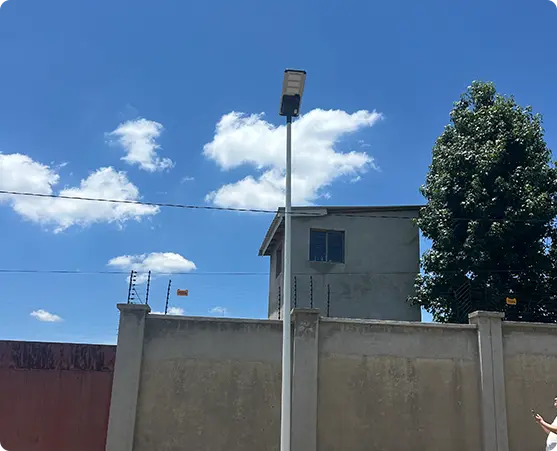
Chancay Port Municipal Roadway Lighting
Off-grid solar lighting package delivered for feeder freight roads connecting the newly constructed deep-water Chancay Port. Heavy-walled poles and smart energy controllers accommodate heavy transport vibration and marine atmospheric humidity.
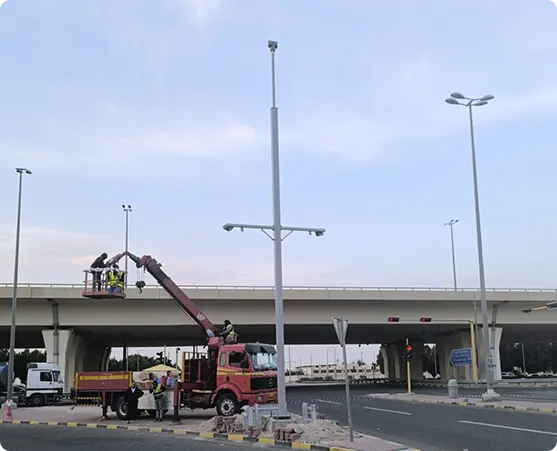
Manas International Airport – Bishkek Highway
Engineered dual-arm hot-dip galvanized conical steel poles lining the main airport expressway. Designed with enhanced low-temperature steel chemistry to withstand rigorous sub-zero winter freeze-thaw cycles without zinc flaking.
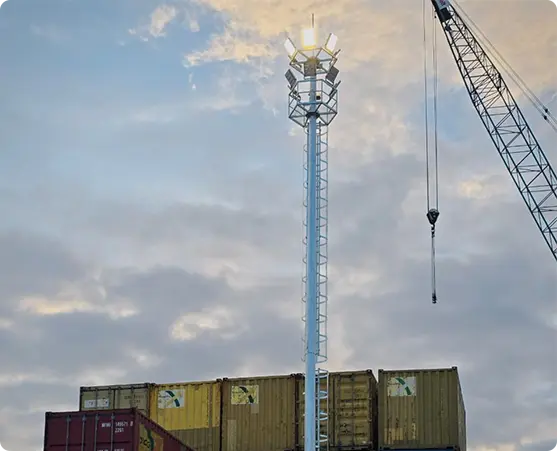
Olympic Stadium & Athletics Track High Mast Array
Fabricated high-load polygonal floodlighting columns with custom headframes configured per DIALux spatial aiming studies, ensuring glare-free, broadcast-compliant horizontal illumination for regional athletic competitions.
Technological Roadmap: The Next Decade of Solar Pole Innovation (2025–2035)
Explore how next-generation solar street lighting poles are transitioning from functional supports into autonomous, smart, multi-functional urban energy nodes.
Vertical Cylindrical Bifacial PV Sleeves
Transitioning away from protruding flat solar panels that create severe aerodynamic drag ($C_d > 1.2$), next-generation poles incorporate wrap-around flexible or curved bifacial photovoltaic modules directly surrounding the vertical pole shaft ($C_d < 0.6$). This eliminates wind-sail susceptibility, resists dust accumulation, and captures 360-degree reflected albedo radiation from paved surfaces.
Solid-State & Sodium-Ion Pole Reservoirs
While LiFePO4 cells lead present installations, sodium-ion ($Na^+$) chemistry is entering volume deployment for extreme temperature environments (-40°C to +65°C). Solid-state non-flammable electrolyte systems are also enabling internal vertical battery integration directly within the pole shaft cavity, liberating sidewalk clearance and eliminating underground burial chambers.
AI-Powered Meshed Telemetric Controls
Deploying machine learning edge-controllers running on LoRaWAN and NB-IoT networks that interpret real-time pedestrian flow, vehicle velocity vectors, and micro-climatic satellite weather forecasts. Automated dimming logic dynamically reserves battery capacity through protracted rainy intervals while optimizing municipal safety.
V2X Microgrid & Emergency Urban Resilience
Future urban street poles will function as distributed micro-power nodes capable of bi-directional power transfer. During natural disasters or grid blackouts, meshed solar street lighting arrays maintain life-safety lighting, route evacuation signaling, and provide localized low-voltage DC emergency device charging.
Localized Engineering Compliance & Factory Acceptance Testing (FAT)
Securing successful sovereign approvals requires full conformity with regional structural design codes, metallurgical standards, and strict non-destructive testing regimens.
Structural Verification Codes
Xintong structures are engineered in strict alignment with regional design mandates:
• EN 40-3-1 & EN 40-3-3: Structural verification, deflections under serviceability limit states, and ultimate structural load resistance for Europe and Central Asia.
• AASHTO LTS-6: Standard Specifications for Structural Supports for Highway Signs, Luminaires, and Traffic Signals (US & Middle East).
• AS/NZS 1170.2: Structural design actions for cyclonic wind regions across Australasia and the Pacific Basin.
Certified Quality & Environmental Systems
Factory processes are executed under audited management standards:
• ISO 9001:2015: Total quality control throughout drafting, cutting, forming, and coating.
• ISO 14001:2015: Certified environmental stewardship in acid recycling and closed-loop galvanizing.
• ISO 45001:2018: Occupational health and structural safety engineering controls across all 7 manufacturing lines.
Non-Destructive Testing (NDT) Protocol
To ensure structural integrity before export dispatch, Xintong maintains rigorous quality checks:
• Ultrasonic Testing (UT): 100% inspection of full-penetration critical base plate and flange-to-shaft welds.
• Magnetic Particle Inspection (MPI): Detection of surface and sub-surface micro-fissures in high-stress door openings.
• Electromagnetic Coating Thickness Measurement: Verifying zinc barrier depth (≥86 μm) per ASTM B499.
Frequently Asked Questions by EPC Contractors & Engineers
In-depth technical answers addressing structural calculation, anti-corrosion science, wind loading, and turnkey solar procurement.
Submit Your Project Specifications to Our Engineering Team
Connect directly with our senior structural and photometric engineers. Send your tender drawings, bills of quantities (BOQ), or site wind load specifications to receive a certified technical review, DIALux simulation, and factory-direct quotation within 24 working hours.
Verified Plant Credentials
Company: Yangzhou Xintong Traffic Equipment Group Co., Ltd.
Address: Guoji Industrial Area, Suiqiao Town, Gaoyou, Jiangsu, China
Established: 1999 | 100,000 m² Heavy Industrial Base
Direct Technical Desk: +86 178 5195 5363
Download Engineering CatalogHeavy-Duty Infrastructure, Split Solar & Utility Power Columns
Explore our heavy-load high-mast masts, stadium floodlight columns, high-power split solar poles, and utility power distribution pylons engineered for major infrastructure works.
Best XT-DT-1 Series (Split Type) Manufacturer, Factories
View Technical Specs
High-Quality STADIUM SERIES High Mast Light Factory, Exporter
View Technical Specs
OEM XINTONG Multifunctional Smart City Octagonal & Conical Poles
View Technical Specs
Buy XT-YTH-3 Series (All-In-One) Integrated Solar Lighting
View Technical Specs
OEM PUBLIC TRANSIT Series Municipal High Mast Poles Supplier
View Technical Specs
Custom XINTONG High Strength Heavy Load Steel Column Series
View Technical Specs
URBAN-GRID Low Voltage Steel Power Distribution Poles Factories
View Technical Specs