
Featured Municipal & Solar Lighting Series
Factory-fabricated high mast towers, smart poles, and high-efficiency solar lighting engineered for airport aprons, urban transit grids, and state municipal tenders.

OEM AIRPORT-PORT SERIES High Mast Light Manufacturer, Supplier
Procurement Details
High-Quality URBAN-GRID Series Urban Low Voltage Steel Power Distribution Poles Suppliers, Factories
Procurement Details
Buy XINTONG Municipal Street Light Pole Series Factories, Exporter
Procurement Details
Buy XT-YTH-3 Series (All-In-One) Exporter, Exporters
Procurement Details
High-Quality STADIUM SERIES High Mast Light Factory, Exporter
Procurement Details
Best Series Decorative Street Light Pole Manufacturers, Manufacturer
Procurement Details
OEM XINTONG Multifunctional Light Poles Integrated Design, Octagonal, Conical & Square
Procurement Details
OEM PUBLIC TRANSIT Series Municipal High Mast Poles Manufacturers, Supplier
Procurement DetailsNavigating Large-Scale Public Solar Street Light Procurement
A definitive engineering guide for municipal authorities, EPC contractors, and global distribution directors seeking verified manufacturing compliance, structural safety, and life-cycle cost optimization.
Total Cost of Ownership (TCO)
In contemporary municipal tenders, initial capital expenditure (CapEx) accounts for less than 35% of total project costs over a 15-year lifecycle. Premature lithium battery degradation, structural corrosion, and driver failure consume budget surpluses. Direct procurement from a qualified manufacturing factory establishes warranty guarantees, traceable component sourcing, and MTBF (>100,000 hrs) validation.
- Zero trenching and grid-cable infrastructure investments.
- L90B10 rated luminaire lifespans minimizing maintenance cycles.
- Grade-A LiFePO4 chemistry with >4,000 deep discharge cycles.
Strict Tender Compliance
Public infrastructure tenders funded by multilateral development organizations (World Bank, ADB, AfDB) require airtight documentation. Sourcing directly from an established exporter ensures that project bids are supported with EN 40 structural safety reports, AASHTO wind-load finite element modeling, ISO 1461 hot-dip galvanizing certifications, and DIALux isolux distribution plots.
- Certified raw material mill sheets for Q235B/Q355B structural steel.
- ISO 9001, ISO 14001, and ISO 45001 production audits.
- Customized foundation cage and anchor engineering submittals.
Integrated Smart City Scalability
Urban lighting procurement is transitioning into multi-asset IoT platforms. Lighting poles serve as vertical edge-computing columns hosting wireless LoRaWAN/NB-IoT controllers, smart environmental monitoring, video surveillance, and vehicle-to-everything (V2X) nodes. Sourcing modular, reinforced poles ensures municipal assets remain adaptable for smart grid integrations.
- Cloud-based central management platform (CMS) integration.
- Dynamic scheduled dimming reducing autonomous battery burden.
- Standardized Zhaga / NEMA 7-pin receptacle architecture.
Global Procurement Industry Megatrends
How technological shifts in high-efficiency photovoltaics, energy storage management, and optical physics are redefining technical specifications in public infrastructure procurement documents worldwide.
1. N-Type TOPCon & Bifacial PV
Traditional poly-silicon and legacy P-type PERC panels are being superseded by N-Type TOPCon cells offering >23.5% module efficiency. Combined with dual-glass bifacial architecture, poles capture ground albedo reflection, increasing energy harvest by 10-25% in snowy, sandy, or concrete-paved environments.
2. Grade-A LiFePO4 & Smart BMS
Tenders increasingly mandate Grade-A, prismatic Lithium Iron Phosphate (LiFePO4) energy storage cells rather than hazardous ternary lithium or bulky gelled-lead acid batteries. Advanced BMS units prevent deep over-discharge and balance cells actively across extreme thermal windows (-40°C to +65°C).
3. MPPT Tracking Efficiency >99.2%
Legacy Pulse-Width Modulation (PWM) controllers waste up to 30% of harvested solar energy. Modern procurement frameworks mandate smart digital Maximum Power Point Tracking (MPPT) algorithms that continuously sweep IV curves under cloudy or partially shaded roadside conditions.
4. Precision Batwing Optics
Municipal standards demand EN 13201 (M3 to M5) and IESNA Type II-M/III-M distributions. Precision multi-cavity PMMA optical lenses spread light evenly across wide multi-lane corridors without creating hot spots or upward glare, enabling pole-spacing-to-height ratios of up to 4.5:1.
Solving Critical Tender Pain Points: Factory Direct vs. Broker
Procurement teams for major international infrastructure projects often experience structural failures, delivery delays, and voided warranties when purchasing through third-party intermediaries.
Direct Infrastructure Factory Model
Full ownership of raw material procurement, laser cutting, automated submerged-arc welding, internal galvanizing pools, and luminaire assembly lines in a certified 100,000 m² facility.
| Procurement Dimension | Direct Factory Standard |
|---|---|
| Steel Traceability | Verified Mill Certs: Q235B / Q355B with calibrated wall thickness. |
| Corrosion Protection | Hot-Dip Galvanized: Total zinc bath immersion >86μm (ASTM A123 / ISO 1461). |
| Photometric Validation | Custom DIALux Calculations: Provided directly with true IES photometric files. |
| Structural Calculations | Wind-Load Certifications: AASHTO/EN structural calculations for local wind speeds. |
| Warranty & Recourse | Up to 10-Year Comprehensive: Direct engineering backing without middleman dispute. |
Third-Party Broker Risks
Brokers assemble unverified components from disparate low-cost workshops, lacking engineering authority, testing laboratories, or accountability when municipal audits fail.
| Procurement Dimension | Broker Pitfall Risk |
|---|---|
| Steel Traceability | Substituted undersized gauge; scrap steel blended with inconsistent weld integrity. |
| Corrosion Protection | Cold-spray or thin electro-galvanizing (<20μm) rusting within 24 to 36 months. |
| Photometric Validation | Generic copied lighting reports; non-compliant lux levels on the asphalt surface. |
| Structural Calculations | No certified wind resistance calculations; failure risks during gale-force storms. |
| Warranty & Recourse | Brokers frequently dissolve or deny responsibility when field batch defects occur. |
Certified Integrity for Project Engineers & Specifiers
Xintong facilitates on-site factory quality inspections, pre-shipment container audits, and live high-definition video plant tours. All test coupons, zinc-coating thickness gauge reports (Elcometer), and spectrometer analyses are provided with each export manifest.
Engineering Taxonomy: System Architecture Selection
Selecting the appropriate solar lighting topology is critical to balancing wind-load resistance, installation labor, autonomy requirements, and solar irradiance conditions.
| System Architecture | Key Technical Configuration | Ideal Procurement Scope | Structural & Wind Characteristics | Autonomy & Battery Sizing |
|---|---|---|---|---|
| All-In-One Integrated (XT-YTH-3 / XT-YTH-9) |
PV module, LiFePO4 battery pack, MPPT controller, and LED array housed in a unified die-cast aluminum chassis. | Urban residential streets, industrial parks, secondary feeder roads, village electrification tenders. | Lowest wind-drag profile (low Effective Projected Area - EPA); simple single-worker pole-top bracket mount. | Standard 3–5 rainy days autonomy; optimized for tropical and high-insolation equatorial regions. |
| Split-Type Photovoltaic (XT-DT-1 Series) |
Independent high-wattage PV panel bracketed at masthead; battery box mounted on pole or underground; separate LED head. | Highways, primary multilane arterial boulevards, regional motorways, perimeter security zones. | Adjustable panel tilt angle (0°–60°) to maximize solar harvest at higher latitudes; calculated pole wall thickness. | High-capacity storage supporting 5–10 overcast days; accommodates wattages from 80W up to 200W LED. |
| Smart Hybrid Solar-Grid (AC/DC Dual Power) |
Solar power prioritizes daily battery charging; seamless automatic relay switchover to grid AC during extended storms. | Class M1/M2 federal highways, critical airport access corridors, international trade ports, border crossings. | Engineered to AASHTO highway lighting structural tolerances; integrated lightning surge suppression. | 100% zero-darkness guarantee; reduces public utility electricity consumption by 85–92% annually. |
| Municipal High Mast Systems (Transit / Airport / Port) |
Multi-sided polygonal galvanized masts (15m–40m) with motorized crown lowering systems and multi-floodlight arrays. | Port container terminals, airport aprons, highway toll plazas, sports complexes, rail freight yards. | Heavy-duty base flange with Q355B high-yield steel; engineered to withstand hurricane-force winds up to 180 km/h. | Grid-powered or centralized microgrid solar array storage configurations with centralized control. |
Technical Sizing Methodology: Solar Street Lighting Engineering
To guarantee zero unexpected blackouts, Xintong application engineers calculate daily load profiles using localized NASA / PVGIS meteorological peak sun hour (PSH) datasets based on the project's exact geographic coordinates:
P_pv = (E_daily * F_safety) / (PSH_worst * η_mppt * η_dust)
Accounts for daily load consumption (Wh), winter-month worst PSH, dust contamination derating factor (η_dust: 0.90), and MPPT efficiency (η_mppt: 0.98).
C_bat = (E_daily * Days_autonomy) / (V_nominal * DoD_max * η_temp)
Guarantees the battery pack sustains continuous overcast or stormy periods (Days_autonomy: 3–7) without exceeding 80% Depth-of-Discharge (DoD).
Global Compliance & Localized Support Framework
Xintong exports lighting solutions to more than 80 countries. Our manufacturing workflows are certified against the most stringent Western European and North American infrastructure standards.
Structural & Wind Standards
Every pole profile is verified using finite element analysis (FEA) to withstand high wind velocities (35 m/s to 55 m/s, equivalent to Category 4–5 hurricanes) in compliance with:
- EN 40-3-1 / EN 40-3-2: Structural design and verification of lighting columns.
- AASHTO LTS-6: Standard specs for highway signs, luminaires, and traffic signals.
- AWS D1.1: Structural welding code for tubular steel structures.
Corrosion Protection Standards
To protect lighting columns operating in humid tropical, desert, and salt-laden marine environments, we execute double-barrier anti-corrosion protection:
- EN ISO 1461 / ASTM A123: Hot-dip zinc immersion with average thickness >86μm.
- ASTM B117: Salt spray resistance testing exceeding 1,000+ hours.
- Electrostatic Powder Coating: Pure polyester thermoset powder in any RAL color.
Electrical & Photometric Tests
Luminaires undergo comprehensive thermal, optical, and environmental stress profiling prior to export dispatch:
- IEC 60598-1 / IEC 60598-2-3: General safety and road lighting requirements.
- IESNA LM-79 / LM-80: Photometric performance & LED lumen maintenance.
- IP66 / IK09 / IK10: Water ingress and mechanical impact protection.
Global Infrastructure Deployment Cases
From deep-sea maritime ports to high-altitude airport corridors and desert surveillance grids, Xintong delivers turn-key manufacturing dependability across challenging operational environments.
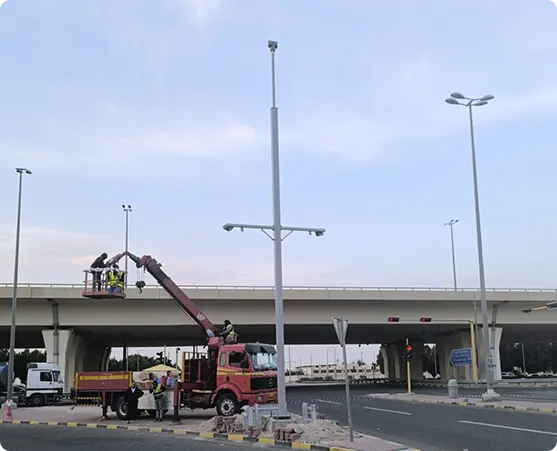
Terminals 2 & 4 High Mast Lighting
Supplied 30-meter polygonal galvanized high mast towers equipped with motorized lowering rings and marine-grade LED floodlights. Designed to withstand severe typhoon winds and salt-air corrosion, ensuring uninterrupted round-the-clock container crane operations.
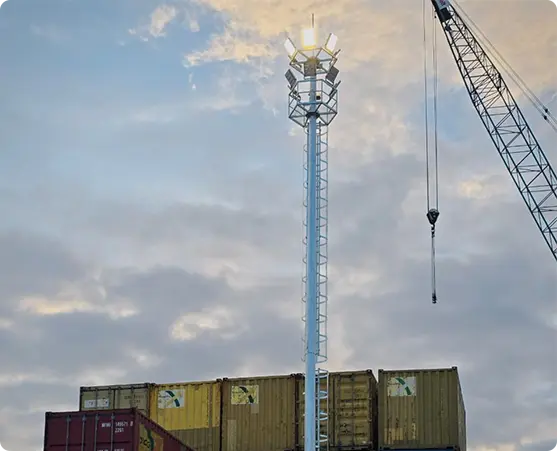
Desert Surveillance & Smart Columns
Engineered heavy-duty polygonal camera poles with customized mounting cantilevers and internal climate-sealed junction boxes. Fabricated to resist persistent desert sandstorms and extreme midday surface temperatures exceeding +60°C.
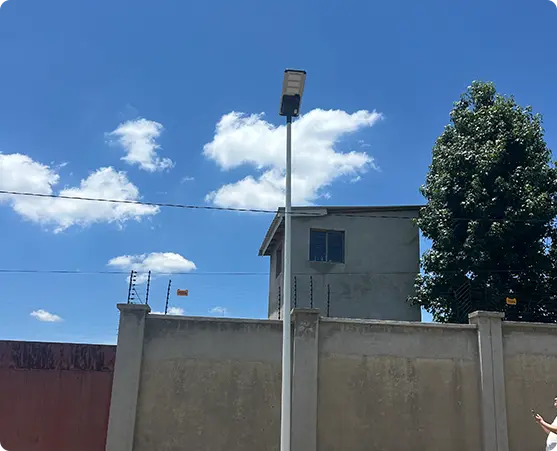
7m / 60W Off-Grid Solar Deployment
Deployed over 4,500 integrated all-in-one solar street lights along suburban arterial roads subject to severe utility load-shedding. Guaranteed zero downtime, improving nocturnal traffic safety and community security without grid dependence.
Technology Roadmap: 2025–2030 Horizon
How Xintong R&D is pioneering the next frontier of municipal lighting systems to meet carbon neutrality targets and smart infrastructure demands.
Sodium-Ion (Na-Ion) Energy Storage
Transitioning towards commercial sodium-ion cell integration for sub-zero environments down to -50°C. Offering zero lithium fire hazard, superior high-discharge safety, and substantially reduced raw mineral supply chain volatility.
AI-Driven Predictive Dimming
On-board edge microcontrollers analyze vehicular traffic density in real time using passive millimeter-wave radar sensors. Luminaires automatically scale lumen output, conserving battery reserve during low-traffic predawn hours.
Perovskite-Silicon Tandem PV
Collaborating with academic solar laboratories to incorporate flexible tandem perovskite photovoltaic coatings onto cylindrical pole shafts, allowing 360-degree solar energy absorption without separate tilted solar racking.
Circularity & Embodied Carbon
Standardizing modular, toolless disconnect luminaire housings manufactured from 100% recycled die-cast aluminum alloys. Comprehensive Environmental Product Declarations (EPD) to satisfy European Union Net-Zero procurement standards.
Explore Full Series Procurement Solutions
Direct factory supply with serialized configurations: heavy-load storm poles, split-type photovoltaic systems, and smart city infrastructure ready for immediate tender quotation.

OEM XT-YTH-9 Series (All-In-One) Factory, Factories
Procurement Details
Custom XINTONG High Strength Light Pole Series: Engineered for Extreme Conditions
Procurement Details
Best XT-DT-1 Series (Split Type) Manufacturer, Factories
Procurement Details
Custom XINTONG Full Series Municipal Street Light Poles Conical, Octagonal
Procurement Details
OEM AIRPORT-PORT SERIES High Mast Light Manufacturer, Supplier
Procurement Details
High-Quality URBAN-GRID Series Urban Low Voltage Steel Power Distribution Poles
Procurement Details
Buy XINTONG Municipal Street Light Pole Series Factories, Exporter
Procurement Details
Buy XT-YTH-3 Series (All-In-One) Exporter, Exporters
Procurement DetailsFrequently Asked Questions (Tender FAQ)
Authoritative answers to technical, commercial, and operational questions asked by government procurement committees, EPC project managers, and international distributors.