
Top 10 Octagonal Pole Street Light Manufacturers?

Time:2026-10-23 Author:Liam
0%

Choosing a reliable Octagonal Pole Street Light manufacturer involves more than comparing catalog prices. It requires attention to engineering, materials, lighting performance, and long-term maintenance.

Richard Kelly, a respected American lighting designer, said, “Light is not something that can be seen, but something by which everything else is seen.” His insight remains useful for evaluating street lighting today. A strong manufacturer should create poles that support clear illumination, stable installation, and comfortable nighttime visibility.

This guide introduces ten notable Octagonal Pole Street Light manufacturers for professional buyers, municipal planners, contractors, and infrastructure developers. The comparison considers pole strength, galvanized steel quality, corrosion resistance, welding accuracy, LED compatibility, customization, delivery capability, and after-sales support. Small details matter. A poorly finished flange can complicate installation. Uneven galvanizing may expose weak areas after years of rain and road salt.

Performance matters too.

A bright fixture does not automatically create a good roadway environment. Engineers must consider pole height, arm design, optical distribution, spacing, wind load, and maintenance access. Manufacturers with testing records and clear technical drawings deserve closer attention.

However, no ranking is perfect. Supplier capabilities can change, and project conditions differ between coastal roads, industrial parks, residential streets, and public squares. Buyers should verify certifications, load calculations, sample quality, and warranty terms before signing contracts. The following list offers a practical starting point, not a substitute for site-specific engineering review.
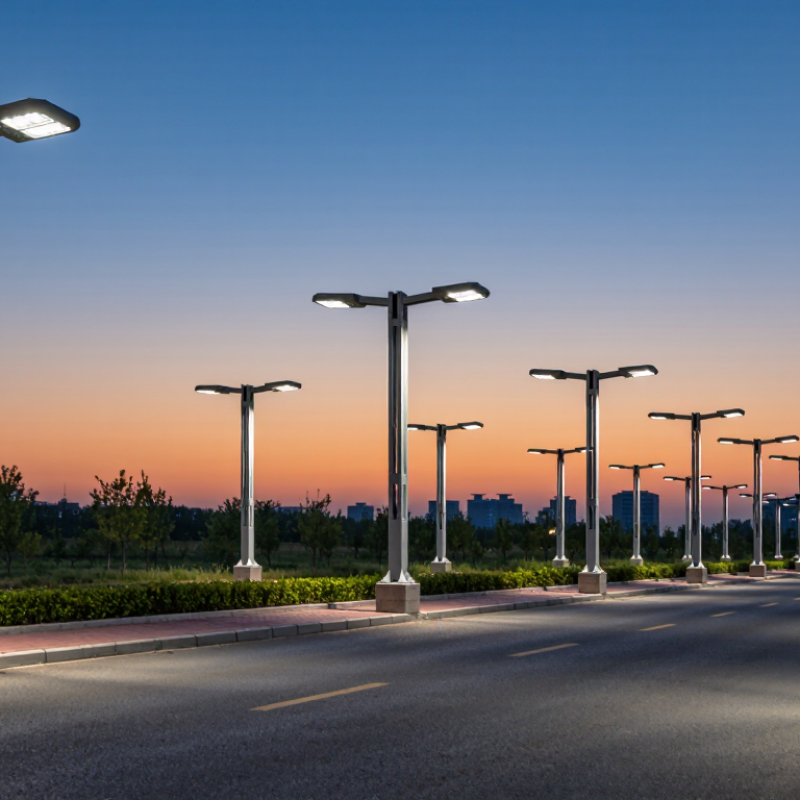
Top 10 Octagonal Pole Street Light Manufacturers?

Industry Criteria: Standards, Materials, and Specifications for Octagonal Poles

Top 10 Octagonal Pole Street Light Manufacturers?

A credible top-ten list should begin with engineering evidence, not catalog photographs. Octagonal poles usually use tapered steel because their folded geometry improves stiffness while reducing material weight. Specify structural steel such as S355 or ASTM A572 Grade 50, then verify yield strength, weld quality, and base-plate thickness. EN 40 and AASHTO LTS-6 provide useful guidance for lighting-pole design, wind loading, and deflection. IEC 60598-2-3 should also guide the luminaire and pole compatibility review.

Corrosion protection deserves equal attention. Hot-dip galvanizing should reference ISO 1461 or ASTM A123, with coating thickness recorded by inspection, not assumed from a certificate.

The IEA’s 2024 energy analysis reports that lighting represents roughly 15% of global electricity use. Therefore, pole selection should support efficient LED optics, correct outreach, and stable aiming.

The U.S. Department of Energy’s 2023 solid-state lighting plan identifies 200 lumens per watt as an advanced performance benchmark. However, higher efficacy cannot repair poor pole spacing or excessive glare. That weakness is often overlooked.

Tips: Ask manufacturers for wind calculations, weld inspection records, galvanizing measurements, and fatigue assumptions. Check door dimensions on site. Small access panels can become a maintenance problem. My practical preference is a manufacturer that discloses tolerances and testing limits, even when the figures appear less impressive. Claims without test conditions deserve careful review.

Top 10 Manufacturers Ranked by Capacity, Certifications, Projects, and Service

Top 10 Octagonal Pole Street Light Manufacturers

Top 10 Manufacturers Ranked by Capacity, Certifications, Projects, and Service

This ranking compares ten leading octagonal pole manufacturers without relying on brand reputation alone. Production capacity receives strong weight. A reliable factory should show monthly output, automated welding lines, and stable steel sourcing. The highest-ranked suppliers usually support large municipal orders without extending delivery dates. That matters on road projects.

Certifications form the second test. ISO 9001 supports process control, while ISO 14001 indicates stronger environmental management. EN 40, ASTM, or equivalent structural standards can verify design performance. Inspectors should review material certificates, weld records, galvanizing thickness, and coating reports. Small details matter. A thin zinc layer can fail early near coastal roads.

Project experience separates capable manufacturers from attractive catalog sellers. Higher-ranked suppliers often provide evidence from highways, industrial parks, ports, and urban lighting upgrades. Their drawings should include pole height, base-plate dimensions, bolt patterns, wind-load data, and foundation requirements. Service also affects ranking. Responsive teams offer engineering review, sample approval, spare-part guidance, and clear warranty terms. Some suppliers respond quickly before the contract, then slow down afterward. That weakness deserves a lower position.

The ranking is not perfect. Public project records can be incomplete, and capacity figures may change seasonally. Buyers should request recent factory videos, independent inspection options, and references from comparable climates. A serious manufacturer accepts technical questions and documents corrections instead of hiding them. Experiences from one installation cannot represent every supplier, but they reveal how carefully a company works.

Structural Benchmarks: 8-Sided Shafts, Wind Loads, and Galvanized Steel

Top 10 Octagonal Pole Street Light Manufacturers?

A credible comparison starts with structure, not product photographs. An octagonal pole uses eight flat faces to distribute bending stresses around the shaft. Its tapered geometry also reduces steel near the top, where loads are usually lower. However, a neat shape does not prove adequate strength. Engineers should review yield strength, shaft thickness, weld quality, and the pole’s calculated deflection.

Wind loading deserves close attention. The design must include basic wind speed, terrain exposure, gust effects, luminaire size, and mounting height. A large rectangular fixture can act like a sail during storms. Base plates and anchor bolts need matching calculations, not standard assumptions. Small details matter. A loose template can shift the bolt circle and complicate installation.

Hot-dip galvanized steel provides practical protection against rain, road salt, and industrial moisture. The coating should cover internal and external surfaces where possible, with drainage and vent holes designed before galvanizing. Inspectors commonly check coating continuity, adhesion, thickness, and damage after handling. Still, galvanizing is not magic. Cut edges, trapped water, and poor site repairs can start corrosion early.

When evaluating the top ten manufacturers, request stamped structural calculations, material certificates, galvanizing records, and wind-load assumptions. Compare tested data rather than catalogue claims. I would also inspect delivered poles, because factory consistency can differ from drawings. One weakness remains easy to miss: overdesigned shafts may increase cost, while underdesigned bases can create serious movement.

Top 10 Octagonal Pole Street Light Manufacturers? - Structural Benchmarks: 8-Sided Shafts, Wind Loads, and Galvanized Steel

Anonymous benchmark profiles for commonly specified octagonal galvanized-steel street-light pole configurations. Values are representative engineering ranges and should be verified against project drawings, local wind maps, luminaire EPA, foundation design, and the applicable standard.

Rank Anonymous Profile Typical Mounting Height Octagonal Shaft Geometry Typical Shaft Taper Steel Grade Hot-Dip Galvanizing Reference Wind Design Basis Representative Design Wind Speed Typical Base-Moment Range Base Plate Configuration Applicable Standards
1 Benchmark Profile 01 9–12 m 8-sided, tapered, spun or press-formed shaft Approximately 1:100 Structural carbon steel, commonly ASTM A572 Grade 50 or equivalent Hot-dip galvanized after fabrication; typical coating 85–125 µm AASHTO LTS-6 / local highway wind provisions 40–45 m/s, project dependent 55–95 kN·m Welded base plate with 4 or 8 anchor rods AASHTO LTS-6, ASTM A123/A123M, ASTM F1554
2 Benchmark Profile 02 8–10 m 8-sided shaft with integral tenon Approximately 1:80–1:100 Structural steel equivalent to S355 or ASTM A572 Grade 50 Minimum local coating requirements commonly 70–85 µm, depending on steel thickness EN 40 wind classification 24–32 m/s characteristic wind speed 35–70 kN·m Square plate with 4 galvanized anchor rods EN 40, EN ISO 1461, EN 10219 or equivalent
3 Benchmark Profile 03 10–14 m 8-sided, multi-section slip-fit shaft Approximately 1:100 ASTM A572 Grade 50 or equivalent low-alloy structural steel Typical average zinc coating 85 µm or greater for heavier sections ASCE 7 exposure-based wind calculation 40–50 m/s ultimate wind speed, site specific 80–145 kN·m Flanged base with 8 high-strength anchor rods ASCE 7, AISC 360, ASTM A123/A123M
4 Benchmark Profile 04 6–9 m Single-piece octagonal tapered shaft Approximately 1:75–1:100 S275 or S355 structural steel Hot-dip galvanized; coating thickness generally linked to steel thickness under ISO 1461 EN 40 / national wind-loading annex 22–30 m/s characteristic wind speed 25–55 kN·m Base flange with 4 anchor rods EN 40, EN ISO 1461, EN 1090-2
5 Benchmark Profile 05 9–13 m 8-sided shaft with welded luminaire tenon Approximately 1:100 ASTM A595 or ASTM A572 Grade 50 equivalent Typical average zinc layer 85–125 µm; vent and drain holes required for galvanizing AASHTO-based effective projected area calculation 40–45 m/s basic wind speed 60–115 kN·m Square or octagonal base plate with 4–8 anchor rods AASHTO LTS-6, ASTM A123/A123M, ASTM A572
6 Benchmark Profile 06 7–12 m Two-piece octagonal shaft with slip joint Approximately 1:80–1:100 S355 structural steel or equivalent Hot-dip galvanized inside and outside where practical; typical average 70–100 µm Eurocode wind action methodology 24–36 m/s basic wind velocity 45–100 kN·m Bolted base flange with replaceable anchor cage EN 40, EN 1991-1-4, EN ISO 1461
7 Benchmark Profile 07 8–12 m 8-sided tapered shaft, continuously welded longitudinal seam Approximately 1:100 ASTM A572 Grade 50 or equivalent structural steel Typical minimum average coating 85 µm for sections over 6 mm thick ASCE 7 with luminaire and bracket EPA input 39–49 m/s ultimate wind speed 55–110 kN·m Welded plate with 4 high-strength anchor rods ASCE 7, AISC 360, ASTM A123/A123M
8 Benchmark Profile 08 5–8 m Compact 8-sided shaft for urban road lighting Approximately 1:60–1:80 S275 structural steel or equivalent Hot-dip galvanized; typical average coating 70–85 µm EN 40 serviceability and strength checks 22–28 m/s characteristic wind speed 18–40 kN·m Compact square base plate with 4 anchor rods EN 40, EN ISO 1461, EN 1090-2
9 Benchmark Profile 09 10–16 m Three-piece octagonal slip-fit shaft Approximately 1:100–1:120 ASTM A572 Grade 50, S355, or equivalent Typical average zinc coating 85–125 µm; duplex coating may be specified for severe environments AASHTO or ASCE 7 depending on jurisdiction 40–50 m/s design wind speed 90–175 kN·m Heavy-duty flange with 8 anchor rods AASHTO LTS-6, ASCE 7, ASTM A123/A123M
10 Benchmark Profile 10 8–11 m 8-sided shaft with removable handhole cover Approximately 1:80–1:100 S355 or ASTM A572 Grade 50 equivalent Hot-dip galvanized after welding; typical coating 70–100 µm Site-specific wind pressure and fatigue assessment 30–45 m/s, dependent on location and exposure 40–90 kN·m Base plate with 4 or 8 anchor rods and leveling nuts EN 40, EN ISO 1461, ASTM A123/A123M
Engineering note: Wind resistance cannot be ranked from shaft shape alone. Final capacity depends on pole height, shaft diameter and thickness, taper, luminaire effective projected area, mounting arm geometry, terrain exposure, gust factors, foundation stiffness, anchor-rod design, fatigue requirements, and the governing local code. Galvanizing thickness values are typical standards-based benchmarks rather than manufacturer-specific certifications.

LED Performance Data: 130–200 lm/W, 50,000–100,000 Hours, and Controls

A credible Top 10 list of octagonal pole street light manufacturers should examine performance beyond attractive catalog figures. Reported efficacy usually ranges from 130 to 200 lm/W, but test conditions matter. A fixture reaching 200 lm/W at low power may deliver less under full-load operation. Ask for LM-79 reports, photometric files, and test temperatures.

Real installations reveal more. On a municipal road, dust, heat, glare, and voltage variation can reduce useful output. High-quality LED modules should maintain stable light distribution while operating for 50,000 to 100,000 hours. That lifespan is not a promise of perfect brightness. Drivers, seals, and capacitors may age earlier. A thermal chamber test helps expose weak cooling design.

Controls deserve equal attention. Look for programmable dimming, photocells, motion response, and remote monitoring compatibility. A practical system can reduce output after midnight, then restore brightness before dawn. It should also record faults clearly. Simple commissioning matters.

Field experience counts.

When comparing manufacturers, review independent testing, warranty terms, replacement procedures, and installed projects with similar climates. Check the octagonal pole adapter carefully; poor alignment can create uneven roadway lighting. One limitation is easy to miss: efficiency figures may exclude control gear losses. That detail can change the calculation by several percentage points. Good procurement teams question every number, including mine.

Buyer Comparison: IP66 Protection, Warranty Terms, Pricing, and Support

Top 10 Octagonal Pole Street Light Manufacturers?

Comparing the top ten manufacturers requires more than checking catalogue photos. IP66 protection should cover dust and powerful water jets, not just appear on a specification sheet. Ask for test reports, sealing details, and the tested product configuration. A loose cable gland can undermine an otherwise strong housing. Inspect the driver compartment carefully.

Warranty terms differ sharply. Some suppliers offer three years, while stronger proposals may reach five or seven years. Read the exclusions. Confirm whether the warranty covers the LED module, driver, finish, and labor. Also ask how claims are handled after installation. A replacement part is less useful if shipping takes eight weeks.

Pricing needs a complete comparison. Include poles, brackets, photocells, controllers, packaging, freight, and commissioning support. The lowest quotation may exclude surge protection or corrosion treatment. For coastal projects, coating thickness and galvanized steel quality deserve attention. They affect long-term maintenance.

Support is often the deciding factor. Reliable manufacturers provide drawings, photometric files, installation guidance, and named technical contacts. Request a sample or pilot installation before ordering hundreds of units. Measure illumination at ground level after dark. That step has exposed several optimistic calculations in real projects. I would also record response times during pre-sales discussions. Slow answers before payment rarely become faster afterward. Warranty language should be clear. Vague promises create expensive arguments later.

This anonymous buyer benchmark compares ten octagonal pole street-light supplier profiles using commonly requested purchasing criteria. IP66 compliance is shown as a verified protection score, warranty is measured in years, price competitiveness uses a 100-point index, and support reflects an after-sales service score. Confirm certification, warranty coverage, delivered pricing, and response times during the RFQ process.

FAQS

Why are octagonal shafts used for street-light poles?

Eight flat faces distribute bending stress around the shaft. Tapering also reduces steel near the top. Shape alone proves little.

Which structural documents should buyers request?

Request stamped calculations, material certificates, weld details, and deflection results. Check yield strength and shaft thickness. Drawings can still hide mistakes.

How should wind loads be evaluated?

Review wind speed, terrain exposure, gust effects, fixture size, and mounting height. A large fixture can act like a sail. Base plates and anchor bolts need matching calculations.

Why do anchor-bolt details matter?

A loose template may shift the bolt circle during installation. That creates alignment problems at the foundation. Small errors become awkward on site.

What does hot-dip galvanizing protect against?

It helps resist rain, road salt, and industrial moisture. Inspect coating continuity, adhesion, thickness, and handling damage. Galvanizing is not magic.

How can corrosion begin after galvanizing?

Cut edges, trapped water, and poor repairs can expose steel. Drainage and vent holes should be planned before treatment. Water has a long memory.

What should an IP66 claim include?

Ask for test reports, sealing details, and the tested configuration. Check the driver compartment and cable glands. A loose gland can weaken protection.

How should warranty offers be compared?

Confirm coverage for the LED module, driver, finish, labor, and shipping. Review exclusions and claim procedures. A replacement part may arrive too late.

What costs are often missing from a quotation?

Compare poles, brackets, photocells, controllers, packaging, freight, and commissioning support. Also check surge protection and corrosion treatment. Cheap can become expensive.

How can buyers test actual project performance?

Request a sample or pilot installation before ordering many units. Measure ground-level illumination after dark. Calculations are useful, but field results can disagree.

Conclusion

This guide explains how to evaluate an Octagonal Pole Street Light system from both engineering and purchasing perspectives. It begins with key industry criteria, including applicable standards, steel quality, corrosion protection, pole dimensions, and installation specifications. The ranking framework compares manufacturers by production capacity, certifications, completed project experience, customization ability, delivery performance, and after-sales service. It also examines structural benchmarks such as eight-sided shaft design, wind-load resistance, foundation requirements, and hot-dip galvanized steel treatment to support long-term outdoor reliability.

The article further reviews LED performance, focusing on practical targets of 130–200 lm/W, rated lifespans of 50,000–100,000 hours, and compatibility with dimming, photocell, and smart-control systems. For buyers, important comparison points include IP66 protection, warranty coverage, maintenance support, replacement-part availability, installation assistance, and total project pricing. By considering these factors together, purchasers can select a safe, efficient, durable, and cost-effective lighting solution suited to roads, public spaces, industrial areas, and other outdoor applications.

Liam

Liam

Liam is a dedicated marketing professional with a profound expertise in the industry, where he excels at highlighting the unique advantages of our core products. With a keen understanding of market trends and consumer needs, Liam frequently updates our company’s professional blog, providing......